Below is another excerpt from my upcoming ITALY book (chapter 19).
One of the ways I’d sold this whole month of Italy concept to Terri was by emphasizing its educational aspects. Partly due to our regular travel schedule, and also the fact that we insisted on living in two states at once, we had thus far entirely home schooled our children. This had many benefits and effects on our family life, one of which was to turn us into opportunists always on the lookout for ways to teach. So my sales pitch was an easy lob across the plate: What could be more educational than to go and see in person many of the things one normally only gets to read about in books? It was a strong argument, of course.
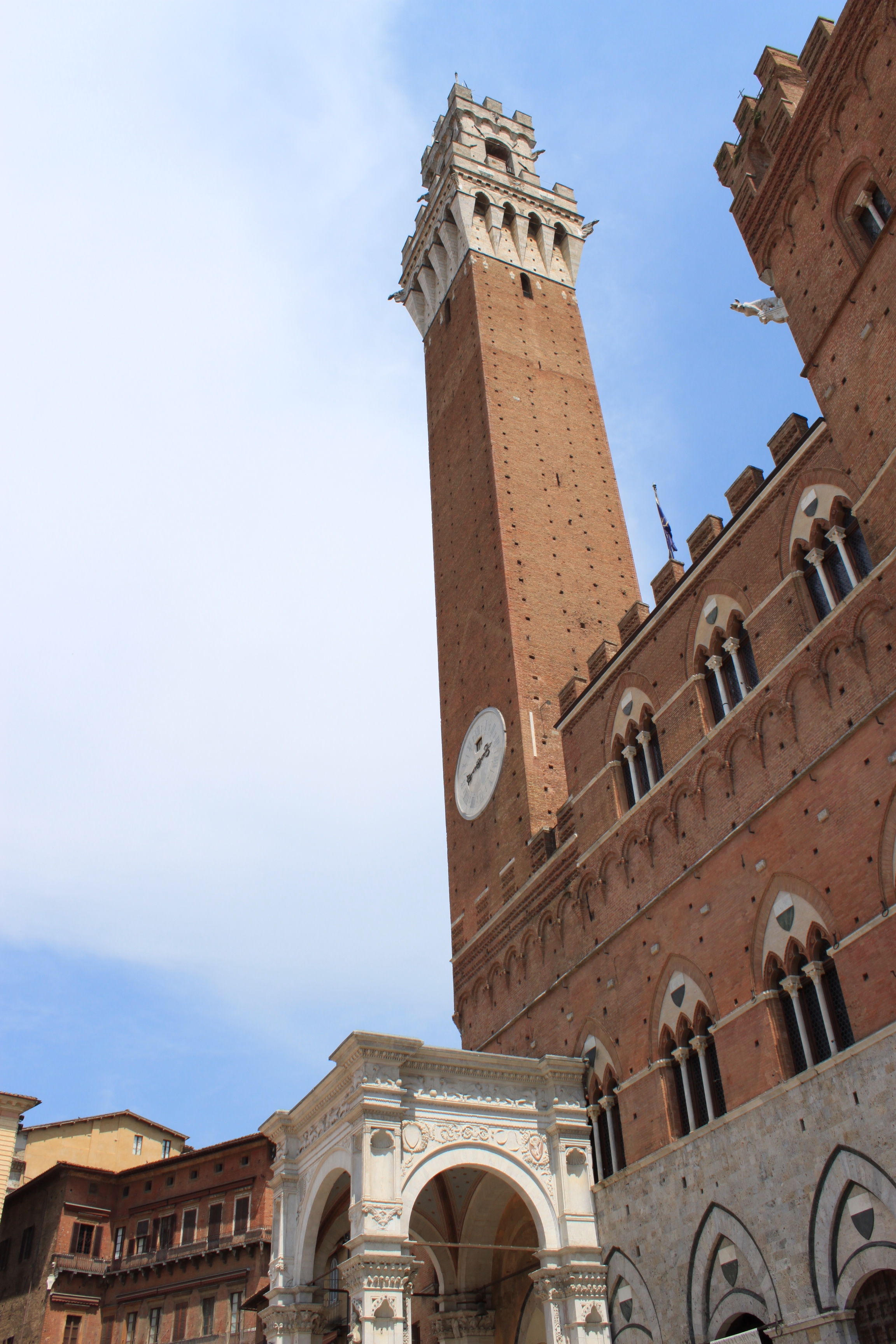 While in Siena, as we were touring the magnificent town hall called the Palazzo Pubblico, a project to restore some of the building’s many fabulous frescoes was underway. Christine stopped cold in her tracks when she noticed a college-aged woman lying on her side on the floor, carefully applying freshening color to a border originally painted over six hundred years prior. This gave us the spontaneous opportunity to explain to our children the process of painting en fresco,wherein the artist applies the paint to the wall as its freshly laid plaster is still drying. In this way, the art is applied into the wall and not merely onto it. For this reason, the art is much more durable throughout the centuries. Fortunately for us, and the world, the Renaissance painters from Michelangelo to Raphael painted almost entirely en fresco. This was a moment of art history at its best.
This one little lesson inspired a search for art supplies and resulted in several afternoons of drawings and sketches. Nathaniel and Christine each drew and colored fabulous renderings of the temples from Poseidonia, complete with fluted columns and admiring tourists. J.R. drew a colorful rendition of his own, and Casey took a little table and chair out into the yard and made a near perfect sketch of La Contea.
On another occasion, right around bedtime, Casey sat on the small love seat adjoining the desk I’d set up as my temporary office. “Dad,” he inquired, “how come my allowance is worth so much less in Euros than it is in Dollars?” I was glad he was seated, because my answer would take a bit of explaining. As I launched into one of my favorite topics, Nathaniel heard what was going on and joined us. Soon Christine and J.R. were there, too, and now I had eight brown eyes looking at me intently as I explained international monetary policy and the effects of inflation, balance of trade, and currency exchange rates. I couldn’t believe their concentration level, their uninterrupted attention spans, the incredible teachable moment. Their questions were pointed, informed, and insightful. We chatted back and forth for almost two hours when finally Christine said, “Thanks for teaching us about inflation, Daddy.”
“How was that for some home schooling?” I asked pridefully of Terri after the kids were in bed.
“It was fantastic,” she agreed.
“I couldn’t believe how attuned they were to everything I was saying. Even little J.R.. I think this trip has awakened in our children the hunger to learn,” I said, never one to miss a chance to reinforce a sale I’d made.
“Yes, I’d agree. But there was also another factor at work,” she said.
“And what was that?”
“It was bedtime and they were stretching it out.”
Fast-forward six months after our month in Italy. We were settling into our new surroundings in North Carolina, having recently sold our home in Michigan. Terri had taken the kids to an event at a local museum in downtown Raleigh. As a guide led the group around a corner and into a section of Italian art and history, my kids apparently came alive. There was a painting of Mt. Vesuvius they recognized immediately. They were even able to name some of the artists and their works. As Terri recounted this story to me afterwards, I couldn’t help thinking how satisfying it is for a salesman to hear of his customer’s satisfaction.
I have long believed that history is critical to a proper understanding of our human existence. Billions of people have inhabited this place before us, and they’ve left fascinating clues and hints about the lives they lived. They aren’t just names and places and dates, they were real people just like us. They felt deeply, suffered terribly, laughed merrily, loved, ate, traveled, thought, raised children, worshipped, wrote, expressed themselves through art, built wonderful buildings, and wrote penetrating thoughts. I get lost in wonder just pondering the depth and width of human history. It is mysterious because so much of it is irrecoverable. Tiny proofs of it are scattered across the globe, leaving often agonizingly incomplete records of what transpired before us.
History is also one of the most difficult subjects to impart to children. It takes patience and a deep appreciation of it on the part of the teacher to have any hope of transferring its wonder to the next generation. Many times as I relate stories from history in my speeches or writings, I run across adults who say they’ve never really understood history before. “It was always so boring,” they say. But it is not boring. History is magnificent and as full of mystery as life itself. It’s a story without full answers, an unfinished work of art still being crafted each minute of every day. It was this depth of appreciation I hoped a slow and easy trip through Italy would impart to my children. But I wasn’t leaving it to chance.
In my opinion, perspective is the key to appreciating history appropriately. This must occur through the agency of two other things: geography and a timeline. I love maps. In another life I probably could have been a cartographer, holding up in a dusty office in Florence or Genoa, working with parchments and ink, reproducing the territories being discovered by the brave mariners of the late fifteenth century. Timelines too have been a fascination, the way they provide insights into concurrent events, or the proximity of one event to another. When looking at timelines I have often been hit with “aha” moments, realizing for the first time, for instance, that the conquests of Alexander the Great were a great connector between the civilization of the ancient Greeks and the Roman republic and empire to follow. So in the interest of maximizing the impact of our historical touring through Italy, I had decided to use both maps and timelines with the children.
One day we assembled at the wooden picnic table on the veranda. With a long, blank piece of paper we together wrote out a crude timeline, showing first the ancient mysterious peoples populating the Italian peninsula, then the Etruscans, next the Romans, followed by the Dark Ages and the rise of the official church, then the Renaissance, and onward up to the present day. In one sweep, portrayed with colored pencils in the Tuscan sunshine, my kids were treated to the perspective only obtainable through simplification.
“Now,” I asked, “Where do the frescoes we saw being redone in Siena fit on this timeline?”
A little finger came forward and rested on a spot.
“Almost,” I answered, then was able to give some explanation.
“How about the ruins we saw in Poseidonia? Where do they fit on here?”
This time the point was accurate. I continued with these kinds of questions until I noticed boredom creeping in.
Next I flipped over the crude timeline and drew an even cruder map of Italy. It was at this point I was thankful we weren’t taking a month in Hungary, or Poland, boots being so much easier to draw than livers or spleens.
“Who can point to where we are in Tuscany right now?” I asked.
Again, out shot a little finger.
“Good. And how about where we are on the Amalfi Coast. Where’s that?”
Another nearly perfect point.
I was feeling so good. This teaching stuff was a piece of cake. Then I caught myself and realized it wasn’t my teaching ability, and it certainly wasn’t my map or timeline making ability, rather it was the power of being here and seeing it all firsthand. It was the power of place all over again.
Next I asked, “And who painted the Sistine Chapel Ceiling?” I was certain they’d get this one easily. We’d been talking a lot about art history, and one of my favorites of all time is Michelangelo. Besides, we were planning to go to Rome soon and had been discussing seeing the Sistine Chapel.
“I know!” yelled Christine full of excitement.
“Okay, sweetheart, who?” I asked, waiting like every proud teacher to hear a demonstration of the growing knowledge of his pupil.
“Michael Jackson!” she answered with all the sincerity in the world.


 Welcome to Chris Brady's Blog
Leave a comment