Leadership involves two things: being able to kick your own butt so you can and will personally perform, and caring for and loving the people who follow you.
As your influence grows your roles will change. In essence, this is what Orrin Woodward and I were attempting to teach in the Launching a Leadership Revolution book. But you must always be willing to perform, and at the same time grow in the love and grace you show your people.
Lead.
Love.
Everything falls into those categories.
-
-
I thought her a beauty
And took to her smile,
But you told me otherwise
Suspecting her guile.
I liked his stories
And thought them a laugh,
But you told me otherwise
Said don't believe half.
Their group took me in
And made me feel part,
But you told me otherwise
And picked them apart.
I wonder how life
Feels walked in your shoes,
Where nobody's good enough
And none you'll approve.
It's good that you're there
To show other's flaws,
I'd probably think them fine
If you caused no pause.
But you make me think
How sad it must be,
To see mere scary water
When watching the sea.
You told me of you
And wanted my praise,
But you told me otherwise
In living these ways.
Chris Brady @Copyright 2010
-
 How much conflict, trouble, and strife could be avoided if we who are believers in Christ were better beacons of his example? My favorite verse is Matthew 5:16. "Let your light so shine before men, that they may see your good works, and glorify your Father which is in heaven."
I was reminded of this in a recent conversation in which Pastor Tom Ascol of Grace Baptist Church in Cape Coral, Florida was quoted as saying something to the effect of, "Two things we should do: 1) become better Christians, and 2) act like it." The context was in regards to parental training or something of the kind, and the admonishment was that a lot of the time and effort expended in learning techniques and approaches would not really be necessary if we could execute number 1 and 2 above.
Does Christ's spirit come through in all we do? Do we "Let our light so shine?"
If we don't (and who among us doesn't fail here in some degree?), it is because we are forgetting where this "light" comes from. That light is reflected from God above. It was imparted to us by His glory through the finished work of Christ on the cross.
Maybe it is too easy for us to forget where we would be without God's grace.
Maybe we lose touch with how messed up and helpless we are on our own.
Maybe we get a little too caught up in our own sense of the injustices perpetrated against us by others.
Maybe we think that light is based upon our own merits or something great we have done.
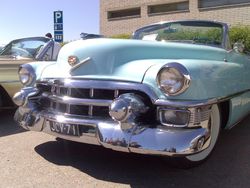
When it comes to that light, we are as pieces of chrome reflecting His glory like bumpers in the sun. We cannot boast of the shine ourselves, for we are not its source. How silly is a bumper that struts? All we can do is reflect it by living out our lives in ways evidentiary of His grace. May we seek to do that more so each day, becoming better Christians and acting more like it, so men will glorify our Father which is in heaven.
-
We strive mightily to make things perfect. But would we really like them that way?
What would a game of golf be like if every drive and putt were perfect every time? What would be the fun in hunting if every outing produced record game with perfect shots? Would victory of any kind carry reward if it didn't lie on the other side of struggle? Who would want to see a move with no conflict to be resolved?
As we deal with the difficulties of this world, it may be good to consider that while we do not like pain, pleasure is not that much better for us. Ponder this: too much struggle and heartache drive us to despair. But on the other hand, too much pleasure and freedom produces boredom and emptiness (think of the many famous people who apparently "had it all" but destroyed their lives).
Could it be that we are only "happy," nay, sane, living somewhere in between? Before we rail too hard against struggle as an enemy, perhaps we should make ourselves equally aware of his counterpart at the opposite end. At least pain and suffering are obviously hurtful. Pleasure and ease are sneak-attackers.
So what are we to do in between?
I posit that living life on purpose, for a purpose, is the way we are supposed to navigate these waters. We will suffer some pain, experience some pleasures, tossed about by both as on waves, but our vessel should be pointed at that distant shore. It matters where we are sailing, and it matters how we sail. As you set your compass, I recommend Ecclesiastes 12:13 for a bearing.
-
What one thinks and how one came to
think that way must be two of the most important facts about a person. Education, occupation, geographical
background, and even personality traits pale in comparison to the history of
thought development in an individual.
To truly know someone, it is necessary to understand at least a little
bit about how they think. Unfortunately,
since thoughts are private and cannot be fully known by anyone external to the thinker,
this important part of a person’s makeup remains largely obscure.Even the best of history books and
biographies are left to guess at the thought pattern behind the behavior, while
most don’t even venture to try.
Autobiographies, on the other hand, ought to dive into this realm
wholeheartedly. It would seem that
a good autobiography would not just relate the when and where of what happened,
but also the why. Alas, very few
seem to do this with the candor or depth that might be expected. Even the authors, apparently, are more
interested in actions and results than the thought stream behind their life,
however interestingly lived. Either
that, or they themselves don’t think to think about their thoughts.It would appear that how we think and
what we think are such a part of us that we don’t stop to consider them
separate from ourselves at all, much less give them a hearty analysis to make
sure of their accuracy and nobility. -
No rewind on life
Our grasp has no grip
There's not a thing we can do
To slow down this trip.
Open your eyes wide
See all that you see
Gales blow to the rocky shore
We list to the lee.
We kick against goads
Blame struggle for pain
Totally blind to the point
That hurt reveals gain.
For how could we know
That all that we want
Elusive and misleading
In this lifetime jaunt?
For if we caught it
Our tail in our teeth
Would we stop and just wonder
Our time slipped the sheath?
Our empty pursuits
Our grubby hand-holds
Will only fail to secure
All that's dear we hold.
A deeper yearning
Tugs soft at our sleeves
We hide under a bushel
Ignore what it means.
But it's there for good
For our greatest gain
And sometimes we find it most
When in the most pain.
It's our true calling
Our life's one purpose
That carries us home again
Safe harbor's purchase.
The hound of heaven
Viciously runs down
Many strivers and dreamers
When they've hit the ground.
Keep your eyes upward
Use your strength to chase
Eternal not temporal
Or your life you'll waste.
@Copyright 2010 Chris Brady
-
 Being
Being
decadent is easy. Evil is everywhere. It takes nearly nothing to succeed by
cheating, lying, stealing, or selling to the profane nature of humanity. Violence, sex, anger, hatred,
victimization, and escapism come easy to entertainers and sell easy to a crowd
of nobodies. The fastest route to
tinsel-town success, the empty kind full of fame and money and no fulfillment,
is to sell directly to the clamoring masses the poison for which their blackened
hearts crave. The Bible says,
"And this is the condemnation, that light is come into the world, and men
loved darkness rather than light, because their deeds were evil." Left to our own natures, we love
darkness and actually gravitate toward things that aren't good for us. I am never impressed with the angry
young faces full of rebellion and hatred that I see on the covers of
entertainment magazines. All I see
when I look at them is more young people who think they are being creative by
being bad. It's an old, old story
that is neither innovative nor impressive.
There is nothing clever or cute about evil. To court it is to play with fire.Thomas
Mann's classic, Doctor Faustus (based on the old English legend of the same name: author unknown), tells
the famous story of a man selling his soul to the Devil in exchange for fame
and fortune as a musical composer.
In a hollow way the Devil fulfills his end of the bargain, in that the
success in this life that was so dearly purchased is a Hell-on-earth of its
own. It destroys the character
even before he dies. This Faustian Bargain is exactly what results
from success obtained the wrong way. -
 I
I
was busy in my home office one morning when my wife Terri walked in with one of
my sons, the nine year old. The
bottom lip was quivering, anger and frustration were bubbling up, crying had
obviously been taking place, and the fight to maintain composure was about to
be lost. And my son didn't look
much better, either! Obviously,
this was a moment for the wisdom and strength of Dad. The only problem was the complexity of the situation. As it was explained to me I tried to
keep track of the winding trail of what had happened, looking for motive and
things to correct. By the end of
the explanation I was as flummoxed as my wife. So much for the wisdom of Dad! What unfolded was an
elaborate web of emotional conflict that was not necessarily intentional. It was really just the collateral
damage of a young Rascal unsure how to use the powerful Rascal weapons with
which he'd been born. I said a
quick prayer and did my best to "seek first to understand," as
recommended by Steven Covey. After
my son had completed his nine-year-old style explanation I quickly attempted to
organize the affair in my mind.
Finally I was able to piece together about four areas for constructive
discussion. Overall, though, I
wanted to make an impression that would hit home. I wanted this incident to be a teaching moment through which
my young buck could grow. Finally,
I lighted upon what I felt to be the key concept. It was simple, really, and it cut through all the emotion
and confused jumble of facts."What
this really comes down to, son," I said, "is the decision of how to
use the many gifts you've been given.
You are charming, charismatic, persuasive, influential, attractive,
funny, athletic, and powerful (taking after his Dad). But what you are going to have to decide is whether you are
going to use all that to become a force
for good, or if you're going to become a selfish jerk like almost everybody
else." As we finished the
conversation I realized my son's situation had simplified the position in which
we all find ourselves. We've all
been blessed beyond comprehension.
We've all got a list of gifts we've received just as impressive and as
powerful as my son's. The key question, though, is how we are going to deploy them? -
Here's your chance to win a free autographed copy of Orrin Woodward and my book Launching a Leadership Revolution by submitting the funniest or wittiest caption. Good luck. (Click on photo for larger image)