

-
 In Dante’s Divine Comedy, in Canto III, Dante is guided by Virgil, the Roman poet of antiquity, to the gates of Hell. The first beings they meet on this perilous journey are a group of lost souls called the "Drearies," who linger around Hell’s gate. As Dante writes, they are "those who lived without blame or praise." Author Thomas Cahill calls them "whining wraiths who never truly lived at all, the lukewarm, who are ‘as hateful to God as to his enemies,’ the people no one claims."
To me the Drearies are the very opposite of leaders. They lived on earth for a number of years, ate food, labored at things, and then died. Their lives are entirely forgotten because they stood for nothing, fought for nothing, risked nothing, attempted nothing, and died as nothings. And, at least in Dante’s imagination, their eternal life will be comprised of endlessly more of the same.
Leaders are passionate beings. They attack the status quo, sometimes at great peril to their own peace and well-being. But leaders can do no less. They live while they are alive. Their internal light shines bright for accomplishment, contribution, service, impact, making a difference, and leaving a legacy. Leaders burn with a purpose to fulfill and never feel quite right when not in alignment with that purpose.
Tragically, though, many people fall into the trap of the Drearies. They don’t do much wrong, but they don’t do much right either. In fact, they don’t do much at all. And if they do, they simply dabble. Pastor Robert L. Dickie was given some advice early in his ministry from an experienced and stately gentleman: "Don’t be a dabbler." He says that thought always stuck with him and has served to keep him focused on his biggest priorities.
Why are so many people complacent? Why do so many dabble? Why do so many frit away their days in nothingness and wake up at the end of it all and wonder, "what if?" I wish I had the answers to these and all similar questions. But I do know that life lived fully is better than life simply lived out. We shouldn’t tip-toe through life trying to get to death safely. We should stand and make a difference with the gifts God has given us. Through prayer, counsel, scripture, dream-building, service to others, and meditation, we should search for our life’s purpose and then chase after it with everything we’ve got. You will never regret the time you spent giving your all to a worthy purpose.
So find it.
Give to it.
Live it.
-
Hey Gang:
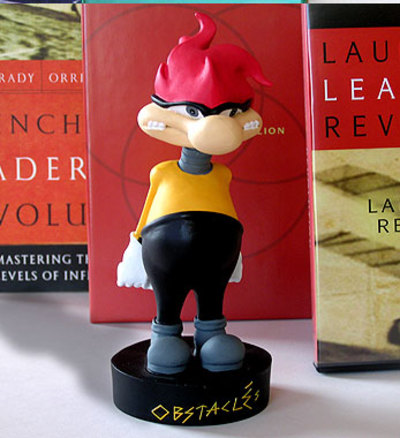
It's your old buddy, Obstacles!
I know, I know, I've been a little quiet lately. But don't worry, I have been busy at work in the background, conjuring many exciting new ways to make you wimpify. After all, dreams are overrated, business is hard, leadership is for sissies, and your momma dresses you funny, (and I won't even mention her combat boots).
Now, let's get down to the real stuff.
I know how many of you LIFE (what a stupid name for a company, talk about generic, your colors should be black and white like those dorky bargain canned goods at the grocery store) guys are all proud of your Power Player Program. "Scores every time," you say. "As long as it keeps working you'll keep doing it," you say. "It doesn't matter if we tell the whole world what play we are going to run next, it will still work, and we'll still run it," you say. Well, I've got the same kind of program. I call it the Power Wimpifier Program. And I'm so confident of its success, that I too will share it openly with you wimpy little leadership knuckleheads.
Here's how it works. All I have to do is encourage the natural tendency in all of you to wimpify. After all, you know you want to already! For those of you tender types, all I have to do is get someone to hurt your feelings. For you tough types, all I have to do is make sure someone else gets the recognition you think you deserve instead. For you money-lovers, all I have to do is get you to think you aren't getting a big enough bonus check, or at least make you wonder why it was the size that it was. For you fun-seekers, all I have to do is make you think you're bored. For you judgmental types, all I have to do is get you to see more and more of your upline's flaws. For you thinking types, all I have to do is get you to make assumptions about why someone did something and get you to think they did it from impure motives, and even on purpose. For you organized types, all I have to do is get you to feel like everything is a mess. For you detailed types, all I have to do is get you to sit through a presentation by someone who doesn't understand details. For those of you who won't take responsibility, all I have to do is provide you with someone to blame. For those of you who can't prioritize, all I have to do is give you a lot of things to consider all at once. For those of you who can't handle resistance, all I have to do is get someone to give you some objections (my most common and effective are "price," "time," and "status").
Well, you get the idea how the first step in my program works.
The second step is the explanation. You see, you can wimpify freely as long as you can come up with a good explanation that "covers" it. Oh, don't worry. No one else will believe it. But that really doesn't matter when you are in the process of wimpification. You see, all you have to do is get yourself to believe that others are believing it. That's the way out!
Finally, there is the placing of blame squarely on the shoulders of someone else (note: this can be anybody other than yourself).
So here's the program, in summary:
1. Doubt, discouragement, jealousy, greed, ego, etc. causes Wimpification
2. Explanation is concocted to cover said Wimpification
3. Responsibility for lack of results is blamed on someone else
And there you have it. My extremely effective, simple, straight-forward, almost guaranteed program for Un-success.
Just remember, life is short. Don't waste it trying to accomplish something. You deserve so much less!
Obstacles over and out.
And don't think I'm not watching you!
(Wimpify. You know you want to!)
-
Jack Welch, former CEO and near-legendary leader of General Electric, in his book Jack: Straight from the Gut, lists the following six rules that are key to leading a company successfully:

1. Control your destiny or someone else will
2. Face reality as it is, not as you wish it to be
3. Be candid with everyone
4. Don’t manage, lead
5. Change before you have to
6. If you don’t have a competitive advantage, don’t compete
It’s clear to me why Jack Welch was so successful and famous as a leader; this list is concise and power-packed. Immediately upon reading it I can think of companies that violate all six completely! Conversely, as I skim back through the pages of author Jim Collin’s book Good to Great, it is apparent that the great companies all live by these simple but powerful rules.

An interesting question might be why the difference between companies? Why do some organizations wallow around in irrelevance, allowing outside forces and markets to move them rather than the opposite, ignoring reality and instead believing some home-spun placebo self-spin, tweaking and spinning the truth to everyone else, managing and controlling instead of leading and inspiring, resisting change to the point of stodginess, and existing in the marketplace without any distinguishing capabilities, while at the same time other companies push boldly forward, with eyes wide open and focused upon brutal realities, being candid and open and honest, leading from the front, changing rapidly and with agility and buy-in, and establishing clear competitive advantages?
I believe the answer is already eloquently spelled out in both Welch’s and Collin’s book: leadership.
As students of leadership, all three of you dear readers out there would do well to learn from this conclusion: leadership makes all the difference. That is why we hash through its principles so incessantly on this blog. Many so-called leaders are simply imposters; or what we used to call ‘posers’ in the motocross world. And many companies just exist, riding out their run until they simply can’t make it anymore. Excellent leaders understand and confront this brutal reality, learning from bad examples and aspiring to the clarity and courage espoused by Jack Welch’s list. Those that can fulfill his mandate are few but phenomenal. And the rest, well, they are simply on the race track to give the real leaders someone to pass.
May you be among those lapping the traffic! Pursue leadership excellence by memorizing and living this list! See you at the podium!
-
-
If you are going to be a leader, you are going to be in the business of building and maintaining relationships. For some people, this is a nearly automatic thing, but for many, it is less than natural. Both types of people, however, should and must learn to make this critical area of leadership a priority.
In a sense, a leader’s life is a collection of the relationships he or she develops. The value, depth, synergy, permanance, and harmony of those relationship will literally make or break a leader. With this being not only true, but hopefully obvious, why is it that so many would-be leaders either fail terribly here or seem to pay this topic no serious regard? Why is it that relationships are so callously thrown away, eroded, neglected, or abused? I believe the answer is a combination of the following:
1. ignorance
2. pride
3. ego
4. selfishness
5. greed
Among others, this list reads like the typical littany of human sinful failings. Considering ignorance: perhaps leaders don’t realize how important their web of lifetime relationships is to their success and lasting legacy. This is inexcusable. And for those reading this article, it is no longer a possiblity. You have been warned.
The rest are much more serious. Leaders who allow these and other failings to get in the way of initiating, constructing, and maintaining relationships will cause both themselves and others a lot of pain. As the saying goes, "Hurting people hurt poeple." I am consistently amazed at the amount of score keeping, gossiping, pouting, indignant anger, the preference of being "right" rather than loving, and rank coarseness that is exhibited by leaders which wrecks their relationships. It is as if the would-be leader thinks that as long as he or she is "right," any amount of responding behavior by them is justified. WRONG. When discussing these failings with them, I usually hear responses like, "Yes, but (the other person) did such and such." Okay, but what the other person does is irrelevant.
What?
Let me say it again.
What the other person does is irrelevant.
Why? There are several reasons. First of all is that the Lord will hold you accountable for YOUR behavior alone. Secondly, we know right off the top that none of us is perfect, and that we are all fallen and sinful creatures, so why should someone else’s failings and shortcomings justify a similar reaction from us? In the words of my mother many times over when I was a child, "Two wrongs don’t make a right!" But the third reason is the point of this article: what is important here is the RELATIONSHIP.
For a leader, building relationships must take priority over being right, winning, getting even, venting anger, righting wrongs, and the like. (Now don’t get me wrong: I am not saying that there aren’t times when an injustice is actually being done by someone, especially when it is being done to someone else, and must be addressed for someone’s protection). But yet I see many people willing to throw away months, and sometimes even years, of investment in a relationship because someone got mad, felt justified in their outburst of anger, or otherwise was willing to trash a relationship for something of lesser value.
An excellent leader would rather give a little bit here and there than tarnish or take away from a relationship. An excellent leader would rather apologize, even if he or she wasn’t sure they were actually at fault, than take a "withdrawal" from a relationship. An excellent leader "dies to self" rather than angling for personal gain at the expense of others.
And let me issue a warning, here, for those who understand these principles and apply them only to people they think can bring them gain: leaders love everyone and treat them with respect even if a person can’t do anything for them in return. Remember, it’s how you treat "the least of these" that Christ said he would count as how you treated Him! This is certainly a leadership principle to fully grasp!
So handle ALL your relationships with tender-loving care. Be gentle, kind, caring, loving, long-suffering, honest, open, genuine, and as Christ-like as you possibly can. And when you fall short, apologize quickly and express your respect for the person and your commitment to the relationship. Do as author Stephen Covey recommends by considering your relationship with each person to be a bank account into which you either make deposits or withdrawals, working consistently to maintain and grow a positive balance. And never forget, your job as a leader is to build relationships. Ignore this at our own peril.
-
There was once a book written by Rich DeVos with this title. In my opinion, it’s a very good title. When I originally read the book, I bought in whole-heartedly to the concepts contained therein. What the concept meant to me (and still does) is the idea that both compassion and capitalism can work side-by-side to the betterment of everyone.
Compassion is good. Caring for our fellow man, wanting to make a difference in the lives of others, and leaving a lasting legacy of positive change are aspirations worthy of every leader.
Capitalism is good. Competition breeds toughness and an even greater ability to compete, strengthening the competing participants and benefiting the customer as a result.
When compassion and capitalism are fused together, as they should be in our free enterprise society, a virtuous cycle results. Competition drives competitors to find better, faster, cheaper ways of doing the same thing; benefiting the customer. Then, as the competition responds, even newer and better methods are found to compete even further. Again, the customer benefits. When these competitors are people desiring to make a difference in their world, they will give generously to worthy causes, operate their business in a fair and balanced manner, conduct their manufacturing and shipping in an ecologically friendly way, and basically become a responsible corporate citizen. The very way they conduct business is contributive to the greater good of society as a whole.
This all sounds good, and I believe most people would agree with the concept. What h
 appens, though, is greed or a desire to protect one’s interests can take over. Fear of stiff competition, being worried that competitors would pick one’s market share apart, and a desire to take the shortcut of protecting one’s interests rather than working toward the long term goal of increasing competitiveness pervades decision making. As in the demise of the once mighty Pan Am Airlines, lawyers take over a company and erase the entreprenuerial spirit that founded it. When this occurs, an interesting thing results: not only does compassion disappear, but capitalism vanishes as well. Everybody suffers; especially the customers.
What do we as leaders do about this?
Always be willing to compete. Be willing to stay in the field and improve yourself and your abilities and/or business with a PDCA (Plan-Do-Check-Adjust) cycle. Never get into "management mode." Don’t build fences to lock your niche in place. Keep the pressure on yourself, and be resistant of shortcuts or special deals that eliminate the need for you to compete, which may be alluring in the short term, but certainly destructive in the long run. Customers always sniff out the best deals. It’s a law of the free market. Better quality, better pricing, better value overall will always be discovered by customers. It can be resisted for a while, but it cannot be overcome. The best thing for any leader, business person, or company to do is make the mature decision to chase the customer demand wherever it should lead them.
When foreign competition of smaller, more fuel-efficient cars were demanded by the skyrocketing oil prices of the mid-nineteen-seventies, the American car companies were forced to respond in kind. Although they so
 ught governmental tariffs and protections from "unfair competition" abroad, they had to learn to face the music or die on the vine of irrelevance. These same stories could be repeated for every industry. Companies and leaders either respond to the changing marketplace, or go out of business. It’s that simple.
As one of my favorite quotes states, "Your only sustainable competitive advantage is your ongoing ability to change." Without that ability, no amount of fencing or wall-building can save you. With that ability, there is no limit to the amount of compassion you can engender to society.
Choose well, and lead on!
-
 (Click on picture to enlarge)


 Check out the person luxuriating on the front porch!


 Welcome to Chris Brady's Blog
