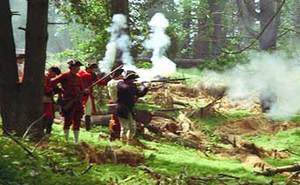
 The American Revolutionary War, which likely hadn't been called that yet, was not going well for the colonials at the end of 1776. George Washington and his volunteer army had been battered all across the islands of New York by the British. The combined forces of the Royal Navy and the British regular infantry and cavalry had made a mockery of the colonial resistance. A nighttime escape in fog was all that preserved Washington’s forces. Made to retreat into New Jersey, the colonials were then pushed all the way across the Delaware River into Pennsylvania. Fortunately for them, the British decided to hunker down for winter, and pulled most of their forces back to New York. Detachments were left throughout New Jersey to keep an eye on the miniscule colonial force.
With enlistments running out, and the confidence in the cause of independence at an all time low, Washington made a daring move to cross the Delaware on Christmas night and surprise-attack the garrison at Trenton. In the annals of military history, it was a small engagement, but in the morale of the colonies it was a master stroke. Washington’s attack succeeded perfectly, capturing the entire detachment at Trenton. Instead of going from defeat to defeat, retreating across state after state, the little band of revolutionaries had proven that they were not yet beaten.
The commander in chief of British and Hessian forces in America, Major General Howe, was furious. He immediately ordered General Cornwallis and his army to march on Washington in New Jersey with full force. Over five thousand professional soldiers, including artillery, set out immediately for New Jersey.
George Washington, managing his prisoners and captured stores in Trenton, received word of Cornwallis’s advancing army. He quickly dispatched 600 men to slow the British advance so he could arrange yet another of his last-minute escapes. Without sufficient time to depart on his terms, his little army would be crushed.
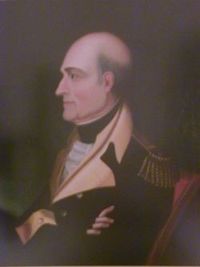
Washington placed the French aristocrat General Roche de Fermoy in command of the small force. de Fermoy was one of a long line of adventurers from Europe who had come to America seeking military honors and fame. Many of these men made claims concerning their past leadership experiences and titles that may or may not have been true. Forced to keep good relations with foreign countries supporting the cause, Washington was often given no choice but to award command positions to many such adventurers. Some proved capable, others did not. Second to de Fermoy, with his 200 Pennsylvania rifleman, Washington placed Edward Hand. Hand’s men, accustomed to hunting in the hills of Pennsylvania, were famous for their marksmanship. They were deadly accurate with their long, rifled guns.
It would be 600 men against 5,000, but the colonials only had to slow the advance of the mighty British. Placing themselves in the woods on either side of the road, and splitting the Pennsylvania riflemen into two groups,100 for each side of the road, the colonials got into position.
The sight of 5,000 men in brilliant military discipline marching boldly down the road was apparently too much for de Fermoy. At the first shot fired he was seen riding at a full gallop toward the rear of the colonial lines. Then he continued
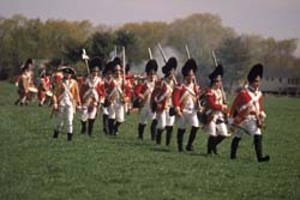 riding and left the scene altogether. Confused and stunned, Edward Hand calmly assumed overall command.
Hand directed the colonials to wait until the British were extremely close before firing. Then suddenly the woods around the British force erupted in smoke and noise and clumps of British soldiers fell wounded and dead. The British scrambled to form battle lines, then they fired in rapid succession. But the colonials had already pulled back through the woods. Now the Pennsylvania riflemen had their turn from a greater distance. Again, the incoming fire into the exposed British was deadly. Not to be deterred, the British ordered an advance into the woods, but by the time they reached where their enemy had been hiding, the colonials were long gone.
This process of heavy hidden fire, quick retreat, Pennsylvania rifle decimation, and more retreat was repeated throughout the day. At no point did the small colonial force give the British a chance to use their superior numbers or artillery. But continuously the raking fire from multiple angles of woods was deadly for the British. By the time this process was repeated for the fifth time, however, Hand and his brave band of men were being overrun. There was only so much 600 could do against 5,000. But suddenly loud bursts of artillery shells were heard as plumes of dirt and death soared into the sky among the advancing British ranks. It was Washington’s main army joining the resistance. The two armies were beginning to engage as it grew dark.
Cornwallis, weary from pushing through heavier resistance than expected, with enormous casualties on his side, decided not to press the attack at night. He called off his troops and encamped for the night. And of course, this is exactly what Washington needed. He kept campfires burning and charged a small group of men with making enough noise to sound like an entire camp.
Washington’s escape was successful that night, as he stole away an entire army from right under the nose of the enemy. Marching quickly before Cornwallis could figure out what happened, Washington and his force showed up in Princeton,
 New Jersey and routed and captured the troops Cornwallis had left there in reserve. Ultimately, Washington was able to escape the beleaguered British and winter safely, riding high on the wave of victories he had stolen from the jaws of defeat.
The small victories at the close of 1776 proved critical. Moral was raised, hope in the cause was re-sparked, and the fight for independence survived its closest brush with extinction. And as is usually the case, it all hinged on leadership. Edward Hand and his contrasting example of leadership as opposed to de Fermoy could not be more illustrative of the difference between true and counterfeit leadership. De Fermoy was all bluster; beating his chest and showing his titles and claiming great abilities. But when the first shot were fired, he fled for the hills like a frightened school girl. On the other hand (couldn’t help the pun), Edward Hand had no formal training or title or claim to fame. But he was a real leader. When the imposter fled the scene, Hand filled the gap. He very confidently and competently took command and did what needed to be done.
This great example from the founding of a nation and what it shows about leadership should never be forgotten. Imposters in the world of leadership abound. Those who talk the loudest about how great they are, what they are going to do, and how great their abilities are, are often the first to flee the scene when the going gets tough. Real leaders, on the other hand, quietly go about the business of doing what needs to be done; often without fanfare or title or official position. As Orrin Woodward is fond of saying, “When the going gets tough, the tough get going.” Indeed, you can learn a lot about someone by how they act when the shots are fired, when the 5,000 are advancing on 600, when it is time to put up or shut up. In motocross racing there is a saying that, “When the gate drops, the talk stops.”
Further, it can be seen how much can be accomplished by just one person deciding to lead. Edward Hand was only one man, and he wasn’t even officially in charge of the 600 men who had been abandoned by their commander. But his actions had enormous ramifications on history. Every leader would be wise to remember his example. One person can, and does, make a difference. And often, that difference is too large to be measured.
So when challenges come your way, when the shots being fired are live ammunition, when the going gets tough: you will have a choice. You can be a de Fermoy, or you can be an Edward Hand. That choice, at those moments, will define your legacy. Choose well. Lead.

 Andy Stanley wrote, "It is not the acquisition of information that properly prepares a leader to lead; rather, it is the application of the right information. People need to be trained around the core principles they need to know, not an endless amount of information that is nice for them to know."


