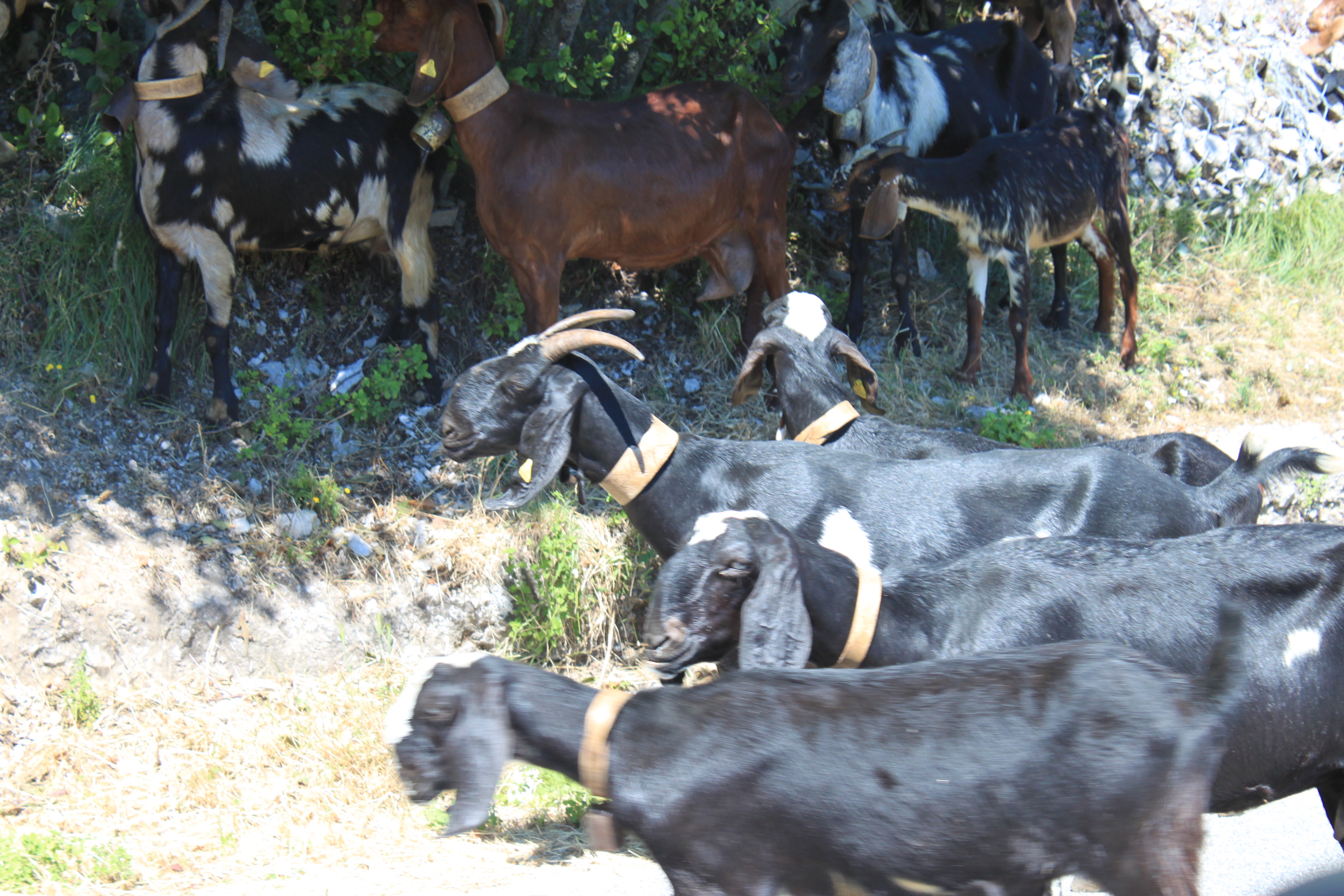
 I had what might be called a conversation with the steward of our cliffside villa, inquiring about the limited routes over or around the mountain range behind us and back over to Naples (Napoli). He spoke some English, he thought, and I some Italian, I think. It seems there are as many as three routes, though wrong turns are easy to make. No problem, I thought, we've got all day, and I've got my new GPS (purchased in Salerno as a replacement for the shattered one we brought with us). Well, the GPS was no help at all, as lost in the terrain as I was in the language. So we soldiered on bravely through the tight, winding, tight (did I mention tight?) mountain roads, feeling like mountain goats and passing a herd of actual ones along the way. All the while our GPS was telling us to "turn around when possible." It's request was laughable, given the dimensions of our clunky mini-bus and the (did I mention?) tight roadway. But we made it, finding the Autostrada and zipping along like natives (in my element once again).
 But then the exit was entirely nonexistent due to construction. Being the experienced world travelers we are, we simply took the next exit and navigated according to the sometimes visible bay of Naples in the distance, in combination with our ever-so-helpful GPS. What eventuated would be hard to depict without videographers, but it certainly would have made good comedy. Somehow, trusting our good ol' GPS, we found ourselves stuck at a tight (have I used that adjective before?) turn between buildings, parked cars, zipping scooters, pedestrians, a big delivery truck, and yep, shirts for sale on a portable display. I pulled in my mirrors, snuggled up as close as I could to a parked Smart car, the clothing rack was quickly removed, and the delivery truck passed. Then the GPS told us to turn right, but alas, the entire road (a complimentary term I now use to refer to anything as wide as a footpath that could at least be traversed by a soldier from the 10th Mountain Division) was nonexistent due to construction. I will never know exactly how we got our clunky mini-bus out of there, but am quite sure I violated a few laws of geometry along the way.
 By this point we disabled the GPS and went it alone. What could possibly happen without it? I guess we could get lost or something, or maybe even end up at the end of some tight (there's that word again) dead-end street with clothes for sale at the curb. We quickly found our own way back to the Autostrada, but unbelievably, the entrance too was totally nonexistent due to construction. These Neapolitans are serious about their road repair (we, for one, think they ought to widen them). Looping back around to the sound of the ever helpful voices from our children offering encouraging rejoinders such as, "Are we there yet?" and "I'm hungry" and "I have to go to the bathroom," we soldiered on. It was at that point Terri somehow spotted a sign for Ercolano, and almost immediately we were there.
That wasn't so bad.
Ercolano is the Italian name for the Roman city of Herculaneum, the thriving coastal town that was buried beneath the blast from Mount Vesuvius in 79 A.D. Because of the nature of how it was covered, the city beneath was captured in an instant and preserved as it was on that day.
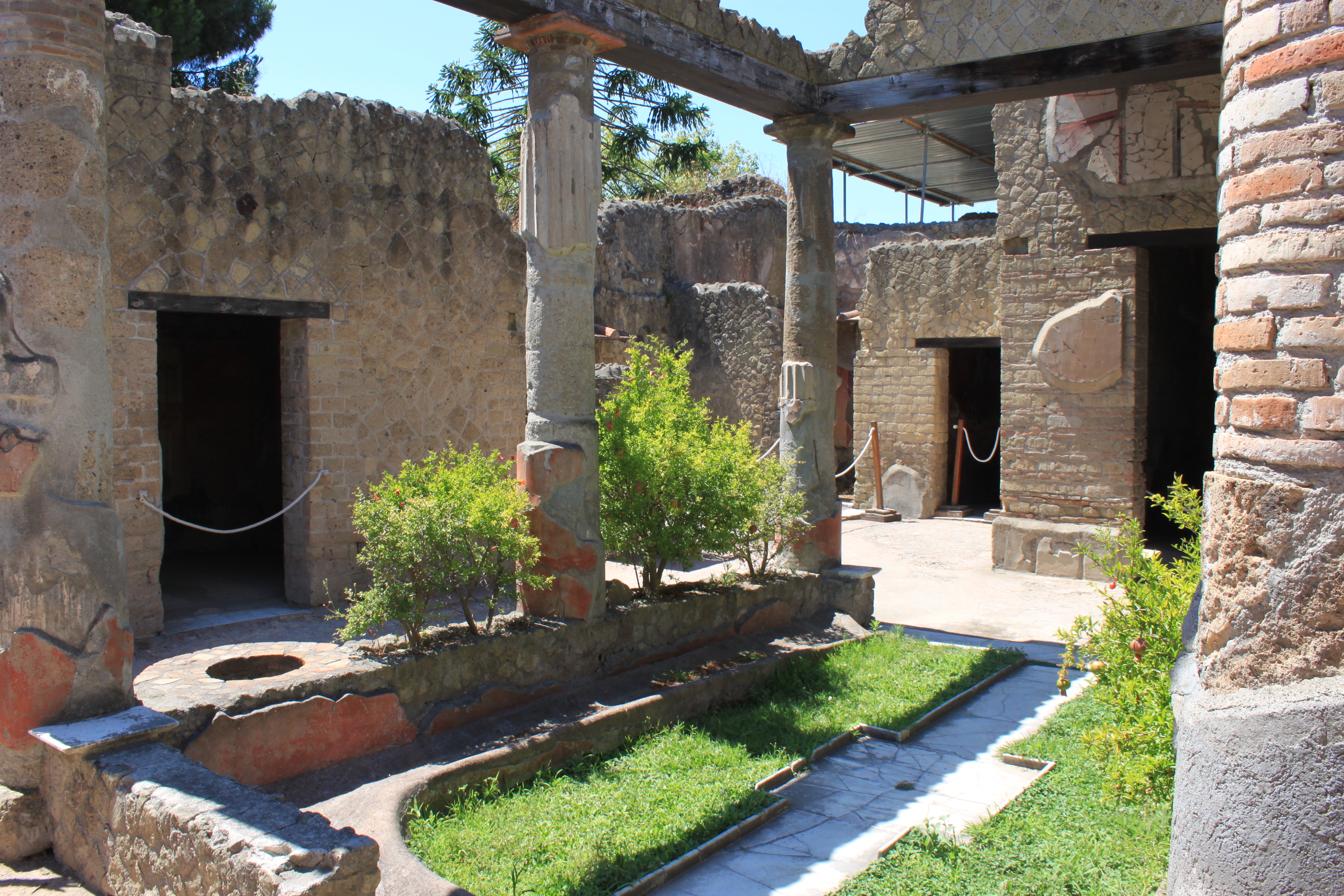
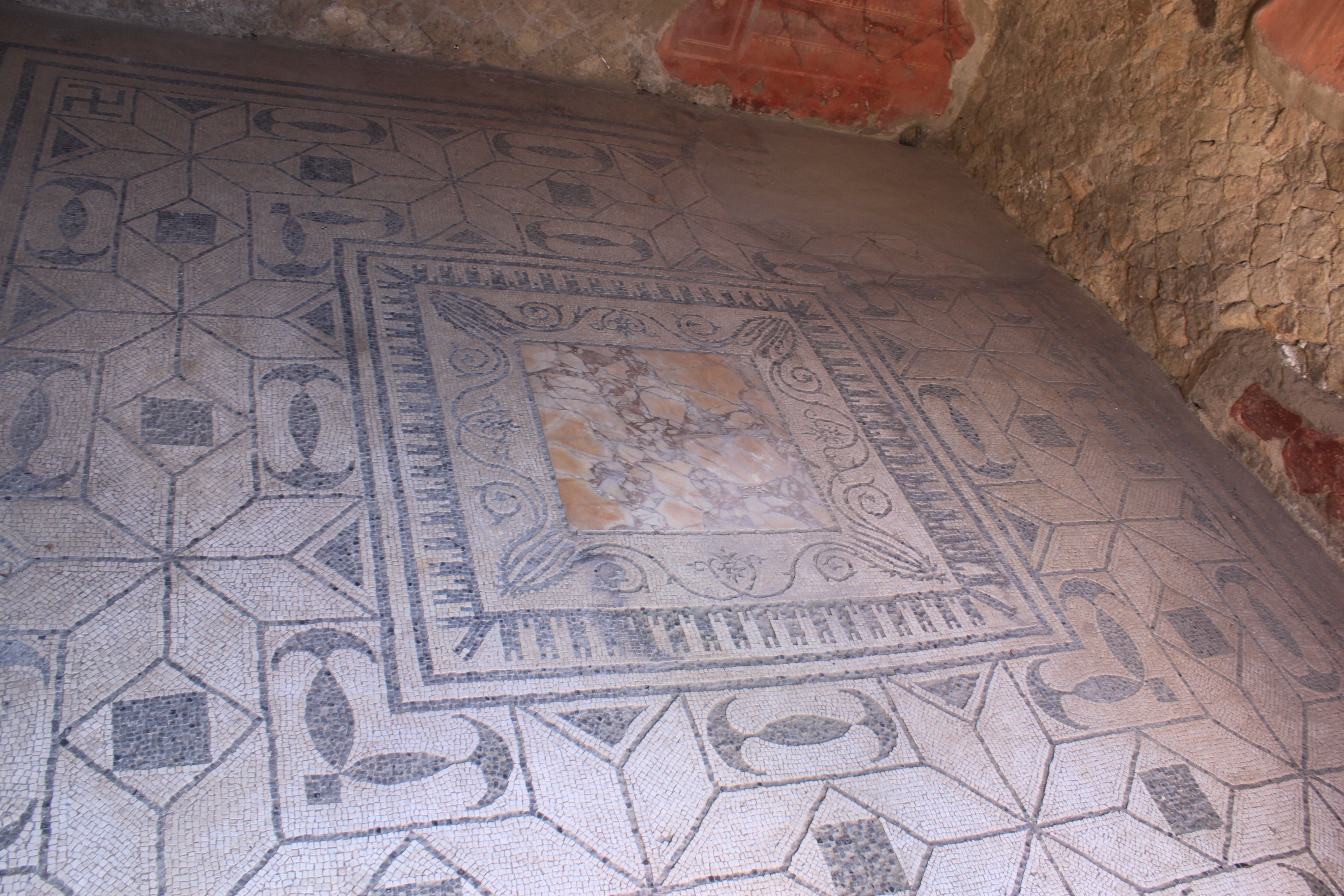
Walking through the ancient city, which is even better preserved than the more famous Pompeii, hits the lover of history in many ways. Surprisingly, the first impact I felt was just how similar their life was to ours. Floor patterns of tile and stone were very much the same as we have today. Wall paintings and barreled ceilings felt familiar. Even much of the architecture was similar. Of course, part of the reason for this is the tremendous impact the Roman civilization had upon the known world at the time and the amazing lasting impression it continues to make upon artists, designers, and architects – meaning much of what I saw in its original form has been copied again and again right down to our very time. But still, there was something eerily familiar in the walking of their streets. They had taverns for lunches located on street corners, indoor latrines, second floor living quarters, shop fronts along the street level, boat niches at the wharf, monuments to their heroes in the town square, and of course, the richest homes were along the sea coast. I was not able to verify, however, if they sold shirts at the curb of their tightest streets. Much of these features (and many more) are nearly no different than any modern city. They even had lead pipes and, in some cases, hot water.
Now, cult worship temples and altars for sacrifice hit the modern tourist as not only unfamiliar but shockingly ancient. Class stratification and slavery evident in the many artifacts recovered still seem unbelievable to our modern sensibilities (though not as far removed nor obliterated as we would wish). So they were similar, but still different.
I will leave the profound questions all this raises to the reader's consideration. I will also leave out the details of our return trip, which was much less eventful but still filled with "are we there yet," and "I'm thirsty." I can only wonder if the ancient Roman children were similarly impacted by the majesty of their own history lessons.


 Welcome to Chris Brady's Blog
Leave a reply to ferragamo shoes Cancel reply