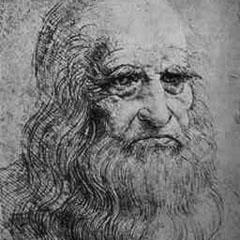
 It at first seems odd that Leonardo da Vinci is so revered
today. None of his sculptured works have survived, and only around a grand
total of fifteen of his paintings are known. Although he wrote a lot about
architecture, no buildings anywhere are credited to his name. Dispassionate
scientists have long debated the originality of his many inventions found only
in his sketchbooks – little evidence exists that he ever actually built or tested
any of these ideas.
Yet Leonardo is heralded as a universal genius, the ideal of
the Renaissance in which artists were not only proficient but expected to be
masters in many fields. He is shrouded in mystery and myth, movies and books
being written about his sensational secret codes, mischievous messages, and
secret handwriting (which was actually just backwards).
As with most post-modern heroes, however, closer inspection
reveals a somewhat smaller man. Although unarguably monumentally talented, Leonardo
suffered from what art historian Ken Clark called his “constitutional
dilatoriness.” Pope Leo X said, “Alas! This man will never do anything!”
Leonardo often accepted commissions for works he never finished, in many cases,
works he never even began. Of the paintings we know of, such as the Mona Lisa,
he worked on them off and on for years, most experts agreeing that the art
itself shows the weaknesses of such a lackadaisical methodology. Perhaps
authors D’Epiro and Pinkowish asked it best: “Why did the man who was arguably
the greatest painter who ever lived dissipate his energies, often quite
carelessly, among so many other fields?”
Let’s address his current mass media popularity first: In
our post-modern times, which seek any source of credibility against God and
ultimate truth, Leonardo is a ready poster child for the Godless – possessing
abundant talent and shrouded in sufficient mystery to speculate about alternate
truths. In short, from a world-view that disdains accomplishment and merit (what
one accomplishes and earns) and instead focuses upon position and power and
prestige (who one is and who one knows), heroes are made out of those who seem
to succeed despite the rules of effort, contribution, and earning it. Leonardo
didn’t have to accomplish much (in proportion to his gargantuan talent, that is) to be revered by those who don’t really want to
accomplish much themselves.
Additionally, his atheism is seen as reassurance, as if
to say, “If the great man didn’t believe, then I can make myself great by being
a disbeliever too.”
But all that is really beside the point. There is absolutely
no denying the fact that Leonardo da Vinci was an extremely gifted man, one of
the towering giants of the Renaissance. The question that carries the most
meaning for those of us on our own journeys of life accomplishment is “Why so
little output?” I am reminded of the Stephen King quote concerning the author
of Gone With the Wind: “Why didn’t she ever write another book?”
Success is the product of many components, of which one of the
most prominent is focus. We can do many things in our lives, but we can’t do
everything. We can have wide interests, and to a certain extent that is good
and healthy, but we shouldn’t dissipate our true well of talent on too many endeavors. If genius like that of a Leonardo is wasted by too broad a stroke, then
what happens to those of us who are less well endowed? As Leonardo himself wrote, “As a kingdom
divided against itself cannot stand, so every mind divided among different
studies is confused and weakened.”
I would posit that the less talented we are, the more
focused we must be. Even the least talented can accomplish grandiose achievements if
applying themelves ferociously, consistently, and with enough focus over time. In fact, it
seems that often the greatest accomplishments go to those who actually aren’t
all that talented, but retain just this one last shred of talent: the ability
to focus intensely and over the long term.
Sadly, we will never know what wonders of painted
masterpieces Leonardo may have produced for the enjoyment of the world. He
spent too much of his time elsewhere, on areas other than his gifting. While in
many cases he was still better in these areas than most of the rest of us, the
loss still stings. One is left wanting more, but time answers back a heartless
“too late.” This brings us to the saddest consideration of the squandered gifts
of life: What could have been?
Do not squander what you’ve been given, no matter how much or little, rather, harness it,
develop it, hone it, and focus it, bring it to bear on a daily basis and letting the world see what you were given. It is a duty to return our gifts of talent
totally spent and depleted in worthy use. Or, if not, one may join the great
Leonardo da Vinci himself, who wrote toward the end of his life, “Di mi se mai
fu fatta alcuna cosa (Tell me if anything was ever done.)”


 Welcome to Chris Brady's Blog
Leave a reply to Nike Shox Turmoil Cancel reply