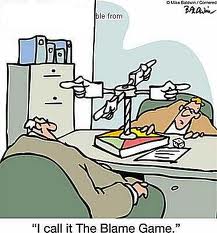
 Over the course of my life I've been fortunate enough to find myself with a vantage point on the behavior of all types of people under all sorts of circumstances. An enormous benefit of this has been the sheer entertainment value provided therein. One example of this is the contact sport which has provided hours of fun for young and old alike. What is this sport, you ask? It's called the Blame Game. Immensely popular, timeless in its appeal, the Blame Game has been passed down as a classic from generation to generation. I am sure you've had at least some exposure to the fun and frolick this game delivers, but just to help you maximize your enjoyment of an American classic, I thought I'd supply a few of the rules I've observed in operation as folks have played this game for hour upon hour. I know these rules are helpful, because they've kept people engaged in playing the Blame Game long after most would have tired of such sport. So here you are, the Rules of the Blame Game (and, by the way, if these don't help you reach maximum enjoyment of the game, it's not my fault. Blame it on the person who gave me the idea for this article, she's the one that is the cause of all of this! (You know who you are!))
1. The person playing the Blame Game is never allowed to take responsibility for anything that ever happens, ever.
2. Someone else, or several someone elses, must be chosen to "receive" the blame for what has gone wrong (please note: it makes no difference whether or not the recipient(s) of the blame was actually responsible, or even involved in the situation at all. It is even okay if they have absolutely no knowledge of what happened.)
3. A motive or reason for the behavior of the recipient of the blame must be concocted, and again, it need not have any bearing on actual facts.
4. A decent amount of vitriol may be mixed in, and heaped mightily on the head of the recipient of the blame.
5. Blame can be assigned to the recipient through several means of communication, such as gossip, Internet chat rooms, blog commentary, coffee pot conferences, telephone calls, text messages, and the like. As a matter of fact, today's communication technology provides no end to the ways in which blame can be assigned to someone else. Accomplished gamers use any and all these channels continuously.
6. Others should be enlisted to agree with the blamer and to join in the assigning of blame to the recipient. The more voices in the choir of blame, the more the blamers can actually feel that they are justified in their blaming, and the more they can comfort eachother that their lack of personal performance is not their fault.
7. All manner of emotions can be dressed up in the Blame Game, such as envy, jealousy, hatred, covetousness, bitterness, self-pity, and the advanced condition known as "holier-than-though."
8. Once the fun of blaming starts to wear off, it is often helpful to get around other blamers to confirm the acidity of one's thoughts and to keep from slipping into any amount of introspection or taking responsibility for one's actions.
9. The Blame Game is extremely popular in election years, and can be used to avoid any real discussion of issues or principles. The best way to take advantage of this particular aspect is to pick a side and immediately begin blaming the other side for everything wrong in the country. Once you see how easy this is, you'll understand why it's so popular.
10. Accomplished players learn to play the Blame Game in multiple areas of their lives. Here are a few examples: Bad Marriage = blame spouse. Bad Job = blame boss. Bad health = blame restaurants. Bad Attitude = blame weather. Bad psyche = blame parents. Bad children = blame society. Bad relationships = blame friends. Bad business = blame economy. Bad church = blame pastor/priest.
Remember: When it comes to blame, it's just a game, to soil someone's name, so you can remain the same.
(Dear reader: do not get offended. I was not talking about YOU)


 Welcome to Chris Brady's Blog
Leave a reply to Ben Hostetler Cancel reply