Welcome to
Chris Brady’s
Blog

“The only way to be happy, is to give happy.”

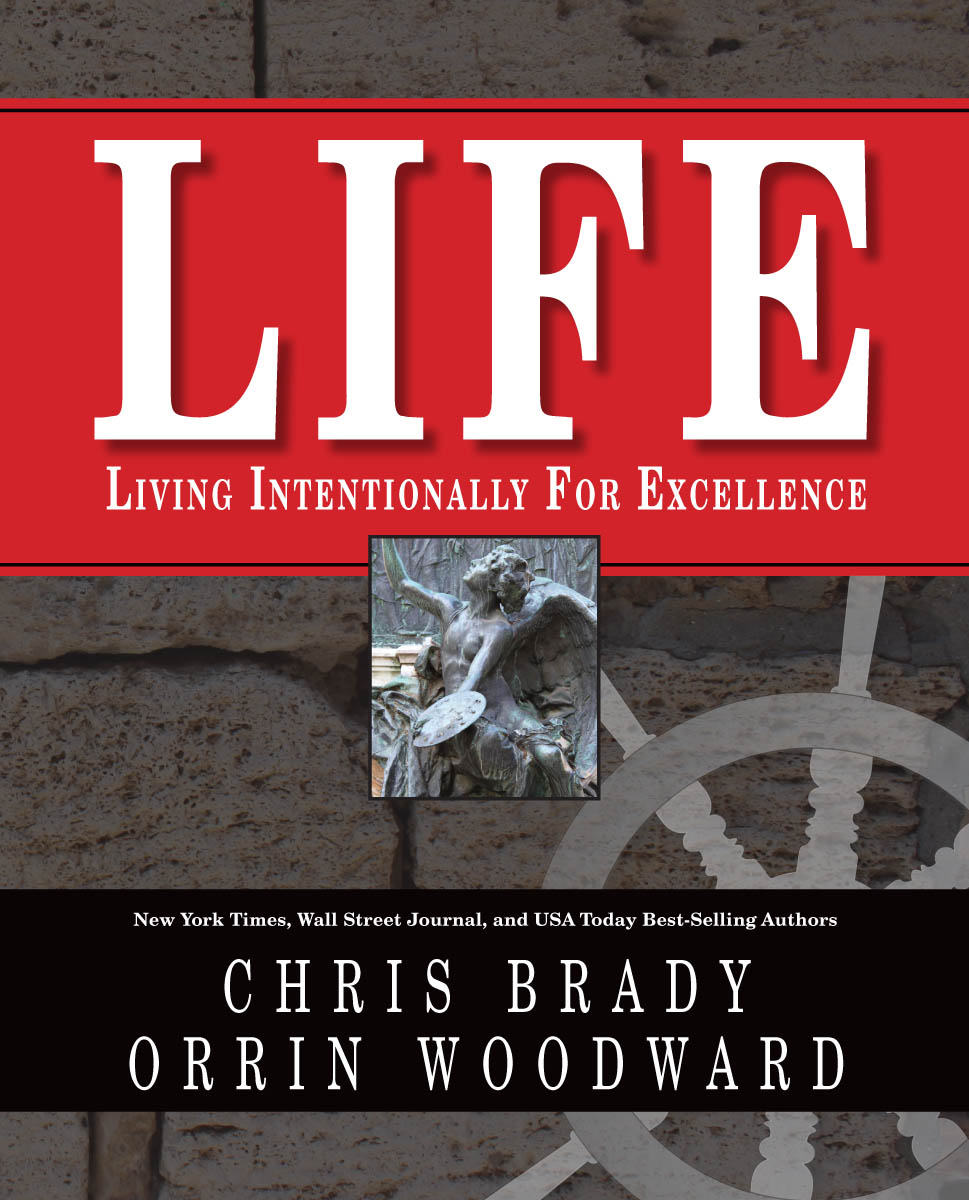
  • LIFE_cover Orrin Woodward and I are happy to announce this week's release of our latest collaborative writing project called LIFE: Living Intentionally For Excellence. This graphical book is unlike anything we've ever produced. Packed with almost 600 of our most popular one-liners from Twitter, as well as several top articles and essays on topics covering the "8 F" categories in which we live our lives (Faith, Family, Finances, Fitness, Friends, Fun, Freedom, and Following), the LIFE book is designed to entertain and educate in a unique and enjoyable way.   

    We sincerely hope you enjoy it! Thanks for reading!


  • Unknown "Most people can't dream too big, cause they have things to keep."  –song lyric by Sugarland

    In the days of monarchs, in which nearly every hill or dale was the domain of a small feudal lord called Sir or Count or Duke, court jesters were often employed. These professional fools were given license for a free and crazy behavior that was tolerated in none of the other courtiers. But these so-called fools were no dunces. They were extremely intelligent, witty, courageous, funny, and often charming. Their job was to say anything at all to the king without threat of punishment. No matter how offensive, cutting, or brutally honest, court fools were free to say it. Why was this so important? In a world where kings were surrounded with "yes men" and those working to ingratiate themselves with the favors of the court, it was of vital importance that someone had the ability to tell it like it was. And that was the job of the fool.

    How did it work? Quite simply the fool was there to remind the king of the truth, to jolt him out of unimaginative decision making, and to keep him from missing his own blind spots. According to author Roger von Oech, "[The king] gave the fool a license to parody any proposal under discussion and to shatter the prevailing mindset. The fool's candid jokes and offbeat observations put the issue in a fresh light and forced the king to re-examine his assumptions. By listening to the fool, the king improved his judgment, enhanced his creativity, and protected himself from groupthink (emphasis added)."

    Strange. Our modern sense of corporate decision making and committee addiction posits that we consult experts and authority figures, who, though they may be fools, generally pride themselves on being just the opposite. Who would ever think to consult an outright fool?

    There are two distinct schools of thought when it comes to breakthrough innovations, indeed, whole works of literature exist to support each viewpoint. One such school submits that it's experts and those who are the deepest into an area of expertise that build upon the work of others who've gone before them in coming up with the best ideas. These ideas are painstakingly extracted from hard work in the category and a trying system of trial and error. The other school maintains that the best ideas come from outsiders who have no real depth of knowledge in the specific field considered and thereby can see things the experts cannot, the experts being too close to the trees to see the proverbial forest.

    Both schools merit some consideration. However, the court jester or fool seems to be a perfect blend of the two. He is on hand for nearly every discussion and major decision making session affecting the kingdom, so he cannot in any way be considered an outsider. However, he is certainly not a leader himself and has no personal depth of experience managing kingdoms. With these considerations it can be seen that the king's fool is a blend of the two schools of innovative thought.

    And that's where you come in.

    You may or may not be a subject matter expert in the endeavor for which you would like to apply your creativity. Perhaps you are simply interested in becoming more creative in general. But whatever level of experience or expertise you have, you can still play the part of the fool. While all of us play the part of the fool sometimes unknowingly, one of the most powerful steps in growing in our creative abilities is to play the fool intentionally.

    How do we do this?

    I would suggest the best way to increase your creativity is to play a little mind game with yourself. Put on a virtual jester's outfit complete with ridiculous colors and pointy shoes, jangly hat and big brass buttons. Then poke fun at your ideas, problems, decisions, justifications, challenges, goals, etc. Give yourself license to take license. By being contrary, you just might reverse a standard assumption. By being disrespectful of some sacred cow, you just may find a false assumption you can slaughter.

    Perhaps, however, it would just be easier to consider a list of things the fool in you may want to do in order to increase the ability of the creative person in you. Here it is:

    1. Change your context – get outside your normal patterns of behavior. Change your environment. Associate with some different people. Play different background music. Look through different books. Consider the problem or challenge from another angle. If you only read non-fiction, switch to a novel once in a while. If you hate poetry, try reading some. Eat new foods, go to new places, throw yourself into unfamiliar territory – and try to do these things on an at least semi-regular basis. 

    2. Ask crazy questions – what if questions seem to be the most powerful. Be unpredictable. Be reckless. Do it in rapid fire succession to create a stream of consciousness.  

    3. Have a pen and paper or audio recorder handy – some of the best ideas sneak up on us when we aren't sitting there trying to "be creative." Have a way to record your epiphanies at a moment's notice twenty-four hours a day, seven days a week. Your court jester is always on duty and can't always be counted upon to flesh out his best ideas between nine and five.

    4. Make strange combinations – put together things that don't normally mix. You can start by blending two things and asking how that might work (but sometimes three or more can be considered). "Let's see, if we put the concept of a convertible with an off-road vehicle, what would we have . . . ?" or "What if we combined a chic environment with a caffeinated beverage?"

    5.Deny the problem – tell yourself a few creative lies about the problem or challenge. Make believe it doesn't exist and see how you would behave differently. Or, make it twice as big, or make it's ramifications so huge that it becomes unbelievable. "If we don't get this product quality issue fixed by Friday, all the food in the world will start tasting like chicken."

    6. Blow things out of proportion – elevate the trivial and demean the important. Change the perspective of the components of the issue or challenge in relation to each other.

    7. Look for patterns – how is this like something else that happened before. How is it the same as itself?

    8. Look for analogies – this is a bit different than blending unrelated concepts together. This one goes more to gaining clearer problem or solution definition. Word pictures and analogies have amazing power to clarify.

    9. Be a prodigious noticer – Mark Twain once used that phrase "prodigious noticer" to describe his ability to find mirth that he could subsequently share with other. Fools notice things that nobody else sees. Look deeper, harder, or from farther afield. Picture yourself being a fly on the wall or an eye in the sky. Remember: you only see that at which you look.

    10. Attack the major assumptions – what are the "known knowns" that you can unhinge? What parts of the situation aren't even being considered because "everybody knows" them to be true or not part of the problem?

    11. Have an open mind – be absolutely dead certain that you don't have all the answers. Curiosity is the doorway through which creativity enters your life. There will be plenty of time to evaluate and implement later. In order to be creative you will need to keep the judge and jury at bay and become an explorer of the possibilities life holds just below the surface. Consider the creative life as a treasure hunt, and therefore always be ready with pick axe and map to burrow deep for that next great innovation or idea. 

    12. Listen to people – I am always amazed at the great ideas that come up through productive conversations. Two minds really are better than one, and many are often even better still. Be able to absorb crazy, asinine ideas without casting them aside too quickly (this is even harder than it may sound). Allow suggestions and comments from others to truly find purchase in the fertile soil of your mind. The crazier the idea seems the more you should consider it. The person saying it might be an idiot, or, he just might be a fool!

    Remember: sometimes a fool makes more sense than a wise man.

    Create a more creative life by playing the part of the fool – at least sometimes. 


  • As a student of marketing I am always enamored by advertisers who seem to "get it." Two of my favorite commercials of all time are shown below (the Toyota commercial called "Swagger Wagon" recently featured on this blog would round out the top three). I love these because they are not only super funny, but also memorable.

    I think it's a coincidence that they both poke a little fun at communism, which is probably due to their era of creation, that is, near the end of the Cold War. And just in case you were wondering, I don't care how popular socialistic thought becomes on college campuses, there is nothing wrong with showing the lunacy of a system that is the enemy of individual freedom.

    Now, back to the lighter side of this post, which was the intention all along. Watch both commercials and try to guess which phrases from each have become a regular part of my (and my friends' and family's) lexicon(s). Enjoy!

  • Finally, finally, finally . . . we have chosen a winner from Caption Contest 2011.2.  Wow, what a tough one it was, too! Never to be denied, however, our super-qualified panel of experts finally selected the following as the winner:

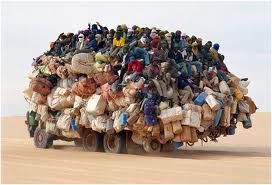
    Everyone loves a free Pygmy-Back-Ride.

    Posted by: Andy Wood | February 04, 2011 at 12:18 AM

    Congratulations to Andy! Simply give us your address in the comment section of this article and you'll receive a free, signed copy of Orrin Woodward and my Launching a Leadership Revolution book!

    And now, for the next contest:

    Images

  • John_lasseter_carsschoenherr John Lasseter and the Pixar Phenomenon

    Let me start with a confession: I cried during Toy Story 3 – twice! Call me a softy (or an idiot), but those little cartoon characters and their situation just pulled hard at the old tear ducts. Just to put things into perspective, the last movie to affect me that way was The Champ back when I was ten years old. 

    Pixar Corporation, the organization of geniuses behind not only the blockbuster Toy Story series, but a string of record breakers including Finding Nemo, Cars, A Bug's Life, Monsters Inc., The Incredibles, Ratatouille, and Up, is a bit of a favorite subject for me. I love art, creativity, design, and movies. I also love business. Pixar is a beautiful combination of the two. And just like any success story, Pixar's is infinitely interesting.

    The Birth of a Dream 

    The life of one man in particular at Pixar, John Lasseter, is inspirational and instructive (as are others, to be sure).  As a child, Lasseter loved cartoons. In high school he discovered a book on animation that changed his life by giving him a dream. He decided to pursue the making of cartoons as a career. More specifically, he wanted to become an animator at Disney.

    Taking Initiative

    Still only a high school student, Lasseter sent drawings to Disney Studios. They recognized his talent (and pluck) and invited him in for a tour. During that visit the professionals at Disney encouraged Lasseter to pursue a formal education in art.

    Getting Training

    Lasseter chose to attend CalArts, the art school founded by Walt Disney years before. In a scenario of perfect timing, Lasseter came of age to attend the institute just as it was launching a program in animation. Lasseter was its second enrollee. 

    Gaining Experience and Finding Mentors

    Lasseter became the summer assistant to the Donald Duck cartoon director Jack Hannah. According to authors Capodagli and Jackson, it was during this time that "John became a master of creative teaming, sharing story and project ideas, and playing critical evaluator with fellow students – a gift that would ultimately help him become a professional animator and inspirational leader." Lasseter also gained experience working directly with three of the original nine Disney animators.

    Running into Roadblocks    

    Eventually Lasseter hired on full-time as a Disney animator. To all outward appearances his dream had come true. However, Lasseter was not only a talented artist, but an extremely creative visionary. He could clearly see that computers would play an increasing role in animation but ran up against strong reluctance on the part of Disney corporate staff. Most of the experienced animators saw computers as a threat that would render their jobs obsolete. 

    A Closed Door

    Incredibly, after preparing only the artwork for a short computer animated film to demonstrate the possibilities of the technology, Disney let Lasseter go, telling him, "Your project is now complete, so your employment with the Disney Studios is now terminated."

    Turning Obstacles Into Opportunity

    Disney may have told him that his project was now complete, but his career was far from it. A small, crack team of computer specialists at Lucas-film Computer Division (founded by George Lucas of Star Wars fame) knew of Lasseter and hired him to help with their computer animation software development. It was there that Lasseter would team up with Ed Catmull and Alvy Ray Smith, as well as a small band of others, who shared his dream of computer animation.

    Progress and Development

    Some time thereafter co-founder of Apple Computer Steve Jobs, a bit down on his luck and struggling to make his new company NExt Computer succeed, was able to acquire the Lucas-film Computer Division in a fire sale (actually a divorce sale). The little group renamed itself Pixar and began producing small computer-animated films to demonstrate the value of the software they had produced. Eventually they realized (or at least got Jobs to realize) their real product was the films they could produce, and not the software.

    Dancing with Destiny

    This is how Toy Story, the world's first fully computer-generated feature film, was born. Its creativity, artistic beauty, depth of characters, and worldwide inter-generational appeal won it critical, as well as financial, acclaim. Its development was not without bumps and struggles, especially with the partnership with Disney to produce and market the film, but the collaboration, leadership, and creative genius of John Lasseter had finally broken through to the rest of the outside world. Toy Story grossed $29 million in its first weekend (nearly matching the entire production cost of the movie) and by early 2009 had grossed $361 million worldwide.

    The Power of Productive Partnership

    Lasseter certainly didn't make his dreams come true in a vacuum. For that he needed to find the right people; those who shared his vision, would collaborate productively, and had the environment and the resources to back the pursuit of his dream. George Lucas, Alvy Ray Smith, Steve Jobs, and many others all played key rolls, as well as hundreds of writers, artists, directors, and programmers, but no one perhaps was as important as Ed Catmull. As Capodagli and Jackson summarized, "For twenty-five years, Catmull and Lasseter have worked side by side in a collegiate manner that is reminiscent of the partnership between Walt Disney and his brother Roy."

    Leaving a Legacy

    In a telling comment by Ed Catmull, he said, "When we finished Toy Story . . . my new goal became, with John [Lasseter], to build a studio that had the depth, robustness, and the will to keep searching for the hard truths that preserve the confluence of forces necessary to create magic . . . We've had the good fortune to expand that goal to include the revival of Disney Animation Studios . . . . But the ultimate test of whether John and I have achieved our goals is if Pixar and Disney are still producing animated films that touch the world culture in a positive way long after we are gone."

    And What About Us?

    From an early age John Lasseter harnessed his talents and sent them marching in the direction of his dreams. No success story follows a straight up trajectory, however, and Lasseter's is no exception. He had a long term vision of where his industry could go and stayed true to that vision through many shifts in the pathway – even when being fired from his "dream job." Lasseter has that unique ability to fall in love with the destination while remaining flexible regarding the route to its attainment.

    Another big component of his continued success is his ability to work with others in productive, collaborative ways. This is not as common as we might wish in our world of dogmatic, false, and uninspiring "leaders."

    Perhaps the biggest thing we can take from Lasseter's example is the comprehensive package our abilities, once diligently developed and continually applied, present to the desires of our hearts. When we align our abilities in the direction of our dreams, and then apply a little pluck, a lot of perseverance, and a ton of partnership, we too just might end up doing something great – such as creating movies that make grown men cry!    

  • It was bound to happen and one day it did, Images

    Papa came home and it was just us kids . . .

    Oops, that's a country song. Well, anyway, it WAS bound to happen (not that I'm a fatalist or anything). It was a bright and sunny North Carolina morning and my ten-year-old and I were driving west on Highway 64 heading for a soccer game. We weren't late, we weren't in a hurry, but unfortunately, as it turns out, we WERE speeding (actually, the use of "we" here is a bit unfair to my ten-year-old as he was merely reading his Kindle in the back seat, but then again, you're only as good as the company you keep)!

    This is nothing new to me, of course. I have quite a colorful and varied collection of traffic violations to my name, though I've always been able to "talk my way out" of many of them, and allow enough time between the unfortunate other ones that points have never really stacked up very high against me, either. It has been a life-long game of staying just a couple steps ahead of the long-arm-of-the-highway-law. But I have been very good lately, very good. I have (had) a totally clean driving record with absolutely no points on it (I AM thankful those crazy parking tickets from Italy don't count)!

    Don't get me wrong. I never leave the house determined or even planning to speed. I believe in highway safety and do not make light of this. However, it just seems that from time to time I look up and find my dashboard indicating a number a bit larger than those posted on the passing signs. This normally happens to me under the following conditions:

    1. When I am in a good mood

    2. When the sun is shining

    3. When I am in a bad mood

    4. When the sun isn't shining.

    Other than those rare times, the only other thing that has gotten me into trouble is heart-pounding, mood-lifting music. Who can't ease on the horsepower a little when listening to that new favorite song?

    But not this time.

    It wasn't a song or music at all. It wasn't wanton disobedience or a blatant ignoring of posted signage. Nope. It was a sermon – good old fashion Christian preaching! I was so immersed in what the pastor was saying on that CD to which I was listening, the way he was illustrating his points, the method by which he was exegeting the scripture, etc. that I just flat lost track of my speed. It wasn't until I noticed that dark colored, unmarked car with flashing grill lights racing up behind me that I even had an inkling that I'd done anything wrong.

    Knowing the drill, I quickly pulled over to a safe place way off the road, lowered my window, shut off the car, and placed both hands on the wheel.  As the officer approached I almost laughed thinking he wouldn't believe my story. 

    "Do you know how fast you were going?" he asked, crouched behind the back passenger window near the relative safety of my gawking ten-year-old.

    "Um, no idea, actually. I wasn't paying any attention."

    "70 in a 55," he said disdainfully.

    "Man," was all I could mutter.

    "Are you in a hurry, sir?" he asked.

    "Actually, no sir. I'm listening to a sermon on CD and it's the best preaching I've ever heard. The pastor was saying some stuff that has never even occurred to me before and I guess I was lost in thought."

    "I'll be needing to see your license and registration."

    When he finally got back to me with my ticket, $171 and 2 points (he guessed), I asked him the following:

    "So I don't get a break because at least my reasons are getting better?"

    To which he cooly replied, "Sorry sir, it's results that count."

    (Honestly – you can't make this stuff up!)

    My reasons may be getting better, but the officer had it dead right – it's results that count.

    In life we need to go for better and better reasons, and sooner or later (sooner I hope, in the case of my driving), our results will get better too. 

  • IMG_2640 One of the constants in life, nay, one thing that never seems to change is the fact that things are always changing. Take safety, for instance. As far back as I can remember people have been at least moderately interested in safety. But the concept itself has evolved tremendously, to the point where many (and by many I mean MOST) of the activities in which I engaged as a kid are now seen as extremely dangerous. Looking back on those days, in which I am quite sure we all felt "nominally safe," I almost wonder how I managed to grow up! 

    Consider the following list of "normal" activities for me as a kid as an example. Then, feel free to add to the list with "dangers" of your own! The times they are a changin'.

    1. No seat belts in cars
    2. No child seats (infants instead rode in the mother's lap in the front seat)
    3. Parents used belts and paddles for spanking
    4. No bicycle helmets
    5. No knee or elbow pads for skate boarding
    6. We drank soda pop out of glass bottles
    7. Many of us wore "Tough Skin" jeans
    8. We rode in station wagons facing backwards
    9. We rode in the back of pickup trucks on the highway
    10. We used lawn mowers without hearing protection or blade-releases
    11. We had asbestos pipes in our schools
    12. People were allowed to smoke in public buildings
    13. People were allowed to smoke in airplanes
    14. We rocked the school bus back and forth
    15. We were read Grimm's Fairy Tales
    16. We had leaded paint, and
    17. Leaded gasoline
    18. We had no smog protection on our cars
    19. We drank water straight out of the tap
    20. We jumped on trampolines without side netting 
    21. We played with lawn darts
    22. Any number of people could ride in a car and nobody thought anything of it
    23. Our high-chairs had more pinch-points on them than a hydraulic press
    24. We ate food without ingredient labels
    25. We operated all sorts of equipment without those yellow caution stickers posted near every lever
    26. We drank McDonald's coffee without being warned that it was hot
    27. Toy guns looked real
    28. We all had BB guns, and shot them at each other!
    29. We played street hockey without helmets
    30. We did our own science projects without any parental assistance
    31. We really did walk to school
    32. We had no hand sanitizer of any kind
    33. Our video games had no ratings system assigned to them
    34. We could drive go-karts without signing a waiver
    35. We organized neighborhood sports games without any parents, leagues, referees, groomed fields, etc.
    36. We played baseball with a baseball
    37. We actually left our own yards without taking along a babysitter
    38. We were never diagnosed with a "Disorder" and medicated accordingly
    39. We were spanked at the Principal's Office
    40. We said the Pledge of Allegiance in school, and
    41. We even prayed in school!

    I can't believe we made it!

  • Benjamin-franklin_playing_chess Count Baldassare Castiglione, in the 15th century in Il Libro del Cortegiano (The Book of the Courtier) wrote about a concept packed into the Italian word: sprezzatura.  Officially meaning nonchalance, Castiglione took the definition of sprezzatura a bit further, explaining that the best courtier, or gentleman, was capable of incredible adroitness at things, but yet at the same time could make them look effortless. This casual excellence was seen as one of the requirements of the upper class, and in particular, for the Italian reputation.

    This concept reminds me of modern day professional athletes who make their sports look so easy one would almost think anyone could perform them accordingly. Once, way back in my snot-nosed motocross days, I had that impression after watching the professional racers in a stadium Supercross event. The following year I was down on the track to try it for myself and quickly found that the professionals had made their craft look extremely easy! I stumbled around, crashed, and burned several times as I rapidly grew in my respect for these inhuman men who could make their bikes do such seemingly simple maneuvers in front of flashing cameras and screaming fans.

    The more I have thought about this concept of adroitness made to look easy, the more I have come to realize that mastery usually looks fun. The best performers always make their tasks seem easy, obvious, and enjoyable.

    One great example of this is Benjamin Franklin. In his case his casual and affable conduct mixed with his mastery to the point where he even fostered enemies who accused him of laziness – in other words, he made it look so easy they thought he wasn't even doing anything!

    Ben Franklin had an interesting life. I like to think of it as being lived out in three distinct phases: first was his early entrepreneurialism and writing. Second came his scientific and inventive exploits. Third was his statesmanship.

    It is in this third stage where he particularly demonstrated what Castiglione would readily call sprezzatura. Franklin, who had spent the better part of his "second phase" living in England as an ambassador for the colonies to the mother country, would then be sent to France at the start of the American Revolutionary War. His task was simple enough to describe but nearly impossible to accomplish: convince the King of France to support the colonies in their rebellion against the King of England. This would involve money (what doesn't?), munitions, clothing, food, and even ships and men. The reason this task was so daunting was because at that moment France was not at war with England. Doubly, what the rebellious colonies were actually doing was warring against a monarchy, of which France was a particular example of one!

    So off sails Franklin across the Atlantic once again with little more than his scientific reputation as a foot in the door at the great court of King Louis XVI. He is representing a band of thirteen colonies which aren't even a country. He cannot be officially recognized as an ambassador, because his home "nation" hasn't even been recognized as such. The diplomatic challenges were immense. The risks for France were grave. The costs of what Franklin was attempting to obtain were enormous. The spies and opposition from England were prolific and proficient. Incredibly, however, the young colonies of North America had sent perhaps the only man capable of pulling off the miracle.

    Franklin was to work with two other colonials, Silas Deane and Arthur Lee, two men who would quickly set to feuding with each other and then Franklin. At one point Silas Deane was recalled to the colonies where he then proceeded to trash Franklin's reputation and ability to everyone and anyone who would listen. Deane was replaced by John Adams, a man whom Franklin had had previous dealings. Both Franklin and Adams expected the arrangement to work well, but that didn't turn out to be the case. Adams too would become a very vicious critic of Franklin's ineptness, at first confining his vitriol to letters, and finally haranguing Franklin openly and bitterly. 

    There were other difficulties for Franklin. For one, other colonies sent over their own individual commissioners to pester the court of Louis XVI and did nothing but muddy the waters. Additionally, his own household was fraught with English spies. Further, his own grandson (just seventeen years old) was forced into service as his only secretary, and was never really compensated for eight years of dedicated service. Franklin even had terribly painful bouts with gout, attacks that often left him immobile and incapable of going out. 

    So besieged by enemies from within and without, hampered by an almost non-existent staff, set in the middle of constant bickering by his supposed teammates, and wracked with health challenges,Franklin went about his task. He quickly won over France's chief minister Vergennes and built a personal relationship that was to become the hinge point of the entire French war effort. Some of the early colonial victories at Trenton and Saratoga helped legitimize the rebel cause, but progress was slow and required the most masterful diplomacy to move forward even an inch.

    Then things progressed from bad to worse. The British took Charleston from the colonies. The Continental Dollar was devalued by overprinting (sound familiar?) down from 40 to 1! A massive feud developed between naval commanders in which Franklin had to constantly mediate, and it cost over a year of time for getting much needed supplies to Washington's army (and Franklin himself was blamed for this). And to top it all off, John Adams wrote some extremely nasty things about Franklin:

    "The history of our revolution will be one continued lie from one end to the other. The essence of the whole will be that Dr Franklin's electrical rod smote the Earth and out sprung George Washington. That Franklin electrified him with his rod – and thence forward these two conducted all the policy, negotiation, legislatures, and war."

    At one point Vergennes became so exasperated with the Americans as to almost lose hope for the cause in which he had so extended himself. Wrote Stacy Schiff, "Vergennes deplored American infighting, his allies' obsessions with their personal affairs seemed to take priority over their independence." (Again, does any of this sound familiar?) But the bad news would not stop coming. Horatio Gates, the top colonial general in the south, suffered a string of embarrassing defeats and had to be replaced. Next, Benedict Arnold famously became a traitor and attempted to entrap and hand over General Washington himself to the British. And in almost impossible-to-believe timing, at roughly that same time Congress was voting upon whether or not to recall Franklin for ineffectiveness!

    Franklin's efforts, however, were bearing fruit. His personal relationship with Vergennes and the mutual respect the men had developed literally came to the rescue. Stacy Schiff wrote, "[Franklin] was fortunate in that the combined offenses of the Lees and the Adamses were every bit as effective as his own eloquence. Vergennes was as offended by the [political infighting and sea captain debacle] as was he. As much to spite Franklin's enemies as to gratify America, the French minister determined immediately to grant additional funds. He also directed [the French minister in America] to sing Franklin's praises. It was purely out of esteem for and confidence in its minister plenipotentiary that Vergennes now resolved to help America out of her financial embarrassment. 'Let them judge by my gesture, which is entirely personal, if the behavior of this minister [Franklin] had endangered the interests of his nation, and if anyone other than he could have obtained the same advantages.'"

    A clear indication of the difference between a diplomatic virtuoso like Franklin and an egotistical amateur like Adams can immediately be seen in the contrast between two of their comments relating to these squabbles:

    Franklin: "They quarrel at me rather than with me; for I will not quarrel with them." 

    Adams: "Resentment is a passion, implanted by nature for the preservation of the individual. Injury is the object which excites it. Injustice, wrong, injury excited the feeling of resentment, as naturally and necessarily as frost and ice excite the feeling of cold, a fire excites heat, and as both excite pain. A man may have the faculty of concealing his resentment, or suppressing it, but he must and ought to feel it. Nay he ought to indulge it, to cultivate it. It is a duty."

    In the end, of course, we know what happened. Franklin's entreaties through Vergennes to King Louis XVI were successful. France contributed more to the American Revolution than they had to the entire Seven Years world war a decade and a half before, in which they were directly involved. Ultimately, France's contribution to the American cause would lead (among other things) to the bankrupting of France's government, the French Revolution, and the beheading of Louis XVI. In essence, what Franklin had secured through masterful diplomacy would birth one nation and kill another, toppling monarchies and fostering the Age of Revolution.

    How did Franklin do it? How did he keep his sanity through it all? How did he keep his eye on the task when all around him was turbulent and tumultuous? How did he keep from quitting in despair? And ultimately, how did he accomplish so much while appearing to be hardly exerting himself at all?

    The answer, I believe, comes from the definition of sprezzatura as posited by Castigione over two centuries before. Franklin had a way of having fun through all of it, and this kept him balanced and sane. He wrote humorous little ditties that he even published in newspapers. He made many friends in upper Parisian society (a strategic move as much as an entertaining one), and even carried on a couple of famous public flirtations with high-profile French society women. He always seemed to keep an element of fun and lightheartedness to his dealings. He controlled his temper and refused to drop down to the level of his adversaries. He remained humble, never totally able to take himself as seriously as the snobs and the selfish around him who were so uptight about their honor and their appearances. This, quite possibly, came from the fact that he could never totally overcome in his own mind the fact that he had been born a humble candlemaker's son. All of this allowed Franklin to move at the pace of events, doing just the right amount at just the right time with just the right people – the hallmark of professional diplomacy. In fact, diplomacy is the very craft in which "trying too hard" or being too busy can almost always result in the opposite of what is intended. Perhaps more than any other endeavor, diplomacy requires the art of making it look simple and, well, nonchalant. Of this, Franklin was a master.

    It is quite sad that in our entertainment-saoked culture today we pursue fun as an object in itself. Of course, such pursuit can only end in an empty chase for more fun. Unfortunately, most of the "fun junkies" of our world are missing the point of fun entirely. Fun is not there for its own sake alone. Fun is a tool of sanity, of effectiveness, and of mastery. Fun leads to an apparent but misleading nonchalance, more accurately stated as, "I have mastered this activity and look how much I am enjoying maximizing my gifts in a worthy purpose." You see, the reason the best at any field make it look so easy is because there is something deeply satisfying about working hard for a long time at a worthy task and finally getting good at it.

    Fun can be a powerfully effective tool by:

    1. creating a good first impression

    2. disarming enemies

    3. building and "greasing" relationships 

    4. helping one to keep a proper perspective

    5. diffusing tense situations

    6. disavowing prideful behavior

    7. keeping sanity as a "pressure relief valve"

    8. restoring our frayed nerves and attitudes

    9. allowing one to "keep one's head" (no pun intended, sorry Louis)

    10. producing situations in which some work can actually get done (called "dinner table diplomacy" in Franklin's day)

    So use fun as a leadership tool. Find fun in your every day dealings and find fun things to do in between, all the while relentlessly pursuing mastery in your calling. Spread fun among others. Do all of this, and you will likely sail higher, farther, and better than your rivals, who will be forced to observe your competence in frustration as you make it look so easy. You will reach a state of sprezzatura to make even Castiglione proud. 

    One final salute to Franklin from the pen of Stacy Schiff: "[Franklin] was the opportunistic envoy from the land of opportunity, that pluralistic singularity that is the United States. His was an initial display of America's scrappy, improvisatory genius . . . . " May we all become the same! 

     

  • Monkey If you've ever tried to preach a sermon you will immediately hold in higher regard those who do it for a living. I will never forget the first time I was given the honor of trying to handle the Word for others. I think I prepared for over twenty-four hours for a sermon that lasted less than one, and it was terrible to boot!

    As in anything, however, mentors and information from the correct source can be infinitely helpful. This was true in the case of my (attempts at) sermons. 

    Seeing my lackluster ability, no doubt, inspired one man of experience to recommend some good books to me. In a particular book I learned a simple little insight that not only applies to sermons, per se, but to all effective communication:

    1) state

    2) illustrate

    3) apply.

    State – this first step requires the speaker to effectively communicate, in clear fashion, a statement of what is to be communicated. This may be a proposal, theory, or principle. This one is a bit obvious, and unfortunately, many speakers never get beyond this one. Instead they simply state things and then state some more things and then state even more things and thereby think they've communicated. State your main point clearly and simply, and realize you have only begun. 

    Illustrate – this second step is where many a speaker falls off the cliff. Remember, the best way to tell someone something is to tell them a story. Stories are the most entertaining, capture the listener's attention, and are the most memorable of all verbal communication. Stories are simply illustrations for the main points you are making. Choose or create a story (or analogy, or colorful example) to "illustrate" the point you have made in the "state" step. To assist in this, ask yourself, "What is a real life situation that would paint a picture or image of what I'm trying to say?" or "What is like this?" or "What story from history, or movies, or books, or my own experience would reinforce my main point?" or "What do people first think of when I state my main point?" These kinds of questions will be helpful in coming up with illustrations for your points. Consider the most famous communicators of all time such as Winston Churchill, Abraham Lincoln, Ronald Reagan, and others, and you will quickly find they were experts at illustration.

    Apply – in this step you make the information and illustration make sense in the life of the listener. It's one thing to make grand statements and color them with clear illustrations, it's quite another to make them relevant to the audience. Ask yourself the question, "What is in it for them?" or "Why does this matter in their life?" or "How can they apply this to get practical results in their own lives?" The answers to these questions will give you ways to demonstrate for the listener how he or she can integrate the new information into their own experience. This may be the hardest step of all, but remember, every listener you will ever encounter will be asking (either consciously or subconsciously) "How does this apply to me?" or "Why should I care?"

    In every instance of communication, whether one-on-one or to an audience of thousands, these three principles are relevant. Now that you know them, I'll bet you will be able to pick them out as you listen to effective preachers, teachers, and leaders. All the best have some form of these three elements in their communication.

    Do the hard work of thinking through these steps as you prepare your material and get ready to experience an uplift in your ability to connect with others. Remember: it's better to make one point really, really well than to make several poorly. 


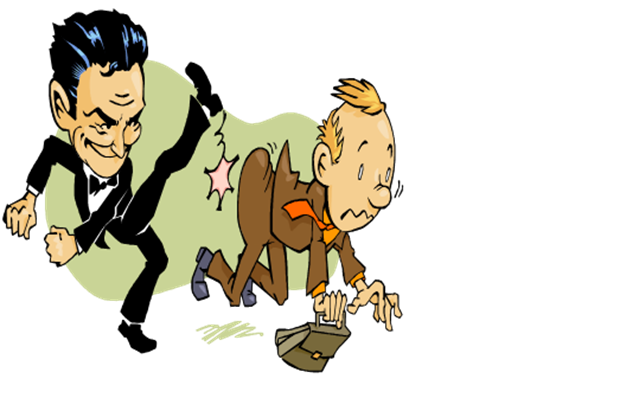
  • Kicking-butt The garden of prosperity is a curious place in which many strange activities occur. Simply observing the scurry of the Modern Man reveals an unorganized Olympic-like competition featuring the following events:

    10. Climbing over others to get to the top

    9. Throwing babies out with the bath water

    8. Running behind

    7. Pounding the pavement

    6. Kicking butt (and taking names)

    5. Throwing others under the bus (one with four wheel drive and a lift kit, no doubt)

    4. Hurling insults

    3. Catching drifts

    2. Jumping to conclusions

    1. Passing the buck

    There are others, to be sure, such as Dodging responsibility, Chopping others off at the knees, and Stabbing people in the back.

    Perhaps you have witnessed a few of your own. Feel free to add them to the comment section.