Welcome to
Chris Brady’s
Blog

“The only way to be happy, is to give happy.”

  • The following excerpt was taking from Chris Brady‘s critically acclaimed book, Leadership Lessons from the Age of Fighting Sail.

    Few things give leaders more leverage and cause more impact than developing culture. Culture is the combination of values, traditions, ideals, aspirations, and principles that determine what a team or organization stands for—and stands against. Culture says, “This is who we are. This is how we act. This is how we do things here. And this is how we do not do things here.” When a culture is properly instilled, leaders no longer have to dictate from the top; team members get an intuitive feel for what is expected of them. Rather, their role is to hold people accountable to the shared culture and continue fanning the flames of inspiration.

    Leaders must develop a culture of victory—a culture that says, “Here, we are winners. We will prevail. We will not be distracted or deterred from our mission. Nothing can stop us from succeeding.” Leaders are obsessed with winning. They keep score. They are constantly adjusting and adapting to changing circumstances and threats in order to achieve their objective. They stay fixated upon their North Star and sail in an undeviating course toward it, using their sails and rudders to adjust to the wind and waves.

    This relentless focus bleeds down into the lowest ranks. In a well-cultivated culture, the lowest people in the trenches are animated, encouraged, and emboldened by the shared identity. They need not be hounded, prodded, or micro-managed; they take pride in their work and strive to live up to the cultural values and ideals. One of the most critical things a leader can do, therefore, is to communicate and cultivate a culture of confidence.

    Leaders first cultivate a culture of victory and confidence through unwavering principles. Then they build on each success to deepen the culture. They never accept failure. When they lose, they do not place blame or proffer excuses. They accept responsibility. They adjust, adapt, and innovate. Their pursuit of excellence is relentless, their resolve dauntless.

    Chris BradyIn a culture of performance, people are empowered to make independent judgment calls and decisions. Without being micromanaged, they take responsibility for the execution of ideas. They are not afraid to make mistakes; rather, their greater concern is with not taking action. They are held accountable for results, not how the results are achieved. They advance in rank based not on birth or privilege but
    on merit.

    Values and traditions are the bedrock of culture, the DNA of your organization. Core values guide decisions. They are like an organization’s conscience and help you realize when you’ve strayed. When an organization strays from its values without holding itself accountable, the culture will be eroded and distorted. Performance will plummet. Just as people intuitively feel when individuals are out of integrity, they also know when the organization they work in is out of integrity, out of alignment with its values.

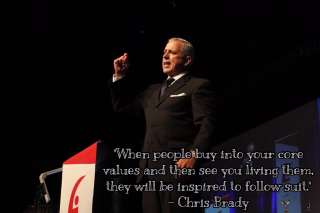
    A leader’s primary role is to shape culture and hold the organization accountable to it. The leader is responsible for communicating to the team how critical the shared values are—not just through his or her words but, more importantly, through his or her actions. When people buy into the core values and see the leader living them, they are inspired to follow suit. They take pride in their shared identity. They strive to live up to the standards. Few things are harder to change in an organization than culture—and few things will give you greater leverage and influence.

    (Posted by Kristen Seidl, on behalf of Chris Brady)

  • In a previous article, Chris Brady and Orrin Woodward covered The Power of Goal Setting from their NY Times bestselling book Launching a Leadership Revolution. Today, we are featuring Brady and Woodward's strategies for an effective game plan.

    The Power of Game Planning

    A leader with a goal but no game plan is like an archer with a target and no arrows. A game plan is a leader’s strategy or map. It provides guidance toward the goal. It provides the very way to realize the goal. It is here that the leader’s creative powers can flourish. It is here that a leader develops the ability to think strategically, brainstorming on the methods of attack. It is here that experience and learning can be big enablers. If Hunger provides the “why,” the Goal is the “what,” and the Game Plan is the “how.”

    Game Plans Are Set in Sand

    Strategic thinking is important, and putting together a well-thought-out plan for accomplishing a goal is vital. But a leader must never allow the game plan to become a masterpiece of its own. The game plan must be fluid, adaptable to changing conditions, and able to be scrapped at a moment’s notice if it’s not working. No plan entirely survives its collision with reality. As mentioned above, often it is necessary for a leader to develop multiple game plans over time before a goal can be reached. The goal is set in stone; the plan is drawn in sand.

    Game Plans Drive the Prioritization of Tasks

    One of the biggest advantages of a game plan is that it drives the process of setting priorities. A leader must think through and understand the question: What’s important next?

    Chris BradyA teacher sought to demonstrate for his students the impact of prioritizing work. He took a glass jar and placed it on the desk next to some large rocks, some smaller rocks, some pebbles, some sand, and a pitcher of water. He informed the class that the object of the exercise was to fit as many of the materials on the desk into the glass jar as possible, providing the densest combination. He first placed as many of the large rocks into the glass jar as would fit, asking the class to confirm that the jar was “full.” Next he placed the smaller rocks into the jar around the larger rocks until the class verified once again that no more rocks could be placed into the jar. Then he crammed the pebbles into the jar around the other rocks until no more would fit. Next he poured the sand around the various-sized rocks until no more would go into the jar. Finally he poured the pitcher of water into the sand in the jar until the jar was entirely full of matter and not one more thing would fit.

    “Now the jar is full,” said the teacher. “If we had not prioritized what should be placed first into the jar, we would not have fit as many of the items into the jar, and we would not have obtained the densest result.”

    “I don’t get it,” said a student. “How does that teach priorities?”

    “Because,” answered the patient instructor, “if we had started with the smaller items such as water or sand, there would have been no room for the bigger-size rocks. The projects we encounter in life must be handled in the same way. Put the big rocks in first and then work downward toward the smaller things.”

    That is the lesson of priorities. Game planning for a leader is the step where this takes place. Without it, the leader will spend time on things that are “good” to do or even “great” to do but not the “best” to do. A leader knows to put in the “big rocks” first.

    Ed Koch, author of The 80/20 Principle, writes, “The 80/20 Principle asserts that a minority of causes, inputs, or effort usually lead to a majority of the results, outputs, or rewards. Taken literally, this means that, for example, 80 percent of what you achieve in your job comes from 20 percent of the time spent. Thus for all practical purposes, four-fifths of the effort—a dominant part of it—is largely irrelevant.” Over time, the leader’s ability in this area compounds toward excellence or devolves toward mediocrity. Remember, a leader is most valuable where he or she adds the most value. Andy Stanley, author of The Next Generation Leader, wrote, “The ability to identify and focus on the few necessary things is a hallmark of great leadership.”

    Game Plans Are Developed at the Macro, Mini, and Micro Levels

    A close relative to the topic of prioritization is the classification of tasks or objectives into different levels based upon their size or importance. It is helpful for a leader to understand that issues can be classified into at least three categories.

    These are:

    1. Macro
    2. Mini
    3. Micro

    The Macro level is the overall top layer. It is comprised of all the big stuff, the high-priority stuff, or the issues that will have the biggest impact for a given task. The Mini level is just below Macro, where issues are smaller and not quite as important. Finally, the Micro level is the tiniest detail level where the issues are the smallest.

    It is important to understand how Macro, Mini, and Micro fit together with the idea of priorities discussed above. It's important for a leader to follow a set of priorities that are arranged according to the principle of “What’s important next?” Associated with each of these priorities are macro, mini, and micro issues. These two concepts together show the leader exactly where to focus to have the greatest impact on reaching the goal. A truly effective leader structures a game plan that starts with the highest priority task and the macro issues associated with that task. As these are completed, the leader works on the next lower-priority tasks and on issues related to those tasks that go from macro down to micro.

    It is rarely necessary that all the priorities be handled or all the issues worked out. Often a goal can be reached before that level of detail is necessary. For this reason, it is important for leaders to review their priorities and issues continually to have the greatest impact possible as conditions change and progress is made.

    Game Plans Are Best When Effective Thinking Is Used First

    A leader’s quality of thinking will have much to do with that leader’s success. There is a tremendous power in effectively thinking through a goal and how it might be attained.

    Brainstorming is the process where thinking is done in a freewheeling style, omitting any early judgments as to the merits of the ideas that result. Evaluation of ideas can come later. Brainstorming is designed to pull all good ideas out of the head and into the game plan.

    Napoleon Hill became famous for his landmark book Think and Grow Rich. His basic premise was that each of us holds true wealth in the power of our thoughts. The Bible says, “For as [a man] thinketh in his heart, so is he” (Proverbs 23:7). Denis Waitley, former Blue Angels pilot and successful author and speaker, said that we have entered in our times a “battle of the mind.” We are no longer in the Industrial Age; we are now in the Information Age. And it really won’t be the quality of information but rather the quality of interpreting that information that will make the difference.

    A key precept to comprehend when thinking strategically through a goal can be understood by envisioning the process like a game of dominoes. For any given goal there are myriad tasks that lead to its accomplishment. When drawing up a game plan, the leader must ask, “What are the major dominoes that will knock all the others down?” It is critical to focus on the major tasks first. This requires forethought and planning. Once a leader has determined the steps of major importance toward the realization of a goal, all efforts should be brought to bear on the completion of those particular steps. This happens before becoming involved in lesser concerns. It is these “majors” that leaders are chiefly responsible for accomplishing. They are entrusted to no one else. Often people miss this point and spend time and energy working on dominoes that don’t knock any others down. At the end of the time frame, the goals have gone unaccomplished, and the leader is frustrated. Effective thinking leads to a proper game plan that prevents this common mistake.

    (For more information on this topic, you can order a copy of Launching a Leadership Revolution by clicking here. Posted by Kristen Seidl, on behalf of Chris Brady)

  • The following excerpt was taking from Chris Brady and Orrin Woodward's NY Times bestselling book, "Launching a Leadership Revolution".

    It is important to be hungry and have ambition to change the status quo, with a clear vision of what is to be, but that energy must be directed at something specific. That is where goals enter the picture. David Schwartz, author of The Magic of Thinking Big, writes, “A goal is more than a dream; it’s a dream being acted upon.” In the words of hockey great Wayne Gretzky, “You will miss 100% of the shots you don’t take.” We must assume he was referring to shots on a goal. Without specific goals at which to direct energies and ambitions, all efforts will be wandering generalities at best. Henry David Thoreau
    wrote, “It is not enough to be busy, so too are the ants. The question is: what are we busy about?” A leader must know the goal of his or her efforts. A leader must know clearly what is to be achieved. In short, leaders use the process of goal setting.

    The story is told of two men who set out to accomplish similar results. One invested the effort to set goals properly and the other did not. At the end of a period of time, both men had worked diligently, but the one who had set a specific goal by far outperformed the other man. This is because everything the goal-setting man did was unconsciously directed toward his goal. If there was something to be done, it was first determined if it would assist him in accomplishing his goal. If it would, then he did it. If it would not help him hit his goal, he would not do it. You see, the goal-setting man had the advantage of priorities over the non-goal-setting man. He also had the advantage of channeling his efforts more effectively through the power of focus. On any given day, there are a number of “good” things to be done, but there are only a few “great” things to be done. And there can be only one “best” thing to do. A leader knows and does the “best” things on a regular basis.

    As with hunger, goal setting is a discipline. It should never be a haphazard affair. As Tom Garriga, president of Tang Wei Martial Arts Institute, tells us, “A goal is an enemy to be conquered with a battle strategy and the commitment of a warrior. The leadership process is founded on resolve and commitment.” With this in mind, there are several components to the proper setting of goals that every leader should embody.

    Goals Must Be Specific

    Goals must be clear and exact. A leader cannot passionately pursue a generality. Examples of proper specific goals would be: “to win the Boston Marathon” or “to become president of the company” or “to sell one million dollars’ worth of products this year.” These are clear and precise. Examples of goals that may not be specific enough are: “to become a better parent” or “to improve in leadership ability” or “to maximize performance at work.” These are general feelings of what could be accomplished, but terms like “better parent” or “improve ability” or “maximize” are not specific enough to trap the leader into performing. Loose terms like these provide “wiggle room” for the leader. How can one know if he or she really became a better parent or improved his or her ability or maximized? Being specific with goals not only gives the leader a clear target at which to shoot, but it also leaves no room for doubt as to whether the target was hit. That is what it means to be specific.

    Goals Must Be Written

    A goal is not a goal until the leader has written it down. This may sound trite, but it is vitally important. As with goals that are not specific, goals not written down leave the leader room to maneuver if things don’t go as planned. But a written goal is hard to avoid.

    Goals Must Be Set in Stone

    The purpose of having a goal in the first place is to organize a leader’s thoughts and provide something specific for which to strive. The setting of a goal must be backed by commitment, or the whole process breaks down. Therefore, goals must be “set in stone.” Once decided upon, goals should not be changed. There is a saying, “Goals are etched in stone, but plans are drawn in sand.” As will be shown in the “Game Planning” section, it may be necessary to modify plans for how to attain a goal, but the goal itself must remain firm. Commitment says that whether the goal is accomplished using Plan A or Plan Z, the goal remains.

    Chris Brady

    Goals Must Be Measurable

    If a goal is to exert a motivating force upon the leader, then there must be a clear, quantifiable method to determine when the goal is accomplished. Can it be measured? How? How easily, and by whom? How quickly upon completion? These are the types of questions to answer when setting a goal to ensure that the leader knows when and how a goal is achieved. The ability to measure progress toward a goal also enables midcourse corrections and the ability for a leader to confront brutal reality concerning his or her progress.

    In sports, there is nearly always a scoreboard that is big and obvious to all contenders and fans alike. It is present all the time with a constant, specific, measurable update on how the participants are performing toward the goal of winning. Goals for leaders must be just as clear and measurable.

    Goals Must Be Realistic

    A leader is not a leader without a vision for a better reality, but in the area of goal setting, this can be taken too far. It is one thing to have a big vision for a better future reality. And it is okay for that vision to seem wild and crazy to anyone except the leader. But the proper way to use goal setting to accomplish that enormous vision is through gradual steps. Each of these steps is represented by realistic, attainable goals. If the goal is too far beyond the leader’s reach, the leader will eventually become exasperated at his or her repeated failure to accomplish that goal. Goals must be realistic enough that the leader believes them achievable and is energized to do whatever it takes to accomplish them.

    Goals Must Provide Motivation

    On one hand, goals must be realistic, but on the other, they must be enough of a stretch to inspire the leader. They must be challenging. They must cause discomfort on the part of the leader and provide an impetus for increased performance. The best way to set a goal is to make sure it is between the ditches of “too enormous” on one side and “too easy” on the other. The leader must believe that he or she can accomplish the goal while at the same time being uncomfortable at the increased level of performance required to do so.

    Goals Must Be in Line with Priorities and Values

    In the struggle for achievement, there will always be temptations to “sell out” or compromise one’s beliefs. There may be conflicts of interest that crop up along the way, but under no circumstances whatsoever should a leader set goals that don’t ring true 64 WHAT A LEADER DOES with his or her true priorities and values in life. As the Bible says, “For what shall it profit a man, if he shall gain the whole world, and lose his own soul?” (Mark 8:36). Every leader should take care when setting goals to ensure that the goal itself is not at cross purposes with his or her core beliefs and that what’s required to accomplish the goal does not compromise his or her honor.

    Goals Must Be Prominent

    The leader must develop systematic ways of regularly reminding him- or herself of the goal. This can be done with signs or placards placed around the home or workplace or even in the car. This may mean telling a spouse or friend or work associate about the goal so he or she can continue to bring it up in conversation. [This step should be done cautiously, however. The Bible warns against casting “your pearls before swine,” (Matthew 7:6), which means be careful with whom you share your most cherished thoughts, including personal goals. Sharing of goals should be done only with the closest of trusted individuals.] Certain music or thoughts can trigger a leader to focus time and again on the goal. The point is that a leader should devise methods of keeping the goal prevalent and in view until the goal is achieved. A goal forgotten is a goal missed. Great leaders know to put pressure on themselves by developing creative reminders of their commitments to achievement.

    Goals Must Have a Specific Time Period

    Once a leader sets a specific goal, writes it down, commits to it, determines how to measure it, makes sure that it is realistic and motivational and in line with priorities and values, and devises methods for making it prominent, it is crucial that an appropriate time limit be determined. If a goal is set without a time limit, it becomes nothing more than a wish or fantasy. A time limit applies the final pressure on the leader, like a clock ticking during the running of a race. Motorcycle racers say, “When the gate drops, the talk stops.” That’s how it is with goals once a deadline has been established. A leader bolts from the starting line headed toward the goal and racing against the clock. The pressure of the clock is necessary to avoid the old saying, “When all is said and done, there is usually more said than done!"

    (Posted by Kristen Seidl, on behalf of Chris Brady)

  • Rascals are able to boldly march in their own direction because of the confidence derived from their competence. Getting good at something is a great way to gain assuredness of direction. The better one gets at something the harder it is for anyone or anything to knock one off that path. Stated more simply, the harder you work at something, the harder it is to quit it.

    Mastery is a concept little understood in today’s world. We tend to glorify top-level athletes as “gifted,” top business pioneers as “geniuses,” and top leaders in many fields as “born” leaders. While there may be some truth to this, there is a lot of research to suggest that success is more about mastery than it is about inborn ability. Malcolm Gladwell wrote, “The question is this: is there such a thing as innate talent? The closer psychologists look at the careers of the gifted, the smaller the role innate talent seems to play and the bigger the role preparation seems to play.”

    Chris BradyThis is why it is so important to understand the difference between being busy and being focused; anyone suffering from the effects of busyness will never be able to muster the focus required to obtain mastery of a certain subject. This is because mastery is the product of applied and focused practice over time. No focus, no mastery.

    Most people do not understand the power of incremental improvements over time. The compounding effect of effort over the long haul is staggering to behold. The fact is that success requires mastery in one’s chosen field. Mastery utilizes the compounding effect of effort over time. And there is a certain type of effort that is required: passionate and perfect.

    Passionate effort is the kind that has heart behind it. There is a drive and a desire for success that empowers the development process. Half-hearted effort and practice is useless. If one is not passionate about what he is doing, some other area of endeavor should be chosen. As the mountain bikers say, “Go big or go home.” Life is too short to fumble along in the wrong vocation. Rascals find something they can be passionate about, then pour their whole self into its mastery. They show up to practice early, work hard, demonstrate a desire to learn with a positive attitude, and push on through the pain of getting better.

    Perfect practice is the other component, as it is the only kind of practice that leads to improvement. Anything else is wasted time at best, counter-productive at worst. Practicing for the sake of practicing, or simply to “put in the time” is not really practice, it is dishonesty. No one is served by a partial commitment. Also, practice that doesn’t lead one to mastery of the fundamentals and to a mastery of proven techniques is also wasted time, because it leads to the learning of bad habits and ineffective methods. This is why the quality of coaching or mentorship is so important. A student on the journey toward mastery needs expert guidance and proper fundamentals. 

    The concept of mastery should be stimulating. This is because the message is that anyone can become great if he is willing to put in the time and effort over the long haul to fulfill his calling. Sure, there may be those who are bigger than you, faster than you, smarter than you, or better positioned within society than you. The facts are, however, that it doesn’t matter. Victory goes to the one who decides to accomplish his dreams, then sets out consistently to master his craft, working hard over the long haul without faltering. What this all means is that achievement comes about as a result of commitment, and commitment is a choice. You can literally choose to become great because you can choose to master your craft.

    Sincerely, 

    Chris Brady

    Chris Brady

  • We want to congratulate the winner of the recent Caption Contest 2017.7! Here is the winning entry:

    Jennifer Dibala said…

    “Choosing the location for the next major function.”

     
    Jennifer: Simply comment on this blog with your mailing address (which will remain confidential) and you'll receive a free, autographed copy of Leadership and Liberty, by Chris Brady and Orrin Woodward. Congratulations!

    And now, without further delay, here's the next Caption Contest! The winning entry will receive an autographed copy of Leadership Lessons from the Age of Fighting Sail, by Chris Brady.

    (Click to enlarge)

    Chris Brady

    (Posted by Kristen Seidl, on behalf of Chris Brady)

  • This passage was taken directly from the book, PAiLS, by Chris Brady.

    When it came to emperors, Rome didn’t have very many good ones. Although his statue in the Piazza del Campidoglio shows him to have a huge head and buggy eyes, Marcus Aurelius was considered to be one of Rome’s better leaders. Also a philosopher, Aurelius famously wrote, “Do not live as though you have a thousand years.”

    How many clichés are there about the fleetingness of time? How often have we heard not to waste it? Apparently, such admonitions go back at least as far as the Roman Empire. Also, I’m sure we could dig out some Proverbs from the previous millennium, and I wouldn’t be surprised if the ancient Egyptians even had something to say about it centuries before that.

    Time may be our least replenishable resource. We all know this innately, but our awareness of its passing doesn’t seem to have much of an effect on how economically we use it. We let the minutes flow into hours, hours into days, days into weeks, and on and on until we can’t believe how much of it has passed and how little we have to show for it.

    Have you ever known someone who seems entirely oblivious to the passing of time? They move slowly, have no schedule to keep, and seem to feel no pressure to make use of the sands running relentlessly through the hourglass. A friend of mine marvels at this by saying, “Have you ever noticed how people with nothing to do always seem to want to do it with you?”

    Contrast those people with their opposites: the frenzied, hurried people. Have you known some of them as well? They seem to never be at ease, are always in a hurry, and never have time for anyone else. They are at the constant mercy of a tight schedule. I am reminded of the rabbit in Alice in Wonderland who was always “late for a very important date!”

    Chris BradyIf we are going to accomplish anything worthwhile in life, we need to make good use of our time. This means that we can’t behave like those who are oblivious to its passing, but it also means that we shouldn’t obsess about it to the point of being frantic. This, indeed, is a difficult balance to strike.

    In her book The Writing Life, author Annie Dillard made a profound statement: “Who would call a day spent reading a good day? But a life spent reading—that is a good life.” I had to think about this sentence quite a bit after reading it. At first, I wasn’t sure I understood what she meant. Then, once I thought I’d gotten it, I couldn’t stop thinking about it off and on for weeks afterward. Here is what I took from it: No one can read all day every day; that would be way too taxing and tedious. But the accumulated benefit from a habit of reading at least some each day can add up to a lifetime of learning and the enjoyment it brings.

    This principle can be extrapolated into a broader application. We can’t go to extremes in chasing after every little second of every minute of every hour of every day. That would drive any of us insane and be a terrible way to live. However, we must be ever mindful of the aggregate of time we are given and shepherd it constantly in the right direction. If we spend enough time on enough days doing enough activities consistently in the direction of our highest purposes and calling, the accumulation of this will produce astounding results when lived out over the course of our entire life. This is the key to making the best use of one’s time without becoming frenzied and rushed.

    Maybe I can make this concept clearer with an illustration from my days of motorcycle racing. At one point in those crazy long-haired teenage years, I was taught that the best racers look the furthest down the track. Amateurs focus right in front of the motorcycle, taking each obstacle one by one in turn, in a first-come-first-served manner. But true professionals look way down the track, not worrying about the next few obstacles but instead keeping their mind fixed on the distant sections of their path.

    I tried it for a while and found the results astounding. When I did it correctly, I was much faster. But it was difficult to master, and I continued slipping into the old habit of focusing too closely on just the next obstacle to come along. Eventually though, I learned to look farther and farther down the track, realizing that I could more easily handle all the short-term bumps and ruts if I maintained a longer field of vision.

    We all know that we are not supposed to waste our time, but we cannot (and will not) make better use of it by managing every little second and fixating on efficiency. To do so would be like looking no further than the edge of our front fender. Instead, we need to keep a long-term view in mind for what we really, truly want to accomplish overall, trusting that by doing so, we will make the correct maneuvers in the short term.

    (Posted by Kristen Seidl, on behalf of Chris Brady)

  • The following excerpt was taken directly from Chris Brady's book, Rascal:

    If any worthwhile dream requires a long term vision and delayed gratification, it stands to reason that perseverance will be necessary, and in droves. Somehow, Rascals are able to hang on long after others are shaken off. And sometimes, after they themselves have experienced significant setbacks.

    In 1835, Thomas Carlyle had finally completed his book French Revolution. It was to be first in a series of three volumes, a massive and ambitious work of scholarship. When tackling an immense project, as many a writer is familiar, the first part is often the most difficult. Overcoming inertia can be intimidating and exhausting. This was certainly true for Carlyle in this case. That first volume had been a struggle. For over two years Carlyle had researched, organized, collected, studied, and finally written it. He had lost sleep, his nerves were frazzled, and his finances were in dismal shape. The book had been a wrestling match, but would surely soon pay off.

    Carlyle was good friends with John Stuart Mill, the famous philosopher and fellow writer. When Mill offered to read the manuscript and provide his thoughts, Carlyle consented with pleasure. One can only imagine the scene when, days later, Mill inquired as to whether Carlyle had retained a back-up copy. When Carlyle answered that he had not, Mill explained that his housekeeper had inadvertently thrown the book into the fire with some old newspapers. It was entirely destroyed. Even the research Carlyle had done was gone, as he had thrown it all away upon completion of the manuscript.

    Chris BradyThe next morning he wrote in his journal: “I will not quit the game while the faculty is given me to try playing. Oh, that I had faith! Oh, that I had! Then were there nothing too hard or heavy for me. Cry silently, to thy inmost heart to God for it. Surely He will give it thee. At all events, it is as if my invisible schoolmaster had torn my copybook when I showed it, and said, ‘No, boy! Thou must write it better.’ What can I, sorrowing, do but obey – obey and think it the best?”

    With this determination, Carlyle sat at his desk and began to write once again. He was tired, stressed, and in financial straights, but he wrote, and wrote, and wrote. For two years he valiantly forced his way up that same old hill of inertia he had already once climbed. And there, atop that hill, Carlyle planted the flag of perseverance for all writers and strivers to see forevermore. He not only re-wrote his initial volume, but finished volumes II and III as well. And to this day, French Revolution is considered one of the master works on the period. Finding the strength to build something of magnificence is incredible enough the first time. But to summon the character to do it again is nearly beyond belief.

    The ability to persevere through challenges and obstacles is a matter of strength, will, and focus. A Rascal keeps his or her eye upon the prize, hangs on tight, and refuses to let go. No matter what turbulence hits, Rascals are tough enough to stay the course.

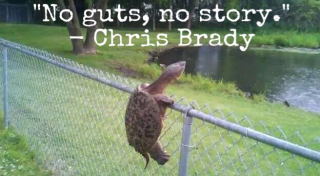
    One trick I have used throughout the years is to encourage myself by stating repeatedly in the face of some challenge, “Doesn’t matter, doesn’t matter, doesn’t matter, I’m still hitting my goal!” Remember, the pain of regret is usually larger than the pain of hanging in there, so avoid regret by growing your mental toughness. Realize that no great thing was ever accomplished without overcoming struggle. In fact, every success story has the same progression: “Dream, struggle, victory.” It is important to notice the order of those words. First a dream. Then a struggle. It must be a natural law that struggle always follows the advent of a real dream. This is because it is in the striving after worthwhile goals and dreams that we become better, and who we become is at least as important as what we achieve. Therefore, in the very nature of success lies a secret to greatness. But finally, notice that victory always follows struggle. Without a test we don’t get a testimony. No pain, no gain. No guts, no glory. And, a popular one with Rascals everywhere: no guts, no story.

    When Rascals feel as if they can’t hang on any longer, they remember the reason they hung on so long in the first place.

    (Posted by Kristen Seidl, on behalf of Chris Brady)

  • Congratulations to the winner of the recent Caption Contest 2017.6! Here is the winning entry:

    Troy Woods said…

    "For the last time, I don't see a trim tab!"

    Troy: Simply comment on this blog with your mailing address (which will remain confidential) and you'll receive a free, autographed copy of Chris Brady's book, PAiLS. Congratulations!

    And now, without further delay, let's get to the new caption contest. The winner will receive a signed copy of Leadership and Liberty, by Chris Brady and Orrin Woodward. Good luck!

    Chris Brady

    (Posted by Kristen Seidl, on behalf of Chris Brady)

  • The following excerpt was taken directly from Chris Brady's critically acclaimed book, Rascal:

    It has often been said, “Attitude is everything.” Author John Maxwell, however, offers a great distinction: “Attitude is not everything; rather, attitude is the difference maker.”

    Having a positive mental attitude could be summed up with the statement, “It’s not what happens, it’s how you respond.” To respond is to react with maturity, with an attitude focused upon the silver lining among the storm clouds, with a belief that “this too shall pass,” and an overriding optimism that says “as long as this doesn’t kill me, I will be just fine!”

    Chris BradyFilmmaker Tyler Perry is no stranger to managing his response to challenges. The son of a verbally and physically abusive father, Perry changed his name to disassociate himself with the man who had inflicted so much pain. As a troubled kid, Tyler dropped out of school at age 16. He eventually returned and obtained his G.E.D., and then struggled to make films relevant to an audience he felt was largely missed by mainstream Hollywood: middle-class African Americans. His first movie, Diary of a Mad Black Woman, received harsh criticism on the Internet. The viewing public felt differently, however, and the project turned out to be a smash hit, grossing over $50 million. Perry has since written, directed, produced, and starred in many more successful films, has been featured on Oprah and 60 Minutes, and has received a smattering of other awards and recognition. Perry’s attitude of overcoming was critical to his success.

    Martha Washington said, “I am still determined to be cheerful and happy, in whatever situation I may be; for I have also learned from experience that the greater part of our happiness or misery depends upon our dispositions, and not upon our circumstances.” Notice that Mrs. Washington used the word determined. She was cheerful and happy because she was determined to be. Having a positive attitude is a decision. The second truth embedded in her statement is that circumstances should not determine attitude. Anyone can be positive when things are going well. It takes a winner to find the bright side of a dismal situation.

    Having a positive attitude also comes from preparedness, hard work, and dedication. Once someone has committed fully to a project or undertaking, it is easier to have a positive attitude because of the confidence that comes from effort and preparation. In this light, a positive attitude is seen not only as a decision in spite of circumstances, but a perspective earned through the correct efforts. Reinforcing attitude with strivings in the right direction completes a powerful circle of positive.

    Having a positive, unquenchable attitude, however, is different than being a blind optimist. Ignoring the facts or sticking one’s head in the sand with a cheerful heart is like smiling while going bankrupt. Nothing is accomplished by such buffoonery. Having a positive attitude doesn’t preclude seeing things realistically, confronting brutal reality, or any other number of assessments required by a Rascal. It merely means that efforts won’t suffer self-sabotage from an immature attitude, and mighty obstacles will be no match for a truly ambitious will.

    Lou Holtz, one of the most successful college football coaches in history, said, “Ability is what you’re capable of doing. Motivation determines what you do. Attitude determines how well you do it.”

    (Posted by Kristen Seidl, on behalf of Chris Brady)

  • Congratulations to the winner of the recent Caption Contest 2017.5! Here is the winning entry:

    Jose Paradis said…

    Airlines announce overbooking solution and option to make flying more affordable. "Super Cheap Basic Frugal Saver fares". The most basic fare with incredible and affordable options that add value to the passenger experience. Premium add-ons include option to purchase "More Breathing Room" and have the privilege of not having an overbooked passenger sitting on you for the duration of the flight.

    *Upgrade starts at just $400+ per leg of your trip. Book now!

    Jose: Simply comment on this blog with your mailing address (which will remain confidential) and you'll receive a free, autographed copy of Chris Brady's book, A Month of Italy. Congratulations!

    And now, without further delay, let's get to the new caption contest. The winner will receive a signed copy of PAiLS, by Chris Brady. Good luck!

    Caption Contest 13

    (Posted by Kristen Seidl, on behalf of Chris Brady)