Welcome to
Chris Brady’s
Blog

“The only way to be happy, is to give happy.”

  • Quote Have you ever considered just what we mean when we say, "He seems like a pretty nice guy?" Does it mean he has good manners, is kind, friendly, amicable, and easy to get along with? Most likely. Does it also mean he is slow to anger and quick to laugh? Also likely.

    Allow me to add another aspect to the mix of those whom we consider to be "nice." There is a subtle behavioral difference among people, I find, and it involves a choice in how to interpret the actions of other people. Here is what I mean.

    You are in traffic, in a rush to get somewhere, and suddenly a slow driver pulls out in front of you with no apparent care in the world. Operating entirely on a difference clock speed than you, the person forces you to sit through red lights you'd otherwise have made, and no matter how you try, you just simply can't get around him or her. How do you react? Do you fly into a rage and begin reciting the relative demerits of their ancestors? Do you take it in stride and just go along with the flow, realizing there's not much you can do to change their pace? Or do you react somewhere in between? "They're doing that on purpose!" you might conclude. "They pulled right out in front of me just to spite me!" you think. Perhaps your reaction depends upon the circumstances of your day, your mood, and the position of the moon relative to your mother-in-law. That is all understandable. But allow me to finally get to my point, which is this: when confronted with frustrating behavior (to you, at least) on the part of another person, do you generally

    1) give them the benefit of the doubt, or

    2) assign a motive to their behavior?

    Your answer to this question, I believe, has a lot to do with whether or not people consider you to be "nice," or otherwise.

    "That jerk did that on purpose!" you might say or think. "He did this, which means that, and he knew darn well that . . . ." or "He should have done this if he wanted me to . . . " or "I know what he really meant by that," and the list of examples goes on.

    Some of the "nicest" people I know, who have therefore become great friends of mine, are people that seem to usually choose response number 1). They are slow to assign illicit motive to the behavior of others, they demonstrate a level of patience with other people's actions, and they are slow to pass judgment. Others, with whom I have sometimes temporarily been in association, seem to predominately choose response 2), in which they automatically assign motives and reasons to the behavior of others. Rarely, if ever, are these motives positive. It is as if they think they have an incredibly acute clairvoyance, which allows them to both clearly understand the reasons for another person's behavior (when that person may not even understand his behavior much himself!) and to draw conclusions from that behavior which reflect wider consequences. "He's doing that because blah blah blah, and that can only mean he thinks blah blah blah."

    Our society is actually quite genteel. It is difficult to get away with behavior that is too rude or openly obnoxious. Therefore, many people have learned to shield these "motive assigning" thoughts a little bit. They appear kind and gentle on the outside, but inside they are world-class motive assigners. This leads to passive aggressive behavior, pouting, moping, broken lines of communication, the carrying of grudges, and a whole host of other childish behaviors. Sadly, in the end, they mostly hurt themselves. Their lives are a long, sorry tale of broken relationships and fractured friendships. As the saying goes, bitterness is a poison pill one ingests while hoping to hurt the other person.

    The benefit-of-the-doubters, on the other hand, are disarming. The more you hang around them the more comfortable you feel. You become less and less self-conscious, less afraid of being authentic, and less fearful of making mistakes. You begin to realize that even if you do mess up, you will likely be given the benefit-of-the-doubt and everything will be okay anyway. As a matter of fact, when you dig deep enough into the thought process of a benefit-of-the-doubter, you realize that they assign motives, too. It's just that they tend to assign positive ones to you instead of negative ones! Talk about "nice!" Who wouldn't want to hang around someone who was quick to think the best of us as a knee-jerk reaction to any of our actions? 

    As you consider these two types of people, I imagine you've already had names pop into your head of those who fit each of the categories. I know, it's hard not to do. But classifying people that way is almost as bad as assigning impure motives to their behavior! So stop it (and I will try to stop, as well!). Instead, take the constructive side of this message and analyze your own behavior. Are you a motive-assigner or a benefit of the doubter? What would your five closest friends and/or family members have to say about you?

    It's worth considering. And if you don't like the answer you get back about yourself, change!

    If you don't? Well, it simply means that you are a lousy no-good loser that assigns motives to people because you've got an axe to grind with a chip on your shoulder about that one time you asked me . . . aw, never mind. I know why you did what you did, and I'm not speaking to you anymore. 


  • Fbc5bb7a881e I was a newlywed at the time. That should explain a lot. Also, I had grown up doing dangerous things in a world that hadn't yet caught the "safety addiction."

    For instance, when I was a kid it was considered quite normal to be carted around town in the back of a pickup truck, ride in cars without seat belts, hold your baby on your lap in the front seat (our car had baby-bite marks in the vinyl door panel to prove it!), play with lawn darts, ride three wheeler ATVs, mow your lawn without hearing protection, sit in a pinch-your-fingers metal high chair, burn leaded gasoline, ride in the back window of a car, pour your used motor oil out at the end of your driveway, siphon gas with a garden hose, burn your trash in a barrel in your yard, use lead paint, attend schools featuring asbestos pipes, paint a car in your garage without OSHA approval, skateboard without pads, get spanked with Dad's belt, walk to school (both ways, up hill, in the snow), sit two inches from the television, drink water from the tap, and ride a bike without a helmet.

    As I write this, some of these are cracking me up. Others seem quite trivial. The least of these, at least at the time of my "newlyweddedness," was the bike helmet one. I just didn't get it. I'd raced motocross, off-roaded Jeeps and trucks, jet-skied the waves of the Great Lakes, and any number of moderately risky things. Of course, with few exceptions, I'd participated in these activities while adorning the proper safety equipment. I'd even done a fair bit of mountain biking and had, of course, worn a helmet. But riding a bike around a paved neighborhood? Why in the world would I need a helmet for that?

    Married less than a year, we had just moved into our first official home. The sunny summer afternoon beckoned us outside and we pulled our bikes from amongst the stacks of boxes yet to be unpacked. I was about to open the garage door when my wife said, "Aren't you going to put on your helmet?"

    "What?" I said, incredulous. Surely she was joking.

    "Come on. Just wear it. It's about safety."

    "Safety? Are you kidding me? We're going for a little leisurely ride on flat, paved streets! I've never worn a helmet when biking, ever! Only on tough trails and stuff."

    "Honey," she reasoned, "just wear it. It won't hurt to be safe, and besides, it'll set a good example for the neighborhood kids."

    "Neighborhood kids? You've got to be kidding me! They aren't our kids! And besides, they won't even notice a couple of adults casually riding by on their bikes. No way!"

    Showing the grace her husband would (hopefully) someday learn, she let it drop. We raised the garage door and rode out onto our short little driveway. We couldn't have made it ten feet when the three-year-old neighbor girl loudly proclaimed, "Hey! Daddy! How come HE doesn't have to wear HIS helmet!?"

    I couldn't believe my ears. How my wife kept from saying "I told you so" is beyond me. 

    No matter who you are, where you live, or what you do, someone is watching. Importantly, it might be your own children, loved ones, friends, and/or relatives. It may even be strangers. Quite possibly, it will be the three year old girl next door. 

    Example is a funny thing. Whether you want to have one or not, you do. It is not optional. It is simply there, every minute of every day of your entire life. Never underestimate the power of your own example. As Albert Schweitzer is often credited with saying, "When it comes to influencing people, example isn't the main thing, it's the only thing." While this might be an oversimplification, the sentiment is worth considering.

    Give careful thought to who you may be influencing (and how) on a daily basis. Who is watching you? What do they see? If they had to give an evaluation of your behavior, what would they say? Are you a model worth copying? Are you coming across the way you think you are? Or, in the clearest of terms, are you who you say you are? Are you even who you think you are? Whether you want to admit it or not, people watch, absorb, and copy (or reject) you.

    Don't think they don't.


  • 0000128353-anmadv068-004 Scan any book store and you'll find millions of books on how to make more money, thousands about how to be more spiritual, hundreds about how to be a better wife and mother, and maybe five or six on how to be a better husband and father. Rarest of all, however, and relegated to the skinny shelf-space reserved for titles such as "Honesty Among Politicians" and "Government Thrift," you may occasionally find one or two books on friendship.

    Friendship.

    It's a word familiar to us all. Just hearing it evokes an immediate understanding of what is meant by the term. No definitions are required. We understand, got it, get it, and own it.

    Or do we?

    In my life I have been blessed by many friends. But more and more as I age I have come to discover that a true friend is one of life's rarest finds. What passes for friendship among most is no more than familiarity through some shared experience, membership, or proximity. I have experienced (as I am sure has every reader) people who claimed to be or acted like friends who behaved in the most un-freind-like manners. I won't elaborate. Rather, I'd like to focus upon what should be obvious aspects of friendship in an attempt to shine light into this strangely obscure genre.

    First of all, friendship is an unofficial, mutually beneficial relationship involving at least two parties. Friendships generally start spontaneously or casually and blossom into more as bonds are built and commonalities are discovered. But everything can't be in common: some of the best friendships grow out of complementary trait alignments.

    Second, friendship requires giving and taking on both sides. As long as the exchange maintains some sort of balance, the relationship can continue. Anything too one sided is no longer friendship. There must be flexibility and tolerance, forgiveness and grace extended in both directions.

    Third, friendship should be fun. After all, we can always get around people who's company we don't enjoy (insert any number of in-law or family reunion jokes here).

    Fourth, friendship should be relatively easy. It's not that a good friendship won't require some maintenance and uncomfortable moments at times (which can actually serve to tighten bonds of trust and respect), but for the most part, friendships should be a comfortable load in an otherwise strenuous world. We have enough people in our lives with whom we are forced to maintain some sort of relationship; we don't need our friendships to be sources of strain.

    Fifth, and perhaps most importantly, friendships can only exist on a foundation of trust. Many casual relationships carry most of the features above, but when it comes right down to it, the parties can't actually and fully trust each other. Not so for true friendships. In true friendships, trust is a must.

    Let's review, then, these obvious traits: mutually beneficial, balanced, common, complementary, flexible, tolerant, forgiving, grace-filled, fun, easy, comfortable, and trusting.

    Now, if you'd like to get a clearer picture of the friendships in your life, simply write down the five people who you consider to be your "best friends." Think carefully about this. Make sure they satisfy all of the above attributes.

    Were you able to come up with five who totally satisfied the list? Many people can't. When we really stop to consider the features of friendship, a concept we often take for granted, we begin to realize just how rare a true friend actually is. 

    Look at the list of attributes again. Now ask yourself how well you satisfy them for someone else. Who do you think would put you on their list of five? 

    Want to have better friends? Be a better friend. How? By examining the above list of features and remembering to be those things for another person.

    Anonymous Friendship Quotes:

    "A friend is someone who knows all about you and loves you anyway."

    "The best mirror in the world is a true friend."

    "True friends are difficult to find, hard to leave, and impossible to forget."

    "A true friend is one who thinks you are a good egg even when you're half cracked."

    "A friend will help you move, but a true friend will help you move a body."


  • Images People don't like to be told what to do. Even children are not very receptive to instruction. So when governments set out to take over peoples' freedoms (which means, quite simply, government telling people what to do instead of people making their own choices) they have to get crafty. Some serious skill is required. That's where politicians come in. Politicians are educated in the arts of "creep." Not to be confused with the derogatory word which, coincidentally, can accurately be applied to many bureaucrats, creep is a term used to describe a specific strategy nearly perfected by governments. Here's how it works.

    Since people don't like to be told what to do and will generally resist being bossed around, something must happen to convince them to allow what would normally and naturally be considered contrary to their best interest. Although there are many ways to get the process started, usually a crisis of some sort is extremely useful. As one politician recently slipped up and stated publicly, "Never waste a good crisis." A crisis causes fear. Fear inhibits clear thinking and causes all kinds of knee-jerk reactions. One such reaction is to allow people in power to utilize that power to "do something." Almost always, that "doing something" involves the growth of government through the creation of new agencies, bureaus, boards, committees, programs, expenditures, and the passing of new laws. This would all be fine and dandy, except for three little reasons:

    1) they cost money and therefore create massive problems of their own,

    2) they generally don't work, and finally,

    3) they generate secondary consequences (some would say "unintended" consequences, but given the power lust of many bureaucrats, one wonders).

    With each new government creation the "creep" into our personal freedoms increases. Freedom shrinks as governmental interference grows. Many think it's all okay as long as they are getting their pet programs, handouts, freebies, kickbacks, and power perks. This is why a growing government is always accompanied by a growing "mooching class." As this plays out, "experts" in government get to decide things we ought to be free to decide for ourselves. "They" are cock-sure that they know what is better for us than we do. Programs and "Great Societies" and "fairer resource management" and "progress" are trumpeted as grand new foolproof ideas. But it is really the same old story of control over the many by the privileged few that litters the pages of every history book. Freedom bleeds to death on the altar of government worship.

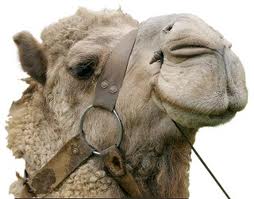
    There is a cute illustration often used to describe "creep," and it goes like this. Anyone who has ever spent any time around animals knows they are filthy. Camels, famously, are some of the nastiest and filthiest of all. Traveling in caravans across the sub-Saharan deserts for centuries, traders would tie up their camels a distance far enough from their tent to prevent the camels from trying to get in. Nobody, no matter how dependent upon his camel for survival and transportation, would choose to lodge alongside his camel within the warmth and comfort of his tent. The camels, however, resisted this fact. No matter how unwanted they were within the confines of their owner's tent, they still desired to partake in a little of that luxury themselves. They would start their attempt by pushing only their nose under the tent flap. If this went successfully unnoticed, they would slide the full length of their head in. Gradually, little by little, they would stick their whole neck inside, and finally their whole body. Suddenly, it would seem, the whole animal would be smugly inside the tent enjoying the shelter from the elements, entirely crowding out the tent's rightful owner. Government can be seen to act in the same way. "It's just a temporary expedient until the crisis is abated," they say, sliding their nose under the flap. "Just a little while longer and we'll have this problem licked," they say, sliding in their entire head and neck. And on it goes. As President Reagan said, "There is nothing quite so permanent as a temporary government program."  

    The strangest fact, however, is that so many people seem intent on actually helping the camel sneak into the tent! But a little thought is all that's required to explain this strange situation: they don't want a camel in their own tent, they only want to help one get into yours! However, if they really have bought so far into the blind dribble of our day to actually think they want a camel in their own tent, then, well, I suppose they deserve the flea bites they'll receive. 


  • In my crazy teenage years I became consumed by a magnificent obsession. It was on my mind in the morning, afternoon, evening, and night. As my tee shirt at the time said: I ate, drank, slept, walked, talked, breathed, and lived motorcycles; specifically, motocross.

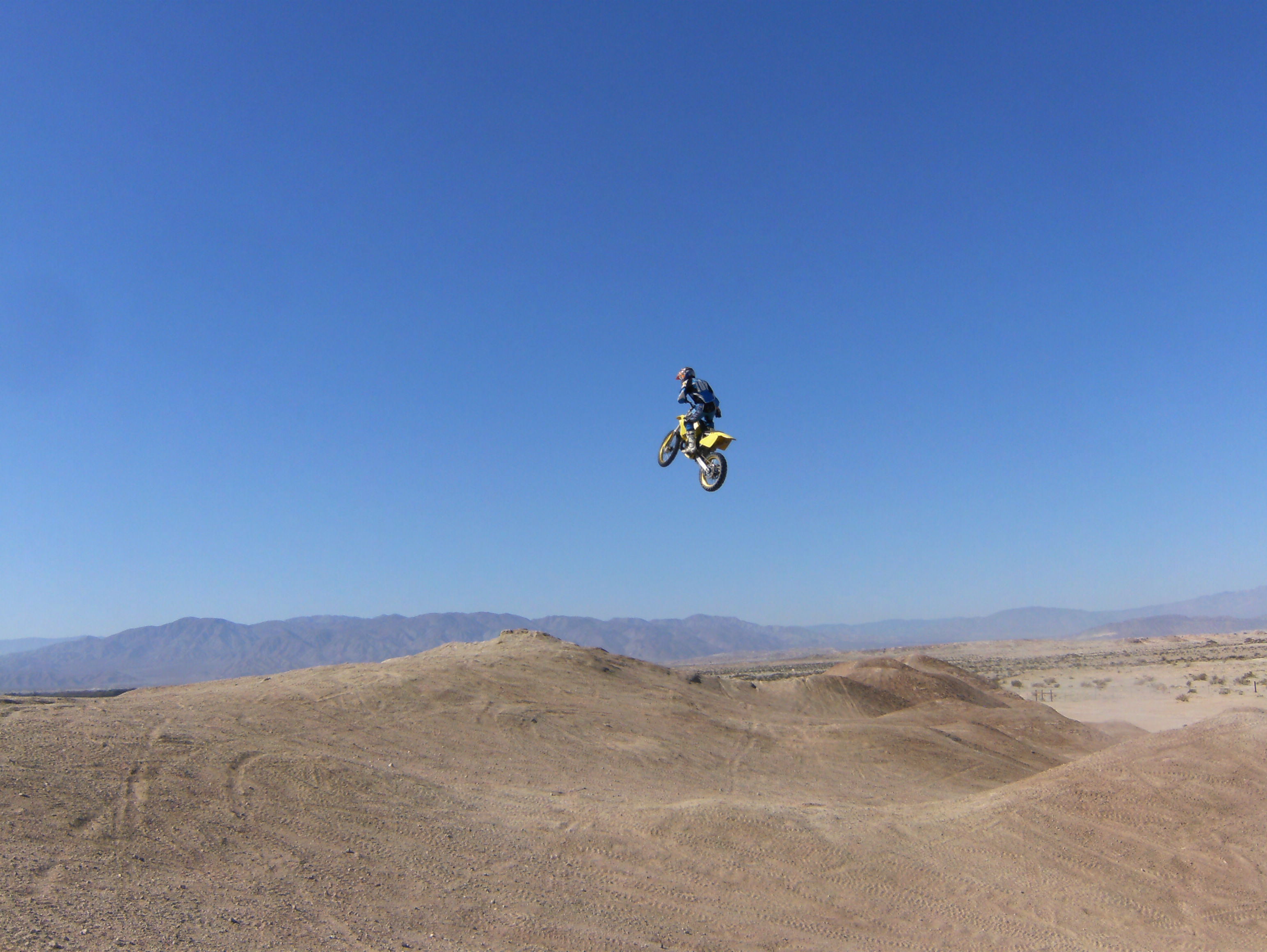
    1.31.2009-026 This was a little before the X-game craze; back when riding a motocross bike meant speed around a track more than tricks in the air. Still, the obstacles of a typical course were challenging and required all sorts of aerial maneuvers for effective racing. Chief among these was something called the Double Jump (and its cousin the Triple Jump, operating in much the same way).

    The concept is simple. Two jumps are placed a significant distance apart. The fastest way to negotiate that part of the track is to hit the first jump and clear the second one, ideally landing on its downslope. This is called "Doubling." Wherever a double jump existed on a track, to be among the fastest riders and therefore have a chance of claiming the trophy, bragging rights, and adoration of "pit tootsies," one had to Double. To hit both jumps individually was slow and downright embarrassing. There is nothing like having all the endorphins in motion a teenager can muster while controlling a highly tuned racing machine only to have another such teenager fly past you in the air. The thought of it can still keep me awake at night. Besides, doubling meant flying much higher and farther through the air, and heck, that was worth it all by itself.

    So we (my buddies and I) had to learn to double. We literally dug into the project. Every day after school we'd grab our shovels and head out to our make-shift practice track behind the Johnson's house across the street from my own. Spade-full after spade-full we'd hurl, until eventually we had constructed a pretty fair replica of what we were seeing on the official tracks on the weekends.

    And of course, we all raced to be the first to try it out.

    Everything is different the first time one approaches a double jump. It's the same terrain leading up to it, but the whole time the rider is aware of the challenge on the horizon. Somewhere in the far reaches of your mind the task ahead looms largely like a heavy cloud over the rest of the track. It doesn't help that your buddies are usually watching, too, ready to laugh, point, jibe, or call an ambulance, in whatever combination they feel appropriate. Finally, the jump is just around the next corner. You fumble your way through it, making the worst turn through that section ever. The nerves are building. The tingle in your throat is there. Your heart is beating hard in your chest. Your breathing slows into shallow little flutters. And then you reach it; the point of no return. It's that moment when you either goose the throttle all the way in total commitment or wimp out and back off, desperately searching for a plausible excuse for your cowardice. It's in that moment when you find out what you're made of, when you learn if you've got what it takes to push yourself beyond the limit, when you discover if you have courage. Your boldness (or lack thereof) is now public, your lunacy confirmed or denied. And usually, you clear the thing by twenty feet! 

    "That wasn't so bad!" is the normal response. The hardest part was truly deciding to do it; to wick that throttle all the way at that critical moment of no return and hang on for dear life.

    Following a successful jump, one is then qualified to 'encourage' the others to do it, too, with helpful rejoinders such as "Come on, you sissies, it was nothing!" 

    Sometimes, however, the story goes a little differently. In the moment where it counts, where there is no turning back, where one must fully commit to jumping the double, some hesitate, back off, or chicken out. Usually this occurs when it is officially too late to turn back, when one's speed is too high to safely hit each jump individually but not high enough to actually clear the second one. The result is not pretty. The term for it is "casing" the second jump. Normally, when a rider reduces throttle suddenly in a panic and hits the first jump, the back of the motorcycle rises up menacingly while the front sinks like a stone. This combination, while hurling through the air at the face of the second jump, is enough to scare anyone out of their wits. It is also enough to cause serious bodily harm. Look through any collection of YouTube videos of this event to see what I mean. It is calamitous, and it was entirely caused by the hesitation of the rider. In most cases, if he (or she) had just stayed with their commitment to clear the double and not backed off or hesitated, they would have been fine. But logic is a little chicken when fear comes around.

    This little lesson in motocross dynamics is more than just a stroll down memory lane, it's a metaphor for life. As we live out our days, we will be confronted with many figurative Double Jumps. What had been normal before will be changed by some event or opportunity on the horizon. Mustering the boldness, courage, fortitude and guts to hurl ourselves over the obstacle will usually result in all sorts of rewards and self-satisfaction. Failing to handle it so well will likely result in damage, loss, and regret. The result is up to us. And usually, it all comes down to our response in that one small moment of decision.

    Will we have the guts to do the right thing? To stand our ground? To accelerate when most sane people would say to slow down? To push for great when good is so enticing? To serve others even when it hurts? To try our hardest when others are loafing? To push through the fears at the edge of our comfort zone and go into new territory? To force ourselves to fly higher and farther than ever before? To face up to ourselves in ways that show us what we're truly made of? To find out if we've got what it takes? To learn once and for all if we have courage or are a coward?

    Perhaps most people don't want to face up to these hard moments in life. Perhaps they don't really want to learn what's inside because they think they might not like what they'll see. That's understandable. But just like that bunch of Michigan teenagers in a vacant field in the ninteen-eighties, you won't know until you try. And I personally believe that you'll like the feeling of pushing past your comfort zone and confronting your fears, even if you crash and burn a few times. Eventually, with enough attempts, with enough bold decisions in the face of fear, you'll discover just how far and how high you can fly. Prepare to surprise yourself!


  • Poison1 I receive many emails covering a broad range of topics almost every day. Many deserve no more than a few second glance or a quick chuckle. Every now and then, however, I'll come across something that stops me in my tracks. This happened recently. Someone had sent me a video clip to watch and I got caught up looking through the viewer comments. Something someone had written there was so stupid, so uninformed, and ultimately, so dangerous, that I have not been able to stop thinking about it.

    What was the topic?

    A "movement" to create a "more fair system" utilizing "proper resource management." At least, those are some of the words this person used to advertise, with excitement, I might add, the concept of Communism by a different name. What bothered me almost as much as this person's naive passion was the almost fearful way people responded to her. It is as if we are not allowed to be candid about things any more. When a snake crawls into our living room we are not allowed to yell "snake"and throw it back outside. Instead, we have to tip-toe around issues, giving everyone ridiculous respect for every idea because our world has become so saturated with "tolerance." As long as you are sincere about your idea it doesn't matter if it is utterly ridiculous, dangerous, and just plain stupid.

    Finally, some of the commenters apparently got as sick of the nonsense as I did. One in particular had lived under a Communist regime himself for decades and brought some actual first-hand experience with a "more fair system" to the discussion, detailing the oppression of the many by the few that Communism always brings. In my Rascal book, I review many stories of people who risked their lives to escape from these types of "more fair" regimes rather than stay behind barbed wire fences to enjoy the benefits of "proper resource management." But idealists are not friends with facts, they prefer fantasies. The young lady continued to babble about her movement and how it was assured to make the world better.

    I am not going to link to the specific article because it is only a representation of a larger issue and can be found in a thousand different places. The question I'd like to pose is this: Why is freedom so hard to appreciate? Why do people who live in a free environment hatch themes and schemes that will ruin their freedom and lead to suffering, oppression, and injustice? Why do they ignore the lessons of history which clearly show what every single one of these "more fair systems" of "better resource management" lead to?

    Here is a second group of questions to consider: Why do people who cling to murderous philosophies think they are the most informed, enlightened, intelligent and compassionate? Why does blind ignorance pass for being visionary? Why is "oppressive" marketed as "progressive?"

    Treat people with respect. Keep an open mind and consider their opinions and thoughts. But in the end, poison should not be allowed to sit in the food pantry as though it is as nourishing as the other items on the shelves. Label it for what it is: Dangerous. Think critically about everything you hear and read. Allow no philosophies to pass into normalcy without a fight in the arena of logic, reason, and the lessons of history. And through it all, remain a Rascal. Freedom has only ever been won, defended, and preserved by people too strong to be fooled by dogma, led by charlatans, and duped by movements.  


  • IMG_1939 "He is lucky," they say. "Had some good breaks," say others. "Yup, knew the right people." "Plus, he was at the right place at the right time." These are the excuses people make vocally about others who've succeeded. Worse, these are the thought processes people uncritically buy into when confronted with the high achievement of others. As they say, the worst excuse is the one you sell your self.

    Why is it that we are so quick to explain away extraordinary accomplishments? Why is our knee-jerk reaction to downplay peak performance as a quirk or bestowment reserved for the precious few? Perhaps we've learned incorrectly how things work. Maybe we haven't been properly educated in the game of success. It's possible we haven't thought through our assumptions deeply enough. Most likely, however, these incorrect responses to high achievement are rooted in the fact that the performance of others makes our own pale in comparison. We reach for an explanation that takes the pressure off ourselves and find one readily at hand in the popular culture around us. Mediocrity is worshipped, decadence masquerades as creativity, and lazy is the new cool. People who strive for high achievement and excellence are freaks or sell-outs.

    Truth, however, is a pesky thing. It doesn't seem to give way to fads, laziness, popular culture, excuses, anger, or false doctrines. It stands tall through it all. And the truth about high achievement and success is that it occurs on purpose, by design, through the tremendous commitment and persistence of individuals who have chosen the harder path. In other words: high achievement is earned.

    This is bad news for someone searching for an excuse or wanting to explain away their own lack of success. On the contrary, however, it should be liberating for the person who has a big dream! The formula is available to anyone, and here it is:

    Hard Work  X  Smart Work (Practice)  X  Time   =   High Achievement and Significance 

    Notice that this equation has almost nothing to say about talent, connections, or breaks. These things may lend a hand regarding starting points, but have virtually nothing to do with finishing at the peak.

    The first component, hard work, is an unavoidable component in success. It simply cannot be avoided or bypassed. The hard truth is that if one wants significant results, significant effort will be required. Curiously, however, this one isn't so hard for people to stomach. Everyone seems to know hard work is a big part of success. What gets missed is that working hard is not the end in and of itself; it must be paired with smart work. This is effort expended toward intentional and painstaking improvement. It is not easy, rarely fun, and isn't productive until mixed with the final component of time. Time is the great amplifier. It takes inputs and multiplies them into something seemingly greater than the sum of the parts. Intentional, improvement-oriented actions compound over time. Conversely, bad choices also compound over time. What one does in the little moments show up in big outcomes over time.

    These three components explain the greatest achievements of mankind. They are the tools of the mature, reserved for individuals committed to maximizing their gifts and making a difference in this world. They are best utilized by an adherence to the principles of excellence in thought and deed.

    So now we have come full circle. Excellence results from excellence. Excellent outcomes come from excellent inputs. Excellence in practice, preparation, commitment, effort, attitude, relationships, goal setting, execution, measurement, analysis, improvement, and persistence produces excellence in results. 

    Are you dreaming of excellent outcomes in your life, career, business, marriage, home, church, or art? Then do the hard work of adhering to the principles of excellence in everything you do. Raise your standards. Make excellence the cornerstone of the life you are constructing. Put it at the center of your personal culture. And don't worry about the competition. If you truly focus upon excellence, there won't be much competition.

  • I was recently notified that this blog was selected as a Top Leadership Blog for Online Masters Degree Programs. Considering the quality and content of the other represented blogs, this is quite an honor. I would like to sincerely thank the folks at Online Masters Degree Programs for this award, and hope to continue producing content that proves useful for their readers.

    Thanks! 

  • 250px-KetteringUniversityLogo When I was seventeen years old I made a decision that would have a lasting impact on my life.  I chose a college to attend.

    Growing up, I can remember always having a big, green plastic dog bank standing in the corner of my bedroom. In black felt-tip marker my mother had written on it the word "college." For years my extra change went into that doggy. Of course, by the time it came to actually tallying up the money and applying it to my education, the total collected was paltry compared to what was required (the cost of a formal education being fodder for my grist mill in a later post, perhaps). However, the programming had taken root. I was determined to go to college and become a success (at the time I had the two indubitably connected).

    At the dinner table one evening my parents laid it out for me. They were proud of me and my good grades in high school, and they wanted to encourage me to go to college. They would help me all they could, but they really didn't have the money available to facilitate me going out of state or to anywhere fancy. They suggested I look around town, and if I could find something, I was welcome to keep living with them.

    Growing up in Flint, Michigan doesn't necessarily put one in the proximity to the world's top universities. But there was one that, to me at least, was world class: GMI Engineering & Management Institute (today's Kettering University). I knew it was world class because the neighbor kid had gone there and he was rich as a result. After all, he had his own S10 pickup truck and a brand new wind surfer.

    So I made a ten minute visit there with my father. It was the only school I visited and the only one to which I applied. The program was attractive to a kid like me without any finances because it offered a co-op experience in which every other twelve weeks were spent in the workplace somewhere out in actual industry. In those days there were still car plants all over the Flint area, so this arrangement worked out great. I could go to work and earn money to pay for school, all the while living at home and saving a bundle. 

    I received hard-core, intense, and thorough technical training at GMI, and obtained my Bachelor's of Science in Mechanical Engineering. I learned that I could work hard and succeed as a result. I learned how to study and fell in love with learning. I also made friendships and connections which are still with me today. The most significant turned out to be a young man whom I met on the first day of an orientation at our co-op employer's office in May of 1985: Orrin Woodward. The fact that we would someday become friends, business partners, and co-authors was in no way apparent in those early days.

    Recently, Orrin Woodward and I were honored by the Kettering University Alumni Association and jointly given the Entrepreneurial Achievement Award.  For this we are greatly appreciative. It has brought back many fond memories which have receded into the past way too quickly. I will forever be grateful for the experiences and knowledge I gained during those years. To the folks at Kettering University I offer a hearty thank you. As to my mother and that green dog, well, I suppose a thanks is also in order!

  •     A mob of people is one of the most dangerous and heartless entities on earth.  Conversely, a team of highly functioning and productive people is one of the most heart-warming and inspirational. The difference is leadership. 

        Few things have ever been accomplished by the lone striver. People must combine into productive groups and each contribute their best to a team effort for real accomplishments to occur. In this way, the whole far exceeds the sum of the parts. Participating on such a team can be one of the most liberating, exhilarating experiences in life. Productive teams are not only fun to be a part of, they are also responsible for just about everything in our civilization, from technological advancements to architectural wonders to sports dynasties.

        The highest functioning teams are aligned in common purpose, for a noble cause, and work respectfully and trustingly together. They are more concerned about the glory of the team than they are about personal accolades. They take care of each other and push each other to higher contribution, in an "iron sharpening iron" way. Peer pressure becomes a positive and heights are reached collectively that would be beyond the ability of any individual.

        Great people are required for great teams. But there is something more. Many times the most "talented" groups do not perform as predicted. Leadership is required to form and lead teams to higher and higher achievement, and it is this leadership that makes all the difference.  

        Leading teams to excellence requires intentionality and hard work, consistently applied, over time. It requires the leader to clearly and continually develop group themes to which everyone ascribes. It requires vision and consistency, fostering of harmony and trust, confronting issues that threaten the cohesion of the team, and a nourishment of the belief that what the team sets out to do it in fact can do.

        As the old saying goes, "Put two idiots in a room with an expert and after a period of time three idiots will emerge." So it is with teams. Even the most talented groups of people can become corrupted and callous if left untended, without true leadership and guidance administered on a regular basis. Leadership is the force that prevents the mob tendencies of any group of people and instead channels those energies into productive alignment. And this leadership can come from any and all levels. Just because one isn't the titular head of an organization of people doesn't mean he or she cannot lead. Any position is in touch with other parts of the team and therefore exerts a certain amount of influence on the rest. A strong leadership example of the right things always has its effect. So lead mightily from whatever position in which you find yourself, and contribute to the smooth functioning of your team. Without it you can expect mob-like behavior. With it, you can expect the absolute best. The choice is yours.