Welcome to
Chris Brady’s
Blog

“The only way to be happy, is to give happy.”

  • IMG_1693  People matter, it goes without saying.  But there is something special about
    getting to know someone, learning their background, building a bond.


    Architecture strikes me the same way.  When I see an interesting building,
    normally the old kind, I can’t help wanting to know the history behind the
    arches, the decisions behind the layout, and the reason for its site selection.


    At La Contea
    (meaning, ‘The Countryside’), our villa perched high on the side of a Tuscan
    hill quite near the Umbrian border, we had the collision of both.  To me, the building was
    fascinating.  It was all stone and
    concrete and tile, with big, wooden shutters that were extremely functional for
    blocking out the scorching mid-day sun and preserving some semblance of cool
    inside for the night’s sleeping (I say some
    semblance).  It was situated on
    terraces carved into the hillside, amidst an active olive grove, with a
    panoramic view of the valley below, including Lake Trasimeno in the
    distance.  Its design was extremely
    effective and infinitely clever. 
    Someone had sunk hours of thought into this place.


    That someone is Giulio Marcelli, the owner and current
    operator of the property.  He
    speaks not a lick of English (though he asked us the English word for ‘fire’
    and ‘wood’ once), but this fact didn’t stop him from conversing with us in
    Italian.  When he and his assistant
    Daniele would come around in the mornings to make sure everything was molto benne, there would always be some
    interesting interaction, some incredibly confusing conversation for which we
    might pick up half.


    As the weeks went by, we learned more and more of this
    gentle septuagenarian and his background. 
    He and his wife had lovingly designed and built La Contea as a working olive grove in 1980, and perched it on the
    site of some old ruins, the type of which we could never discern.  Then she died of a debilitating
    muscular disease years ago, the elevator in the far end of the house then going
    into disuse.  He moved out of the
    place five years ago, turning it into a rental property where tourists thirsty
    for immersion in the joys and mysteries of old Toscana could base themselves;
    even a gang of six from America. 
    Giulio gave us olive oil fresh from his property, and shipped us a bunch
    more.  He kept our pool immaculate
    with loving care every morning before we were awake.  And perhaps best of all, he told me about a motorcycle trail
    that followed the ridge on the mountain behind us all the way to Tuoro, where
    the Roman Flaminus and his 16,000 were slaughtered by Hannibal and his Carthaginians
    a couple millennium ago.


    About to leave on the last day, one of our children pointed
    to the many trophies on display on the high shelves of the library.  Giulio explained that they were his
    son’s, a motocross racer of some renown, who was “always on his motorcycle all
    the time.” That is, until he succumbed to the same disease that had taken his
    mother.  When we asked how long ago
    that had occurred, Giulio looked down at the ground forlornly and held up one
    finger: a single year ago. 


    Daniele is sweet and has smiling eyes.  She showed up to greet us the first day
    dressed in a white summer dress that was as bright as her attitude.  She and Terri just kind of clicked
    right from the beginning.  It was
    good that Terri’s Spanish familiarity helped her with the puzzle of deciphering
    L’Italiano, because like Giulio, Daniele speaks absolutely no English. But she
    has the rather cute tendency to keep repeating Italian words and phrases, dead
    certain that with enough repetition, we’ll come to understand it.  Daniele and Terri would somehow have
    whole conversations that just left me baffled.  Occasionally, though, I could decipher a word or two Terri
    couldn’t smoke.  Glad to be of
    help. 


    As we said our goodbyes and arrivedercies on the last
    morning, Giulio gave me the customary double kiss and waved a hearty buon
    viaggi.  Daniele hugged us all,
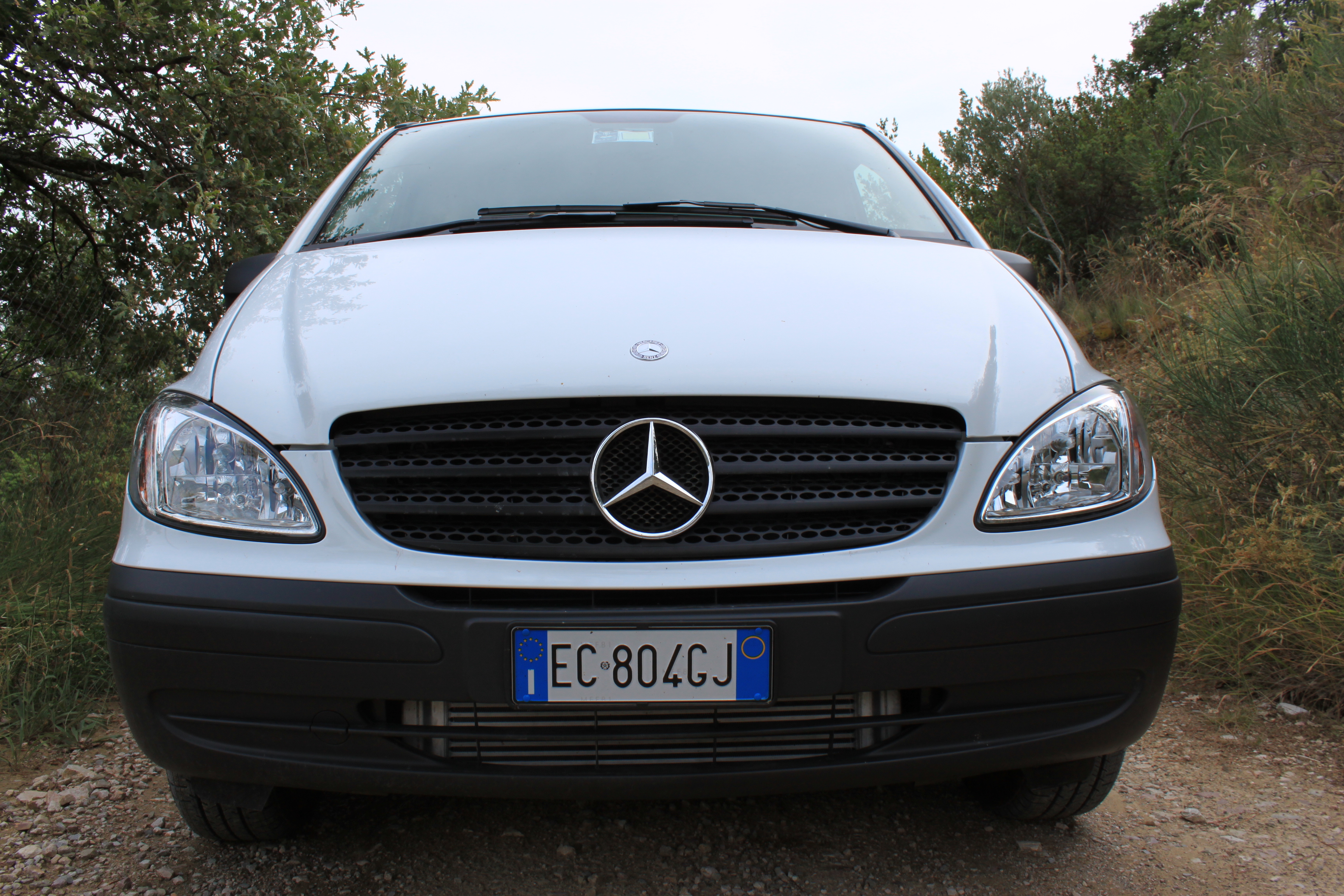
    complimenting the behavior of our children.  The clunky white mini-bus ambled up the bumpy gravel drive
    one last time.  Tuscany and all
    that we experienced here was now transitioning into memories. 


    “I love people,”
    Terri said after a kilometer or two.


    We rode along in silence.  There was nothing to add.  With three words Terri had summed up why it was bearable to
    leave this place we’ve grown to love so much.  We were heading home; to buildings yes, even of our own
    design.  But more importantly, to
    the people we love and miss.     
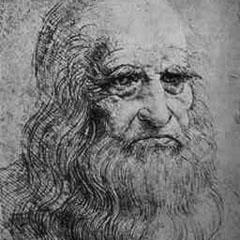
  • Davinci  It at first seems odd that Leonardo da Vinci is so revered
    today. None of his sculptured works have survived, and only around a grand
    total of fifteen of his paintings are known. Although he wrote a lot about
    architecture, no buildings anywhere are credited to his name. Dispassionate
    scientists have long debated the originality of his many inventions found only
    in his sketchbooks – little evidence exists that he ever actually built or tested
    any of these ideas.


    Yet Leonardo is heralded as a universal genius, the ideal of
    the Renaissance in which artists were not only proficient but expected to be
    masters in many fields. He is shrouded in mystery and myth, movies and books
    being written about his sensational secret codes, mischievous messages, and
    secret handwriting (which was actually just backwards).


    As with most post-modern heroes, however, closer inspection
    reveals a somewhat smaller man. Although unarguably monumentally talented, Leonardo
    suffered from what art historian Ken Clark called his “constitutional
    dilatoriness.” Pope Leo X said, “Alas! This man will never do anything!”
    Leonardo often accepted commissions for works he never finished, in many cases,
    works he never even began. Of the paintings we know of, such as the Mona Lisa,
    he worked on them off and on for years, most experts agreeing that the art
    itself shows the weaknesses of such a lackadaisical methodology. Perhaps
    authors D’Epiro and Pinkowish asked it best: “Why did the man who was arguably
    the greatest painter who ever lived dissipate his energies, often quite
    carelessly, among so many other fields?”


    Let’s address his current mass media popularity first: In
    our post-modern times, which seek any source of credibility against God and
    ultimate truth, Leonardo is a ready poster child for the Godless – possessing
    abundant talent and shrouded in sufficient mystery to speculate about alternate
    truths. In short, from a world-view that disdains accomplishment and merit (what
    one accomplishes and earns) and instead focuses upon position and power and
    prestige (who one is and who one knows), heroes are made out of those who seem
    to succeed despite the rules of effort, contribution, and earning it. Leonardo
    didn’t have to accomplish much (in proportion to his gargantuan talent, that is) to be revered by those who don’t really want to
    accomplish much themselves. 
    Additionally, his atheism is seen as reassurance, as if
    to say, “If the great man didn’t believe, then I can make myself great by being
    a disbeliever too.”


    But all that is really beside the point. There is absolutely
    no denying the fact that Leonardo da Vinci was an extremely gifted man, one of
    the towering giants of the Renaissance. The question that carries the most
    meaning for those of us on our own journeys of life accomplishment is “Why so
    little output?” I am reminded of the Stephen King quote concerning the author
    of Gone With the Wind: “Why didn’t she ever write another book?”


    Success is the product of many components, of which one of the
    most prominent is focus. We can do many things in our lives, but we can’t do
    everything. We can have wide interests, and to a certain extent that is good
    and healthy, but we shouldn’t dissipate our true well of talent on too many endeavors. If genius like that of a Leonardo is wasted by too broad a stroke, then
    what happens to those of us who are less well endowed?  As Leonardo himself wrote, “As a kingdom
    divided against itself cannot stand, so every mind divided among different
    studies is confused and weakened.”


    I would posit that the less talented we are, the more
    focused we must be. Even the least talented can accomplish grandiose achievements if
    applying themelves ferociously, consistently, and with enough focus over time. In fact, it
    seems that often the greatest accomplishments go to those who actually aren’t
    all that talented, but retain just this one last shred of talent: the ability
    to focus intensely and over the long term.


    Sadly, we will never know what wonders of painted
    masterpieces Leonardo may have produced for the enjoyment of the world. He
    spent too much of his time elsewhere, on areas other than his gifting. While in
    many cases he was still better in these areas than most of the rest of us, the
    loss still stings. One is left wanting more, but time answers back a heartless
    “too late.” This brings us to the saddest consideration of the squandered gifts
    of life: What could have been?


    Do not squander what you’ve been given, no matter how much or little, rather, harness it,
    develop it, hone it, and focus it, bring it to bear on a daily basis and letting the world see what you were given. It is a duty to return our gifts of talent
    totally spent and depleted in worthy use. Or, if not, one may join the great
    Leonardo da Vinci himself, who wrote toward the end of his life, “Di mi se mai
    fu fatta alcuna cosa (Tell me if anything was ever done.)”


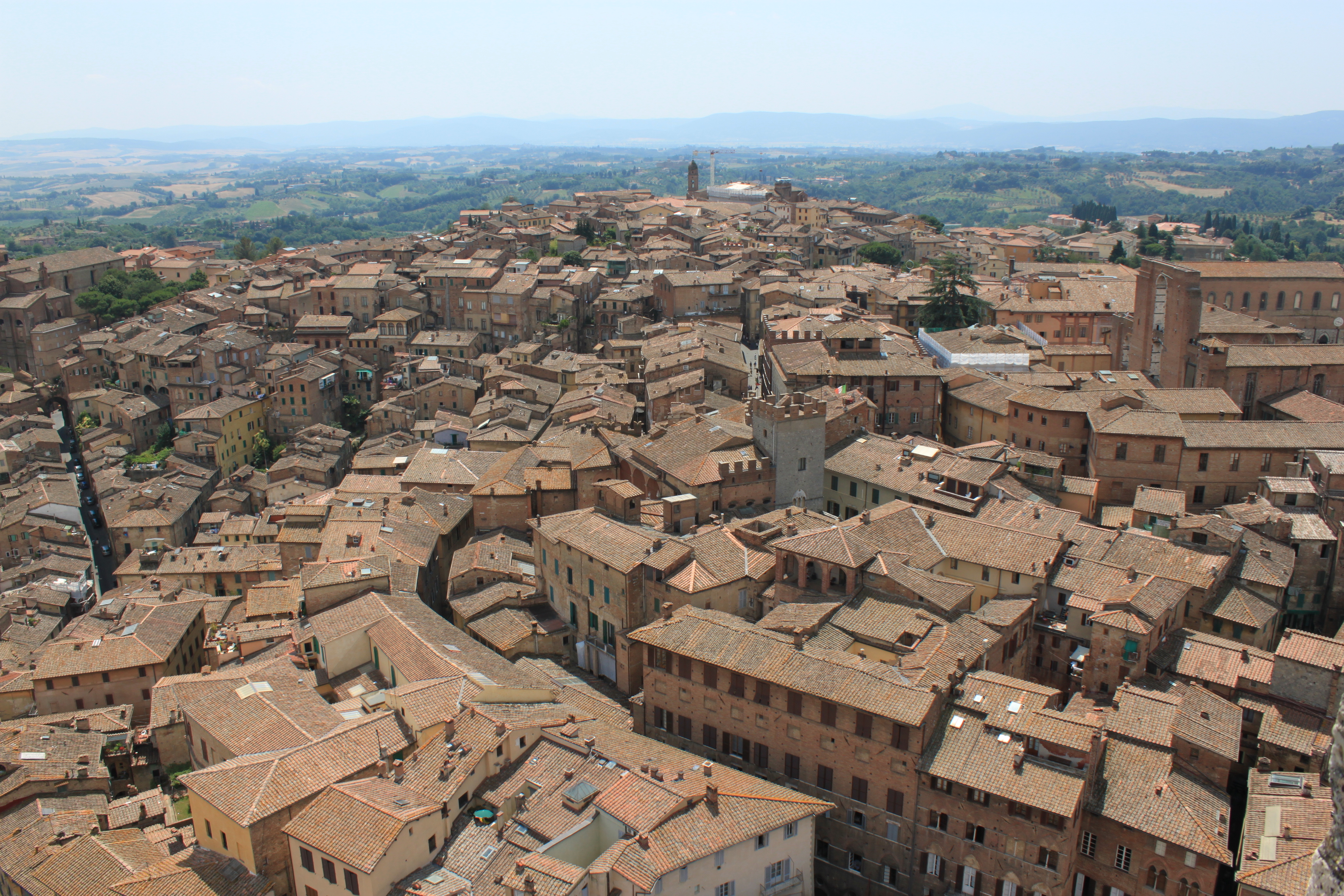
  • Siena is an old city. The world-famous Palio horse race held
    in the large central square, Piazza del Campo, officially dates back to 1283,
    though many think its origins go back to Roman military training.

    IMG_1437   

    One can learn many things in Siena, like the fact that its
    main bell tower, Torre del Mangia, is named after the lazy bell-ringer who was
    “eating” up the profits, or that you can’t just drive your clunky mini-bus
    smack dab into the city center.


    It’s hard to believe the amount of adventure one can have
    with a mini-bus in Italy. In fact, I’ve grown so fond of mine that I’m trying
    to figure out how to buy it and have it shipped back to the states.  The darn thing is practically a magic
    carpet, going anywhere and everywhere as though it weren’t a hundred feet long
    and fourteen wide.


    These old medieval towns throughout Tuscany, many having
    origins predating the Roman era, are built atop hills. You can see their old
    buildings jutting up into the sky from miles away, crowded inside a city wall.
    The hot setup for a tourist is to drive to a parking area just outside the city
    walls, then walk inside for peaceful sightseeing, largely free from cars and
    traffic.


    Until the Bradys come along. Upon arriving in Siena I
    thought I saw a sign for parking just beyond the arched entry. Sure enough,
    there were at least four ample parking spaces provided, which were filled by
    seventy-six midget cars. The GPS confidently led me onward and I confidently
    complied. The roads got narrower and narrower and the crowds of people thicker
    and thicker. Those pesky pedestrians were really clogging up our path and making
    it hard to get through. But the mini-bus was having a powerful effect on those
    folks, parting them like the Red Sea. At one point while we were annoyingly at
    a standstill, a couple of nice ladies attempted to explain something to me.
    With my ever-increasing ability to speak and understand Italian, I got the
    following out of what they were saying: “You idiot.”

     
    IMG_1486  

    Being the experienced world travelers we are came in
    extremely handy at this moment. Terri and the kids jumped out and we made
    arrangements to meet up in the main city square. This was possible because I
    very skillfully kept the conversation going with the vigilante ladies long
    enough to buy time for Terri and the kids to make their escape. Things were
    working out swimmingly. As my five and six year old can only handle so many
    steps taken in the name of tourism, and since their appreciation for Gothic
    architecture and the history of Tuscany’s artists hasn’t quite reached full
    maturity, conserving their travel distance is a great strategy for extending
    the potential time for touring. This latest maneuver of ours would shave off
    literally HALF of their required steps. It was going to be a great day.


    With all the helpful instruction I’d received, snaking my
    way out of town proved to be no problem at all.  Finding a parking space was a bit more challenging, but eventually
    I procured one in Minnesota.


    I have read about walking tours through Siena, and how
    serene and educational they can be. But for my money, I’d rather take the
    driving tour. Trust me, there’s nothing quite like Siena by car, or, um, mini-bus.


  • I learned it the hard way, really, by dragging bulky bags through crowded bus terminals, onto packed trains, and up stairs at a five-hundred year-old hotel. I will never forget slugging two huge suitcases through Narita station in Tokyo, stopping at a trash can and throwing a way a bunch of stuff to lighten my load.

    My wife and children have bought into this dogma unbelievably well, packing for a month in Italy and needing only one suitcase amongst the five of them! Running shoes and a miscount of pull-ups (we've got enough with us to make a raft and float back home across the Atlantic) took us up to a total of two. 

    Traveling light is not only a necessity for anyone wanting to do some serious traipsing around the globe, but it serves as a valid metaphor for life, as well. Let's face it, there are those who just cut a large swath through their life, traveling heavy and weighing things down. While there are others who seem to flit from episode to episode without exacting a heavy toll on those around them.

    Leadership is a lot like taking a trip. Leaders often go into unfamiliar territory, influencing others to follow them there. Leaders must provision themselves and their people for the journey. Leaders must be ready for and respond properly to the obstacles and challenges that inevitably come. The best leaders are the most agile, the most able to adjust and course-correct, the most rock-solid on commitment to a vision but the most flexible on the route. Leaders build trust and develop networks, alliances, and deep relationships. And of course, the best leaders have character and integrity.

    All of these can be seen as features of traveling light through life. Though leaders may carry heavy and often unfair burdens, they do so with grace and fidelity to a worthy cause, which means that they have to carry little else. Here are some areas to consider when seeking to increase your leadership ability by traveling light:

    1. Relationships – heavy is the burden of broken and un-repaired relationships. Light is the load of tight friendships, deep bonds, and heart-felt trust.

    2. Commitments – heavy is the burden of too many commitments or casual ones made without thought or conviction. Light is the load of commitments to God-given principles and worthy goals. While some of the heaviest loads of all are those made up of shards and splinters from commitments we've broken in life.

    3. Focus – heavy is the load for the leader who is unable to focus and prioritize accordingly. Light is the load of a leader who understands that almost anything can be accomplished if enough focus of energy, desire, concentration, talent, effort, perseverance, time, and toil is applied. You can accomplish almost anything you truly commit to, but you can't accomplish everything. You must choose, and then attack with everything you've got.

    4. Honor – heavy is the load of the person who cannot be trusted, breaks promises, fails to keep confidences, and cannot be relied upon. Such a person will find life getting tougher and tougher as the accumulation of those who know them for what they are grows. Worse than the accumulated opinion of those let down is the searing pain of a burned conscience within. Perhaps the heaviest load to carry is one of guilt and regret.

    5. Principles – heavy is the life that doesn't stand for anything except selfishness, self-aggrandizement, and personal glory. Light is the life given over to the glory of God, service to others, and the fight for good.

    The best of leaders are like the best of travelers; they travel light. Like the good traveler who takes nothing but pictures and leaves nothing but tracks, the best leaders take nothing but responsibility and leave nothing but love and example. Become the best leader you can be: travel light.


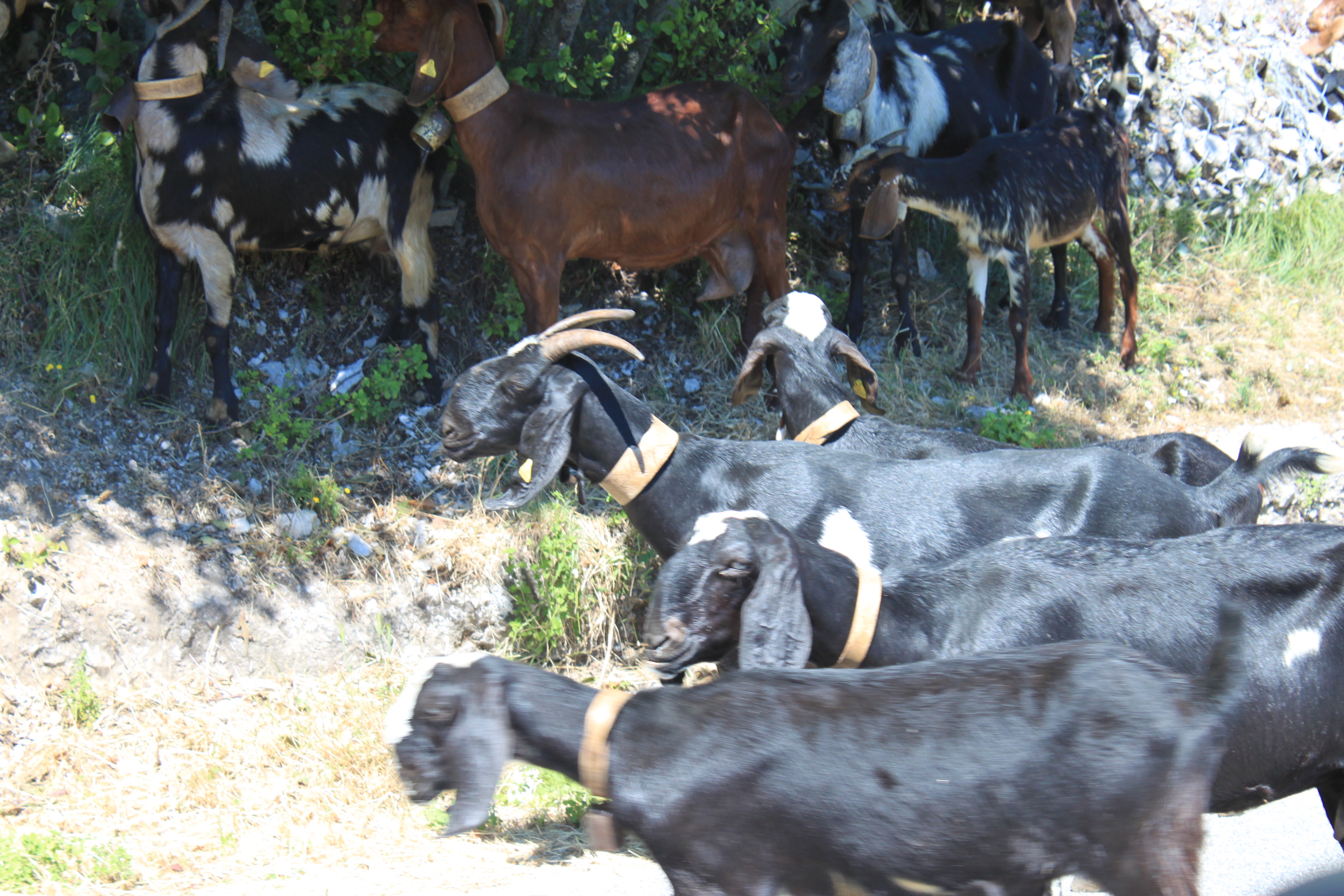
  • IMG_1079  I had what might be called a conversation with the steward of our cliffside villa, inquiring about the limited routes over or around the mountain range behind us and back over to Naples (Napoli). He spoke some English, he thought, and I some Italian, I think. It seems there are as many as three routes, though wrong turns are easy to make. No problem, I thought, we've got all day, and I've got my new GPS (purchased in Salerno as a replacement for the shattered one we brought with us). Well, the GPS was no help at all, as lost in the terrain as I was in the language. So we soldiered on bravely through the tight, winding, tight (did I mention tight?) mountain roads, feeling like mountain goats and passing a herd of actual ones along the way. All the while our GPS was telling us to "turn around when possible." It's request was laughable, given the dimensions of our clunky mini-bus and the (did I mention?) tight roadway. But we made it, finding the Autostrada and zipping along like natives (in my element once again). 

    IMG_1180  But then the exit was entirely nonexistent due to construction. Being the experienced world travelers we are, we simply took the next exit and navigated according to the sometimes visible bay of Naples in the distance, in combination with our ever-so-helpful GPS. What eventuated would be hard to depict without videographers, but it certainly would have made good comedy. Somehow, trusting our good ol' GPS, we found ourselves stuck at a tight (have I used that adjective before?) turn between buildings, parked cars, zipping scooters, pedestrians, a big delivery truck, and yep, shirts for sale on a portable display. I pulled in my mirrors, snuggled up as close as I could to a parked Smart car, the clothing rack was quickly removed, and the delivery truck passed. Then the GPS told us to turn right, but alas, the entire road (a complimentary term I now use to refer to anything as wide as a footpath that could at least be traversed by a soldier from the 10th Mountain Division) was nonexistent due to construction. I will never know exactly how we got our clunky mini-bus out of there, but am quite sure I violated a few laws of geometry along the way. 

    IMG_1179  By this point we disabled the GPS and went it alone. What could possibly happen without it? I guess we could get lost or something, or maybe even end up at the end of some tight (there's that word again) dead-end street with clothes for sale at the curb. We quickly found our own way back to the Autostrada, but unbelievably, the entrance too was totally nonexistent due to construction. These Neapolitans are serious about their road repair (we, for one, think they ought to widen them). Looping back around to the sound of the ever helpful voices from our children offering encouraging rejoinders such as, "Are we there yet?" and "I'm hungry" and "I have to go to the bathroom," we soldiered on. It was at that point Terri somehow spotted a sign for Ercolano, and almost immediately we were there. 

    That wasn't so bad. 

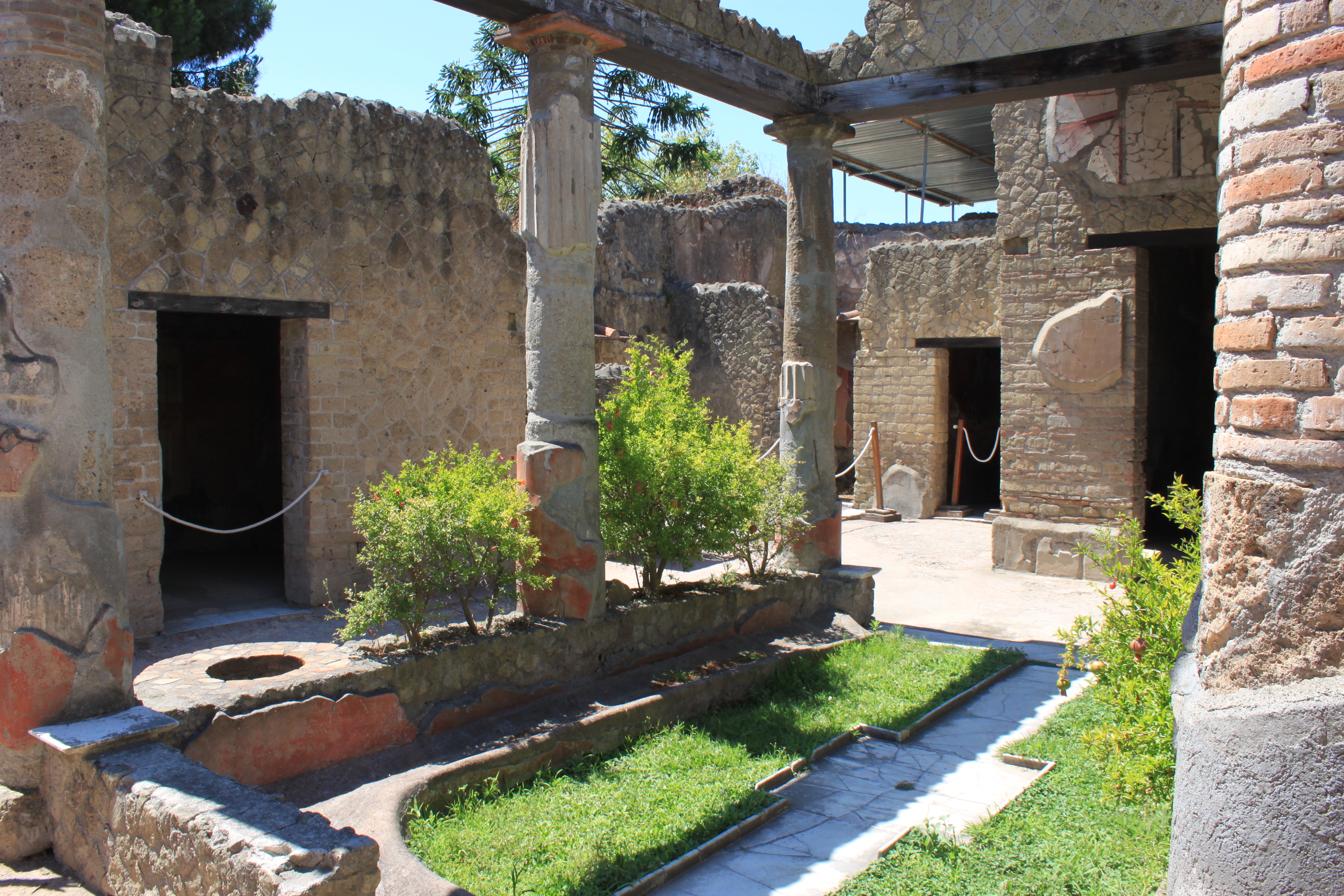
    Ercolano is the Italian name for the Roman city of Herculaneum, the thriving coastal town that was buried beneath the blast from Mount Vesuvius in 79 A.D. Because of the nature of how it was covered, the city beneath was captured in an instant and preserved as it was on that day.  

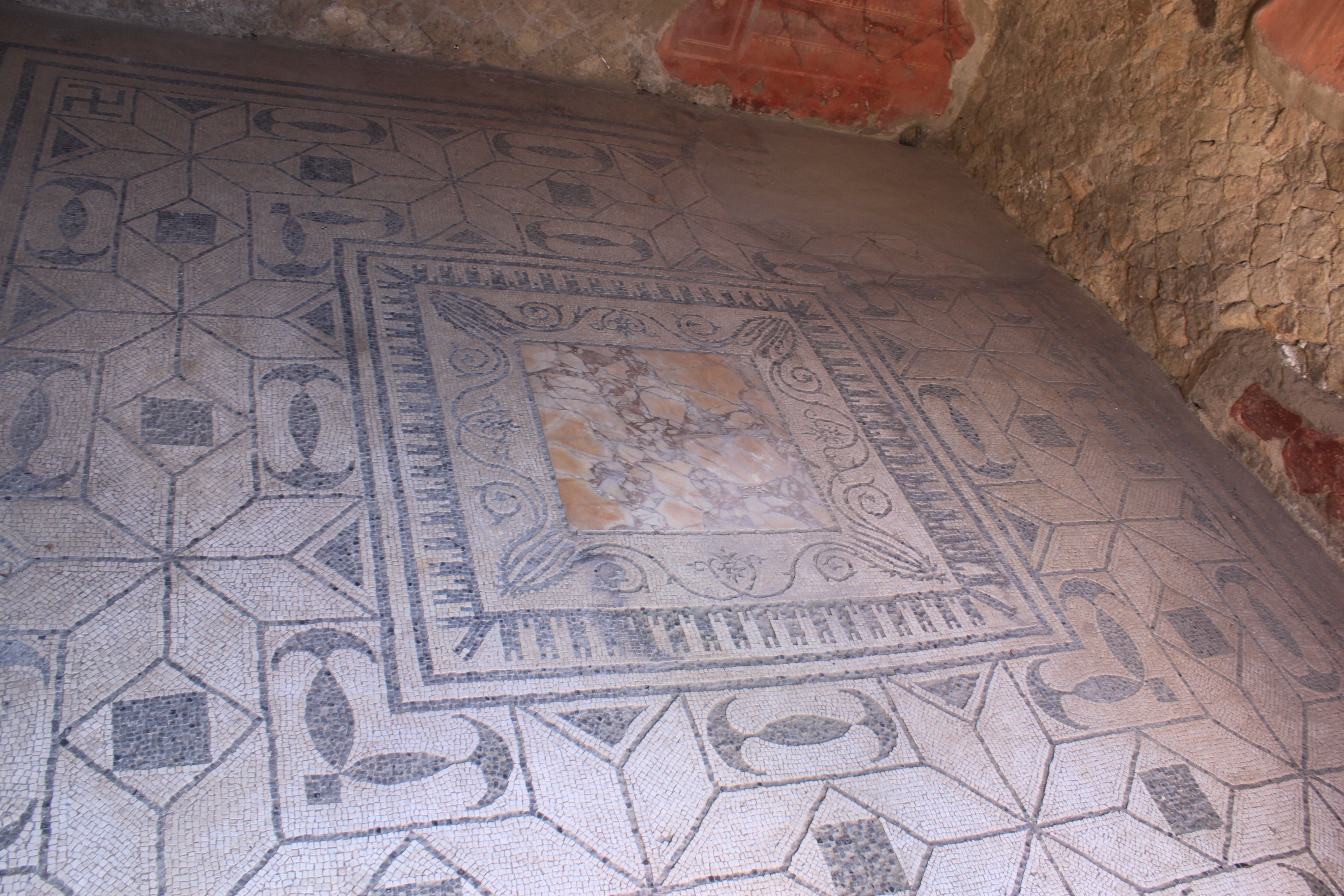
    Walking through the ancient city, which is even better preserved than the more famous Pompeii, hits the lover of history in many ways. Surprisingly, the first impact I felt was just how similar their life was to ours. Floor patterns of tile and stone were very much the same as we have today. Wall paintings and barreled ceilings felt familiar. Even much of the architecture was similar. Of course, part of the reason for this is the tremendous impact the Roman civilization had upon the known world at the time and the amazing lasting impression it continues to make upon artists, designers, and architects – meaning much of what I saw in its original form has been copied again and again right down to our very time. But still, there was something eerily familiar in the walking of their streets. They had taverns for lunches located on street corners, indoor latrines, second floor living quarters, shop fronts along the street level, boat niches at the wharf, monuments to their heroes in the town square, and of course, the richest homes were along the sea coast. I was not able to verify, however, if they sold shirts at the curb of their tightest streets. Much of these features (and many more) are nearly no different than any modern city. They even had lead pipes and, in some cases, hot water.  

    Now, cult worship temples and altars for sacrifice hit the modern tourist as not only unfamiliar but shockingly ancient. Class stratification and slavery evident in the many artifacts recovered still seem unbelievable to our modern sensibilities (though not as far removed nor obliterated as we would wish). So they were similar, but still different.

    I will leave the profound questions all this raises to the reader's consideration. I will also leave out the details of our return trip, which was much less eventful but still filled with "are we there yet," and "I'm thirsty." I can only wonder if the ancient Roman children were similarly impacted by the majesty of their own history lessons. 

  • IMG_0724  He and his family are occupying the space above ours in this
    unique, cliff-side perch above the Mediterranean. In a short conversation by
    the cliff platforms for sea diving, Alan made a simple yet profound statement.
    His words carry the weight of a man older than me in years and twenty visits to
    Italy or so more experienced. Alan said, “Italy is the best kept secret
    – an open air museum for the entire world.”


    Traveling through southern Italy in a clunky “mini-bus” that
    makes our family look like an advertisement for breeding, we have only just
    begun our journey of many weeks, but already have had our breath taken away by
    mountain vistas and calm seas, finding proof enough already of Alan’s
    observation. Sunlight bathes everything here, including ruins from Magna
    Grecia, the ancient Greek colony that once flourished throughout southern Italy.
    The three Doric temples stand in Poseidonia (the Greek name) or Paestum (the
    later Roman name) in stolid witness to the passage of time and the
    inevitability of change, while at the same time evoking the grandeur of art and
    architecture. If this sounds a bit fanciful, it’s because I can’t help getting
    arrested by the beauty of the mosaic of art, architecture, topography, and
    history in which we’ve emerged ourselves.


    Which is just as well, because I am certainly in no danger
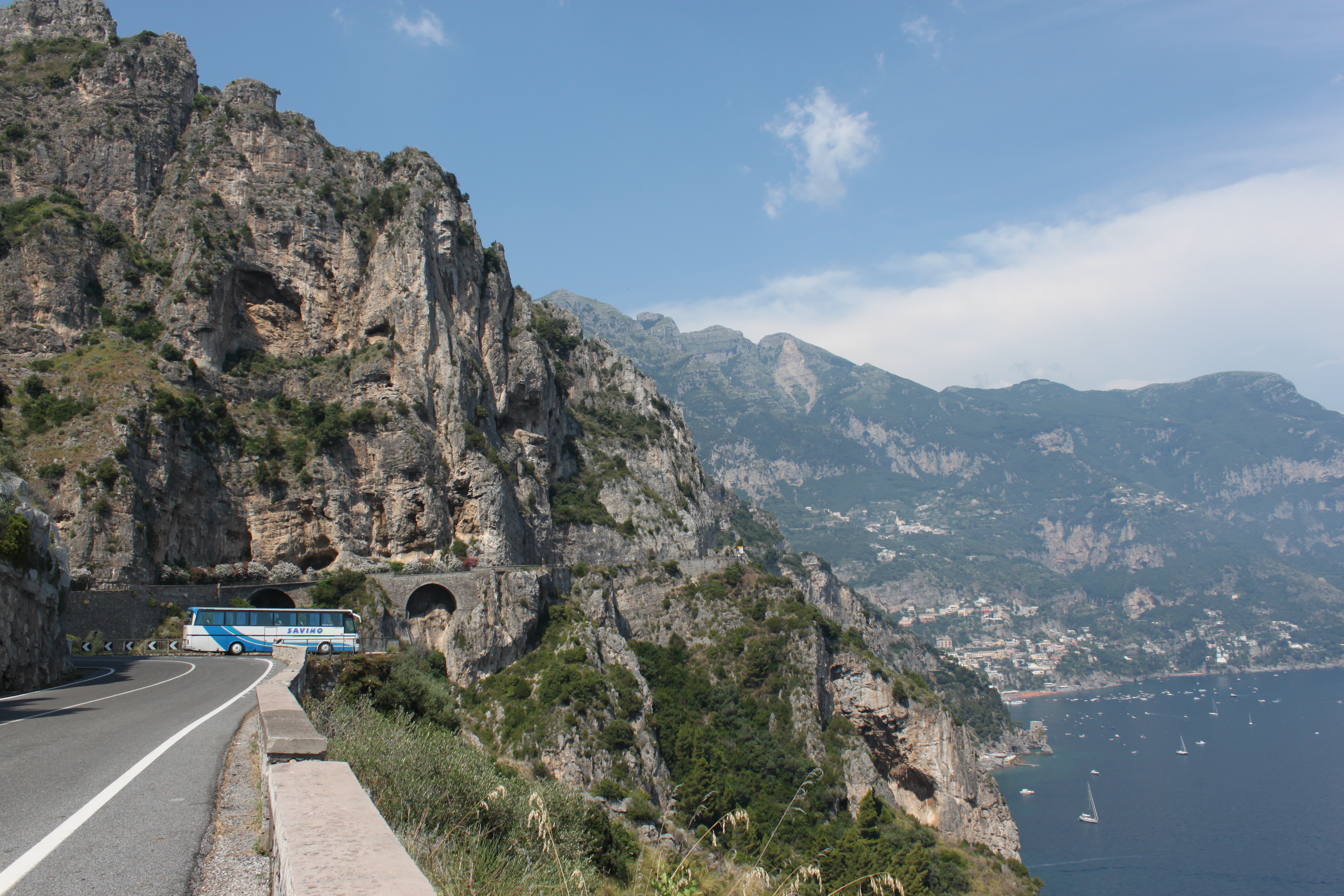
    of arrest for my driving. I am home among crazies here, driving the tight and
    unbelievably twisty Amalfi coastline in my clunky mini-bus (pronounced “mini-boos”,
    but made by Mercedes, nonetheless) and finding the kid in me rushing to the
    daredevil surface. If it weren’t for having the entire family on board, I’d be
    even more tempted than I am to split the miniscule gaps between bikers,
    scooters, motorcycles, Smart cars, tour buses, stone walls, cliff’s edges,
    buildings, and guard rails at full speed (whatever that is). As it is, I am
    only average on the scale of drivers here, bowing humbly to the crazier and
    giving them the respect (and space) they deserve. Happily as well, I can report
    that not once have I encountered even a momentary display of left-lane driving.
    I am pretty sure the traffic enforcement agencies from the great
    slow-driving-or-we’ll-kill-you state of Ohio would have a heart attack if they
    were tasked with making the Amalfi coast more of a safe driving experience.
    Thankfully, that should never happen, and one of Italy’s more enjoyable
    attractions should stand the test of time as well as have its Greek Doric
    temples.


    How’s that for mixed metaphors?


    Oh well, I don’t have to write well, I’m on vacation. 

  • Armymoh  The United States government was still calling the
    involvement of U.S. military personnel in Viet Nam a "police action,"
    but from the intensity of the fighting in the la Drang Valley that day of
    November 14, 1965, it certainly looked like a war.  Especially to the battalion of American soldiers pinned down
    by so much enemy fire that the medical evacuation helicopters refused to fly to
    their aid.  Without supplies and
    the evacuation of the many wounded, the Americans stood the chance of being
    completely wiped out.

                At
    that point, helicopter pilot Ed Freeman and his commander Bruce Crandall
    together decided to volunteer to fly their unarmed Hueys into Landing Zone
    X-Ray, a mere hundred meters or so from the perimeter of the fighting.  Time after time the two men flew
    directly through enemy gunfire to the imperiled American soldiers.  They brought water, ammunition, and medical
    supplies, and returned with the severely wounded.  From the time the medical evacuation was halted, Freeman and
    Crandall made fourteen more trips into the beleaguered zone.  Many on hand that day were quick to say
    that the entire unit might have been eliminated if not for the heroics of those
    two men, and the thirty wounded soldiers rescued that day most certainly would
    have perished.

                Freeman
    and Crandall were considered crazy for flying again and again directly into the
    face of overwhelming enemy fire. 
    But, like true Rascals, they did it anyway for the sake of their
    brothers in arms.  Men were
    counting on them and they refused to let them down, no matter the risk to them
    personally.  In the service of
    others they risked it all.  For
    their uncommon valor, extraordinary heroism, and dedication to duty, Freeman
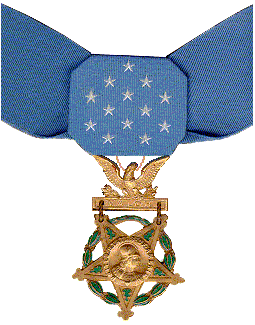
    and Crandall were awarded the U.S. military's highest recognition, the Medal of
    Honor. 

  • Cliffs-of-moher-ireland  For hundreds of years, England held sway over Ireland.  Their hegemony ranged from tyranny and
    brutal murder to loose control, but always, generation after generation, there
    was the yoke of English rule. 
    Lands were taken from peasants and given to rich English nobles.  Religious war and cruelty were
    common.  Favoritism, power hunger,
    greed, fraud, and nepotism dominated the governance of the island.  But always and throughout, there was
    strong resistance to English rule and defiant rebellion led by courageous
    Rascals.             

                Thomas
    FitzGerald, the eighth earl of Kildare, whom the Irish called Gerrold Mor, was
    an Englishman through and through. 
    He'd married a cousin of the King of England, and with his induction
    into the Order of the Garter, he'd been awarded one of the king's highest
    honors.  But consistent with a long
    line of English nobleman in Ireland, he would also be accused of being more
    Irish than English, becoming instrumental in Ireland's resistance to English
    domination.

                Mor
    served as the English governor of Ireland for more than thirty years, but he
    did so by twice openly defying English kings.  In 1478, when emissaries from King Edward IV were sent to
    Ireland to replace him, Mor simply refused.  Then in 1488 Mor did it again.  By 1494 the English monarchy had had enough, and king Henry
    VII sent an army to Ireland to capture power from Mor and arrest him.  After a period, Mor was released, but
    only under the condition that he leave his son behind in England as a pledge of
    loyalty and insurance of obedience.

                Mor's
    willful stands against England made him very popular in Ireland.  But he was also fiercely opposed by
    other factions on the island.  A
    tireless politician, Mor built strong alliances with Gaelic chieftains, and
    used military might to defeat his enemies.  As one English king said of him, "He is meet to rule
    all Ireland, seeing as all Ireland cannot rule him."  In fact, it was his near total sway
    over the island that fostered the jealousy of the English kings.

                As
    a ruler, Mor did much for the cause of unifying the many factions of
    Ireland.   He also helped
    usher in the Renaissance in Ireland by aiding in the establishment of libraries
    and schools, and he encouraged Gaelic art and literature. 

                As
    a Rascal on an island of Rascals, Mor was impressive with his accomplishments
    of unification and resistance to English dominance.  As Malachy McCourt wrote, "Gerrold Mor had ruled
    Kildare and the English pale for nearly forty years, and for the most part had
    remained a popular ruler during the entirety.  He had kept a large range of English kings from meddling too
    drastically in the affairs of Ireland and had stretched his influence over much
    of the island.  Gerrold Mor was
    surely his own man, and he began a family dynasty that would result in proud
    Anglo-Irish defiance."

  •     John Wycliffe was a fourteenth century Oxford scholar.  Charismatic, fluent in Latin, and a
    major philosopher and theologian, Wycliffe was living the life of a sequestered
    intellectual professor.  He was
    well respected and ensconced in the halls of academia.  For most, that would have been the end
    of the story; but not for Wycliffe. 


    JWycliffe2             
    It
    was a time of unbelievable church dominance, in which the church was a
    government all its own, crossing national and/or feudal borders and commanding
    control over every aspect of people's lives.  It was powerful, often suppressive, political, bureaucratic,
    and sometimes ruthless.  It had a
    monopoly on worship in most of Europe, and controlled church attendance,
    taxation, and every aspect of private behavior. 
    The prevailing attitude was that the church was the guardian and
    interpreter of all Scripture, and the common people had no right to their own
    understanding of God's truths apart from the pronouncements of the official
    church.  From our vantage point
    nearly seven hundred years later, it is difficult to imagine.  Nothing exists in today's world to
    resemble it. 

                It
    was real enough for Wycliffe, however, and he felt driven to do something about
    it.  According to author Melvyn
    Bragg, "His prime revolutionary argument, one which, if accepted in any
    shape or form, would have toppled the Church entirely, was that the Bible was
    the sole authority for religious faith and practice and that everyone had the
    right to read and interpret scripture for himself.  This would have changed the world, and those who ruled the
    world knew it.  He was to become
    their prime enemy."  Wycliffe
    decided to square off against this gargantuan power by an act that today sounds
    so harmless; providing a Bible translated into the common language of the
    English people.  To that point it
    had only been available in Latin, which none but priests could understand.  Wycliffe was convinced that getting the
    truth to the people by placing the Scriptures in their own hands and in their
    own language was worth risking his very life.

                The
    translation itself was a huge task, but producing and disseminating the final
    copies was even more difficult, as everything had to be done in secret.  Hidden production lines were
    established, and hundreds of volunteers rose up to help in the clandestine
    movement.  Wycliffe then trained
    itinerant preachers to get the books to the people and teach them the
    Scriptures, which they could now verify by their own readings.  They became known as the Lollards, a
    word taken from the root meaning "to mumble."  Calling themselves the Christian
    Brethren, their movement spread high and low throughout England and Scotland,
    with thousands of copies of the Wycliffe English Bible permeating the countryside. 

                The
    church began by officially condemning Wycliffe.  They complained that "the jewel of the clerics is
    turned to the sport of the laity and the pearl of the gospel is scattered
    abroad and trodden underfoot by swine."  In 1382, a synod of the church declared Wycliffe and his
    followers to be heretics.  They
    were soon gathered up, tortured, and killed.  English Bibles were confiscated and burned.  Later, the English Parliament enacted a
    ban on all English language Bibles. 
    At roughly this same time, Wycliffe suffered a stroke and was paralyzed,
    dying two years later.  Bragg
    wrote, "After Wycliffe's death and despite the condemnation and harshness
    of the Church, copies of Wycliffe's Bible continued to be produced and
    circulated – even when it became a mortal crime to own any of Wycliffe's
    works.  With astonishing courage,
    Catholics who spread the English language were prepared to defy the Pope and
    take a chance with their lives and their eternal souls in order to read the
    word of God to the English in their own language."  As is common with extreme Rascals such
    as Wycliffe, the work lived on.

                Though
    Wycliffe's efforts were largely snuffed, the seeds had been planted.  Where Wycliffe and his Lollards had
    been stopped, William Tyndale and others would later succeed.  Within a little over a century, the
    same English government that had been so zealous in helping the church
    eliminate any and all English Bibles would officially sponsor the publication
    of one of the most famous Bibles in history; the King James.  Wycliffe had not fought in vain.

  • 002-Firenze.Duomo01_small  Ah, art, that sparkling mistress

    She winks at me through brick arches

    Marble columns and stone pediments,

    Frescoes, sculptures, colors and forms,

    Painstakingly extracted from genius,

    Sinews straining against complacency

    Languidly tempted to delay or do nothing.

    What inertia must have been conquered

    That you could have life.

    What loving care must have been mustered

    That you could long survive

    To feel my gaze in an age that little notes

    Nor barely understands what you represent.

    The weight of the years past

    A span of time beyond our easy comprehension

    Is pierced by the remains of those heroes

    Brave enough to unleash their talents

    For at least a season of victory

    Over their frail human nature

    Driven to delay or squander

    The impulse to give form to talent.

    So much conceived and never begun

    How much more initiated and yet still-born,

    But oh, of what survived!

    Of what made it through the dangerous passage

    Between conception and completion

    Surpassing all odds against fulfillment

    Slipping past the weakness of the artisan

    Into the sunny radiance

    Of our latter-day appreciation.

    A chilling reminder to us all

    Of all that may still remain

    Like Buonarroti's figure inside

    Waiting for release from the block of marble.

    And they ask me why I travel to Italy.


    Chris
    Brady@Copyright 2010