Welcome to
Chris Brady’s
Blog

“The only way to be happy, is to give happy.”

  •         Born in 1910 Agnese Gonxhe Bojaxhiu in Uskub, Ottoman
    Empire, she was the youngest child in a family from Albania.  At age eight, when her father died, she
    began attending a Roman Catholic church. 
    By age twelve she was convinced her life would be a religious one, and
    she became fascinated by stories of missionaries.  In 1931 she took her first religious vows and chose the name
    Teresa for herself after the patron saint of missionaries, Therese de
    Lisieux.  In 1946 she received what
    she called her "call within the call" to leave the convent and serve
    the poor.

            It was a courageous and wild decision, one that would throw
    her into hunger and doubt.  She had
    absolutely no income and had to resort to begging for supplies and food.  In the early days she was constantly
    tempted to return to the relative comfort of the convent, but she allowed her
    compassion for the poor to drive her onward. 

                In
    1950 she founded the Missionaries of Charity with the purpose of caring for
    "the hungry, the naked, the homeless, the crippled, the blind, the lepers,
    all those people who feel unwanted, unloved, uncared for throughout society,
    people that have become a burden to the society and are shunned by everyone."  Her charity grew from a tiny concern in
    a Calcutta, India, into an enormous, world-wide organization. 

                In
    1952 she opened her first Home for the Dying. Next she opened a home for those
    suffering from leprosy, as well as several leprosy clinics throughout Calcutta.  In 1955, her Missionaries of Charity
    opened the Children's home of the Immaculate Heart as a home for orphans.  By the 1960s the Missionaries of
    Charity were running hospices, leper homes, and orphanages across India, and
    soon thereafter began expanding similar operations around the globe.

                All
    of this was wonderful in a way. 
    With such a growing organization focused upon the lowest strata of
    existence, Mother Teresa and her Missionaries of Charity garnered international
    fame.  She was featured in books
    and a documentary.  She began
    receiving honors from around the world. 
    She also received some scathing criticism that would follow her
    consistently throughout the rest of her life.

                Caring
    for the poor was fine, according to her critics, but they had problems with her
    methods.  Some attacked the
    conditions in her hospices, others attacked her treatment of the sisters in the
    Missionaries of Charity.  One
    critic said she wasn't doing anything about the condition of the poor as such, but was simply treating people that were poor! Many critics,
    seizing upon her open admissions of the struggle to feel God's closeness during
    struggle and squalor, even expressed doubts about her faith and sincerity.  Her globalism and organizational might
    were attacked as commercially exploiting her image as a saintly servant when
    she was actually an aggressive empire-builder for the church.  One of the most lasting criticisms
    against her was the accusation that she was not treating the poor but rather
    proselytizing souls to the Catholic Church.  Of this she offered no apology, saying, "I'm not a
    social worker.  I don't do it for
    this reason.  I do it for
    Christ.  I do it for the
    church."  Finally, always and
    everywhere, she was vilified the most for her unwavering stance against abortion. 

                Mother
    Teresa dealt with such criticism all the days of her public life.  She simply refused to live her life for
    the reasons critics wished to assign her. 
    Not once was she known to recant from her stand on the issues or pull
    back from her unpopular positions of morality and service.  Not everyone agreed with her values,
    but almost everyone was amazed at her steely spunk.  Perhaps no moment is as illustrative of this as her speech
    given at the National Prayer Breakfast in Washington, D.C., in February
    1997.  Railing against the practice
    of abortion, Mother Teresa at one point said, " What is taking place in
    America is a war against the child. And if we accept that the mother can kill
    her own child, how can we tell other people not to kill one another?"
     
    Conspicuous among the attendees at that prayer breakfast were President and
    First Lady Bill and Hillary Clinton, politically aligned with the pro-choice
    side of the abortion question. 
    Undeterred by such prominent figures positioned opposite her politically,
    Mother Teresa was unafraid and unashamed to state her position defiantly.

                This
    spirit of defiance, of standing for what she believed in no matter who was in
    opposition, was the same spirit that led her to spearhead a rescue of 37
    children trapped in a hospital in a fight between Palestinians and
    Israelis.  It is the same spirit
    responsible for ministering to the starving masses in Ethiopia, tending to
    earthquake victims in Albania, and assisting radiation casualties at
    Chernobyl.  It is the strong spirit
    of a Rascal driven by purpose and living life fully in the service of attacking
    the status quo.  It is the spirit
    that, at the time of her death in 1997, had produced a charitable service
    organization of over 4,000 sisters operating over 600 missions in 123 countries
    with over 100,000 volunteers. 

                In
    the words of Nawaz Sharif, Prime Minister of Pakistan, she was a "rare and
    unique individual who lived long for higher purposes."  From the viewpoint of critics and
    contributors alike, it must be agreed that if anything, Mother Teresa was
    certainly a Rascal, a title that despite Nobel Peace Prizes and beatification,
    she likely has not received until now!

  • Tank_man  We continue our series of "Featured Rascals," considering those who have had the courage to be different in order to make a difference, the character to become a character, and original enough to stand for truth and justice. I am sure everyone remembers this one.

        The protests had gone on for seven weeks.  What began as mourning for the loss of
    a national leader, Hu Yaobang, grew into a gigantic demonstration known to the
    world as the Tiananmen Square Protests of 1989.  Yaobang had been a popular figure among students and
    intellectuals, standing for the concepts of free markets and democracy in a
    communist nation.  At one point at
    the peak, the demonstrations were attended by more than one million people.

                Having
    seen enough, the Chinese government addressed the situation by sending in the
    military.  Throughout the course of
    dispelling the demonstrators, many people were killed and arrested.  An unknown number of others were later
    rounded up and executed.  In the
    typical fashion of tyrannical regimes, the outside world has no complete set of
    confirmed facts regarding the total killed, their names, or the charges against
    them.  There is not even any
    information about the most famous man of the incident, the "Tank
    Man."  All we know about him
    is what was shown through the camera lenses of reporters on the scene, who had
    to smuggle their film out of the country before what happened could be seen by
    the outside world.

                On
    June 4, 1989, as a distant line of armored tanks made their way through the
    square, just days after other tanks had been seen driving over cars and
    crushing civilians, one man stood fast. 
    He held a bag of some sort in each hand, and aligned himself with the obvious
    path of the oncoming tanks.  As the
    tanks reached him they stopped. 
    For a moment a silent stand-off ensued.  Then, the man climbed up onto the tank and appeared to be
    attempting to talk to those inside. 
    At one point, a man inside the tank stuck his head out of the top hatch
    and spoke to the protester.  A
    moment later, as the tanks started to roll away, the man again placed himself
    in front of them.  Another stand-off
    ensued.  This time, men in blue
    uniforms emerged from a crowd of onlookers and took the protester away.  There are no confirmed reports of what
    happened next, although rumors are rampant.  The Chinese government has never been able to produce the
    man, and claims to be unable to state whether or not he was executed. 

                Although
    so little is known about this man, there is a lot that we do know.  We know he
    was courageous.  We know he
    believed strongly in stopping the tanks that represented a repressive
    government.  We know he used a
    non-violent method to do it.  And
    we know that his example ignited the enthusiasm of Rascals around the world for
    the concept of freedom from tyranny. 
    The Tank Man, as he has been called, became an international symbol of
    the small standing up to the big, of the oppressed standing up to the bully, and
    of the defiant standing up to the enslaver.  We may never know exactly what motivated him, but we can all
    be motivated by him.  We may never know what happened to him, but we know what happened to many around the world as a result of his
    stand.  Tank Man represented the
    flame of justice burning inside the breasts of Rascals everywhere.               

  • My friend and co-author Orrin Woodward and I are at work on many exciting projects. One lingering work is the yet-to-be-completed RASCAL book, dedicated to rebels with a cause. For the next couple days on this blog, I will be featuring interesting RASCALS we have come across in our research. These may or may not make the final cut of the book edition, so stay tuned!

    (And if you’re not sure exactly what a RASCAL is, you’ll have to wait for the book.)

    André de Jongh 

                During World War II, Britain’s valiant airmen were magnificent in their stand against the fierce German Luftwaffe.  German bombers would cross the English channel intent on attacking civilian population centers and would be met with the plucky, hard-working, outlandishly brave pilots of the Royal Air Force (RAF). News-graphics-2007-_648224a  

                As the fighting continued day after day it became increasingly difficult to find enough British airmen to keep in the sky.  Many pilots flew for hours on end, coming back to land only long enough to refuel before taking off to fight again.  Thousands of pilots were shot down over northwestern Europe, and it wasn’t long before clandestine operations sprang into place to smuggle them back to England to fight again.  Most of these ‘escape lines’ forming in Holland, Belgium, and France were established under the professional guidance of trained agents. 

                One of the most successful lines, however, was established and run by mere concerned citizens, the majority of them young and idealistic, dedicated to keeping the RAF fully stocked with pilots.  This line would grow to become one of the most successful of all, accounting for over one fourth of the 2,900 airmen returned to Great Britain through escape lines between September 1939 and June 1944.  Even more surprising, perhaps, was its driving force; a twenty-four year old woman named Andre de Jongh.

                Jongh was raised in Belgium and familiar with the heroics of Edith Cavell, a woman executed in World War I for helping soldiers escape the Germans.  Jongh had promised herself that if war ever came to her country, she would follow the example of Cavell.  In May of 1940 Jongh got her chance when the German armies marched into Belgium.  At first Jongh did what she could by volunteering in an army hospital.  It was here she noticed the strict observations of the German secret police.  As more and more British soldiers came into the hospital, Jongh felt the increasing pull to do something about it.  Without funds, experience, formal training, or permission of any kind, Jongh designed an escape route intent on outfoxing the Gestapo, what W. E. Armstrong called “the most efficient and cruelly repressive secret police in Europe.”  It would necessitate the involvement of hundreds of clandestine volunteers risking their lives to transport escapees across three national borders, all the way south through Europe, across the Pyrenees, and finally to Gibraltar.  From there the airmen would be returned by ship to Britain to fight again.

                Jongh began smuggling escapees along her route, enlisting the support of the British consulate in Bilbao, upon whom she left a very favorable impression.  Jongh demanded autonomy and permitted no interference in her operations, negotiated shrewdly, and soon received funding and contacts for support.  Journey after arduous journey proved successful, and soon, Jongh was in trouble.  The Brussels Gestapo had detected her involvement and slated her for arrest.  Her father got word to her during one of her escape runs that she could not return to Belgium.  He calmly took over in her place as she continued to run the line remotely. 

                Airmen safely delivered back to Britain soon began singing the praises of the youthful and vigorous André de Jongh.  They were in near disbelief that such a fragile and warm-hearted figure should be so brave in the face of mortal risk.  The legend of André de Jongh grew and grew.  Accordingly, the Gestapo predictably increased their efforts to find her and eliminate her escape line, which now was being called The Comet Line by the British secret service, after the behavior of comets in the sky to disappear and reappear again without warning.  They arrested and tortured over one hundred of the line’s volunteers; but nobody cracked under pressure, and Jongh was still safely at large.  Then, during her thirty-third passage, Jongh was finally arrested.  Moved from prison to prison, the attempts of her own Comet line to rescue her all failed.  Finally, she was moved to concentration camps.  Throughout this time she was brutally interrogated twenty-one times, revealing nothing more than the fact that she was the master behind the Comet Line; a fact doubted by the Gestapo.

                Incredibly, the Comet Line lived on.  Inspired by Jongh’s example and empowered by her organization, new volunteers seemed always ready to step into gaps created by arrests and murders.  Young person after young person was on hand to assume the responsibility of leadership at each of the key steps along the escape line.  “We felt we couldn’t let her down,” said Elvire de Greef, another young woman, “Dedee [De Jongh] was not simply the founder of Comet, she was Comet.”

                Although Jongh’s father and hundreds of others were arrested and/or shot, eventually the Allied armies liberated Europe and André de Jongh herself was freed.  One pilot said, “André de Jongh was one of those rare beings who felt the misery of the world and would not let it rest.”  There could be no better description of a true Rascal!   

  • Leadership is about the influence one has with others. To gain that influence, one must be an effective performer, trustworthy, visionary, and a whole host of other things we described in Launching a Leadership Revolution. There are some "soft" side considerations, too. One of these, often ignored, is humor.

    Both the ability to inspire mirth and the quickness with which one laughs are effective skills in gaining influence. Why? Because people like to be around those who are fun and make them laugh.

    Below are ten ways to increase your ability to both appreciate humor and to contribute to the laughter:

    1. Don't take yourself too seriously – the world is overstuffed with people puffed up with their own self-importance. Distance yourselves from these bores by taking everything seriously except yourself.

    2. Have an attitude of gratitude – one of the things holding many people back from humor is their bad attitude. They are in too bad a mood to see the funny side of anything. You won't appreciate the subtly that is humor unless you are appreciative to begin with.

    3. Make your foibles the subject matter – the most enjoyable people to be around are those who are able and quick to laugh at themselves. Conversely, the worst kind of people to be around are those who laugh at others.

    4. Stay away from sarcasm – humor is dangerous, especially when it is biting or berating. Tread carefully, and especially when it comes to your "humor style." Sarcasm may be fun to dish out, but it is never enjoyable to receive.

    5. Be good-hearted – one of the things most endearing about someone is their good heart. It comes through in everything they say. When people intrinsically feel that you mean no harm and are instead only interested in their well being, they will be unguarded around you and open to your every statement. This relaxed posture makes everything you say more funny.

    6. Tell stories – some of the merriest moments occur naturally as we live our lives. Capture those moments in your mind in story form and save them for later. Being able to tell good, humorous stories is always a skill in demand.

    7. Become a prodigious noticer – Mark Twain first coined that term, giving away the secret of his mirth. Comedy comes from noticing the small and subtle things about this life we share together. It is this prodigious noticing that will give you the stories to tell in #6.

    8. Techniques – there are some skills that enhance humor, such as timing, delivery, facial expressions, dramatization, gestures, and the like. Over time and with practice, develop a style all your own.

    9. Circular – bringing something back around into a conversation that occurred earlier can be hilarious. Watch for ways to apply earlier humor to new situations.

    10. Be a good laugher – one of the keys to reducing tension in a room is to be a good laugher yourself. Laughter is actually contagious. Be quick to enjoy others and their stabs at humor and their own moods will lighten and be more prepared to receive your quips, as well.

    I could go on all day here, but one final piece of advice about humor: know when to quit!

  • It stopped me dead in my tracks when I read it. As a result, I put the book down and couldn't come back to it for days. When I finally did, I was still stunned by the revelation of my inadequacy.

    What was it that shot like a lightening bolt of illumination into my blinded mind? The statement that "to determine how well you are doing as a leader, take a look at how well the people you lead are doing."

    Ouch.

    To that point, I had been thinking I was a leader when actually I was operating only at the lower level of "performer." It was all about me, my goals, my performance, my motivation, my accomplishments. I thought that if I drove myself hard enough, learned enough, and tried enough, I would be a good leader. Unfortunately, that's not how it works. 

    As Orrin Woodward and I wrote in Launching a Leadership Revolution, leading involves much more than that. Leadership is the art of influencing other people to high performance. It is the power of a performer enabling and enhancing the performance of others. And therein lies the key: OTHERS.

    Want to be a leader?

    Want to increase your influence?

    Want to take your performance to the next level?

    Become OTHER focused. Decide right here and now that your life will not be about you, but about others. Figure out how to add more value to more people with everything you do. As Zig Ziglar famously said, "Help enough other people get what they want and you'll have everything you want." This statement, I believe, is both literal and figurative. I DO believe that by helping others succeed it boomerangs back around and helps the helper. However, the deeper and more figurative meaning is that by helping others get what they want you receive so much more. You receive their thanks and gratitude, adulation and respect, friendship and loyalty, comfort and presence. Just by being the "raiser" of others you have been raised yourself. 

    So make your work and life about others. 

    How they do is the gage of how you are doing.

  • The wait is over! Here is the next caption contest photo. Remember, the winner will receive a free, autographed copy of Orrin Woodward and my book, Launching a Leadership Revolution. Good luck!

    745be6032chumor.jpg  

  • 2010%20FIFA%20world%20CupWhether one is a sports fan or not, it would be hard to avoid the hype surrounding the 2010 World Cup in South Africa, which begins today. Special edition magazines fill the shelves, newspapers feature full inserts, marketers have plastered signs with advertisements featuring local heroes, and television adds have been running all spring. Just what is all the fuss about?

    It's called "The Beautiful Game," and as such, can be quite wonderful. Play never stops, except for halftime, incredible athletic ability is showcased at the top levels, and even a newcomer can observe a game and follow its basic rules and flow. However, there are some detractions, such as fake fouls, over-dramatized injuries, horrendously inconsistent refereeing, and misbehaving fans. Still, soccer ("football" everywhere else but in North America) is a unifying interest around the globe. It is truly THE cosmopolitan sport. I have been on the streets of Venice, Nice, and Cardiff and gotten into conversations with locals inspired by some jersey I was wearing. My children, likewise, have been hugged, high-fived, and saluted because of the donning of their hero's colors. If common ground is the secret to ice breaking, a love of The Beautiful Game has to be one of the most useful for the global traveler.

    So each country fields a team featuring its (supposedly) best players, in an Olympic-style face-off of nation vs. nation (or, in football terminology, "nation v. nation"). Patriotism runs rampant, flags and national colors get painted everywhere, and those annoying plastic horns get blown non-stop (one reason English football is my favorite, English fans being much too sophisticated to succumb to such annoying behavior, opting instead for singing hilarious and sometime ribald songs in stadium-unison – an amazing thing to behold!). It's hype and sport-induced tension at its most elevated level.

    World_Cup_Football_2006_058-1024Really, though, it's just a game, and that matronly reminder may as well be left unsaid, falling on deaf ears as it does. The truth is, who cares if it's just a game? It's fun, it's exciting, and it's entertaining. I, for one, enjoy the spectacle of countries from around the planet coming together in a restrained bit of ball play. It sure is better than war and politics and everything else that passes for important these days.

    Besides, I have learned almost as much watching and participating in sports as I have doing anything else. Success, integrity, character, class, victory, defeat, perseverance, practice, training, coaching, mentoring, injury, emotional control, clutch performance, goal-setting, delayed gratification, physical conditioning, team play, game planning, score keeping, performance measuring, feedback, influence, marketing, messaging, motivation, and a thousand other buzzwords are all amplified and communicated through participation in an artificial construct called "Sports." Hey, it works for me.

    2010_FIFA_World_Cup_Fans_23I know, I know, one can go too far. Certainly. After all, I've got my own dreams to chase. If I were to live too vicariously through a bunch of guys kicking a ball around, I would be deserving of the title spoken in the movie Dumb and Dumber: "One pathetic loser!" But I still enjoy sports, and especially the Beautiful Game – especially at World Cup time.

    So take in a game or two. Get interested in the people behind the hype. See if you can find inspiration and warmth in the stories of some of the lives of the athletes, such as Brazilian star Kaka who has recently come to faith in Christ and proclaims it publicly and joyously, or the rag-tag underdog team from the United States, who aren't given much of a chance.  Who knows, you just might learn something, and I'm fairly certain you'll be entertained along the way.

    My prediction: 

    1st place: SPAIN

    2nd place: BRAZIL

    3rd place: NETHERLANDS

    (But I'm pulling for the American boys all the way).

    Care to offer your predictions? I'll award a signed copy of Orrin Woodward and my best-seller Launching a Leadership Revolution to whomever gets first, second, and third place correct (or the closest). Predictions must be in by Friday, June 11th at 8:00pm EST. Good luck!

  • Being responsible means we are response-able. Between stimulus and response, we humans have the power to choose. This is what separates us from mere animals who rely solely upon instinct. Thank you to Stephen Covey for this insight.

    Acknowledging this, then, we must take stock of our Response Ability. How well do we do responding to the obstacles of life? How effective are we in our responses? Are they measured, correct, and appropriate? Are they productive and emotionally sound?

    Far too many people react emotionally, childishly, rashly, and recklessly to the things that happen in their lives. Strangely, I contend they actually enjoy it! I observed a thirty-something man on a cell phone in a public restroom yesterday berate someone while watching himself in the mirror. The only thing more ridiculous than what he was saying was how he was saying it. He seemed to be getting some kind of satisfaction from playing the idiot.

    Don't be like him. Stay away from antics and the instinctive responses that should be left to animals. Be an emotionally mature human being, with love in your heart, understanding in your voice, and resolution in your attitude. Remember that no matter what happens to you, it is within your freedom of choice to respond appropriately. Choose. And choose wisely. 

    How high is your Response Ability? 

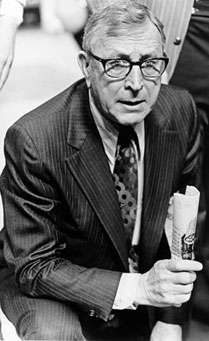
  • John_WoodenRare is the life that is lived well. Most of us, it seems, crash and bang around the pages of our personal stories, breaking glass and hearts in the process. Regrets litter the wake left behind a life full of mistakes and illusions. Through it all we grow wiser, one would hope. 

    Every now and then, however, someone comes along and exemplifies much of what we believe is possible, demonstrating virtues such as love, joy, peace, long-suffering, gentleness, goodness, faith, meekness, and temperance. Nobody is perfect, but there are people whose very walk becomes their talk, whose excellence gives power to their words in a way we can all admire. 

    John Wooden passed away the other day at age 99. I am glad the Lord chose to give him long years, because it was during the later of these that Wooden allowed writers to work on projects with him to capture the secrets of his success. John Wooden as a coaching legend is, well, legendary. His achievements have largely remained unsurpassed for nearly thirty-five years. But just as mighty as his coaching success is his life success. He unabashedly proclaimed his belief in Christ, demonstrated how a long and happy marriage was to be accomplished, and lived modestly and kindly till the end. In an age when athletes and superstars, movie stars and political messiahs posture and pose for our admiration, it is heart-warming and refreshing to occasionally come across the real thing; someone who is both authentic and excellent, accomplished and humble, noteworthy and praiseworthy.

    Thank you Mr. Wooden for an example well given. In tribute, below are some of the best snippets from his books from which I've learned the most.

    * Your family is what counts. You must always remember that as you get caught up in your own professional responsibilities.

    * You must be interested in finding the best way, not in having your own way.

    * You can give without loving, but you cannot love without giving.

    * Never believe you're better than anybody else, but remember that you're just as good as everybody else.

    * Friendship is so valuable and so powerful. We take it for granted, but we shouldn't.

    * You can never make up for a lost day.

    * You have to apply yourself each day to become a little better. By applying yourself to the task of becoming a little better each and every day over a period of time, you will become a LOT better.

    * Too often we get distracted by what is outside our control. You can't do anything about yesterday. The door to the past has been shut and the key thrown away. You can do nothing about tomorrow. It is yet to come. However, tomorrow is in large part determined by what you do today. So make today a masterpiece. You have control over that.

    * Think clearly, have love in your heart, be honest, and trust God.

    * Being a role model is the most powerful form of educating.

    * Even a stubborn mule responds to gentleness.

    * You have little say over how big or how strong or how smart or rich someone else may be. You do have, at least you should have, control of yourself and the effort you give toward bringing out your best in whatever you're doing. This effort must be total, and when it is, I believe you have achieved personal success.

    * Try your hardest in all ways and you are a success. Period. Do less than that and you have failed.

    * The outcome of a game was simply the by-product of the effort we made to prepare.

    * Focus all your effort on what is within your power to control.

    * Team Spirit – an eagerness to sacrifice personal interests or glory for the welfare of all.

    * You might say that a leader has a simple mission: to get those under his supervision to consistently perform at their peak level in ways that benefit the team.

    * A leader must preserve options to be effective.

    * Opponents are working very hard to defeat us. Let's not do it for them by defeating ourselves from within.

    * As a leader, my job was to do everything possible to help those I allowed to join our team achieve this – to create an environment and attitude that brought out the very best in each of them. Personal greatness for any leader is measured by effectiveness in bringing out the greatness of those you lead.

    (Note to readers: I would recommend that anyone involved in leadership of any sort re-read that last one again and again. Actually, one could re-read all of these again and again without harm.)

  • Are you on Twitter? With the rise of social networking as a new feature in our lives, Twitter has rapidly become one of my favorite platforms. This is because small snippets of 140 characters or less make it necessary to compress thought into small bites. I like that. Focus is powerful, and if you can't say something succinctly, you might not be that sure of what you're saying!

    If you haven't already gotten involved on Twitter, I would highly recommend it. You can open an account for free, and then set up your account to have certain Tweets from interesting people you follow directly sent to your cell phone in the form of a text. 

    You can follow me on Twitter at http://twitter.com/RascalTweets

    You can follow Orrin Woodward on Twitter at http://twitter.com/Orrin_Woodward

    Here are some recent Tweets I sent out. Simply food for thought. Enjoy.

    Almost anything good requires effort.

    If you're going to be wrong, at least do it in style!

    Having the facts doesn't necessarily mean you have the answers.

    Statistics merely allow someone to be wrong with authority.

    Liberty without purpose leads to boredom. Purpose without liberty leads to frustration.

    Many people have vision, fewer seem to have integrity.

    Having a vision is fine, but principles are crucial.

    Making things easier or simpler is not that easy or simple.

    Asking good questions of yourself is a good start toward coming up with good answers.

    Getting older is a lot like nothing else.