-
I am so glad English was my first language, inculcated in toddler-hood. It is sublimely in shambles, and must be nasty to learn! The following shalt illustrate the point I doth make (author unknown):
We'll begin with a box and the plural is boxes.
But the plural of ox should be oxen not oxes.
Then one fowl is goose, but two are called geese.
Yet the plural of mouse should never be meese.
You may find a lone mouse or a whole lot of mice.
But the plural of house is houses not hice.
If the plural of man is always called men,
Why shouldn't the plural of pan be called pen?
The cow in a plural may be cows or kine,
But the plural of vow is vows and not vine.
And I speak of foot and you show me your feet,
But I give you a boot . . . would a pair be called beet?
The masculine pronouns are he, his and him
But imagine the feminine she, shis and shim!
So our English, I think you'll all agree
Is the trickiest language you ever did see.
-
 Economic growth is not luck, a surprise, or the result of brilliant politicians or creative banking (although, if any of these four things ever happened, we would accept them!). It is the direct result of actual productivity gains through the proper combination of three factors:
1. taxes
2. money
3. regulation
All things being equal, countries that twist these three knobs to the optimal settings are poised for economic expansion. Just what are the optimal positions for these categories? Does it take sophisticated bankers, talking heads on television, and "Tsars" to figure it all out?
No.
All one has to do is take a look at history. No matter what the collectivist, world-government, elitist, socialist, intellectuals try to make us think, history is clear on the three following points:
Taxes: When taxes are low the economy expands. This is because the fruit of investment and labor finds its way to those who actually earned it. The more one can keep what he earns, the more eager he is to work harder. The less he keeps, the less he works. This applies to individuals, to large institutional investors, and to corporations and their capital outlays alike. It's called incentive.
Money: When money is stable (meaning the overall supply is relatively constant; which minimizes inflationary losses of purchasing power or the converse: deflationary scarcity of capital), consumer and investor confidence grows. Savings increase, meaning money is more available for lending, which drives down interest rates, which makes capital more available to corporations for expansion and individuals for investing. This drives growth. It's called capital availability.
Regulation: The more a market is regulated the more it contracts. This is because every artificial action in a market (through tariffs, trade restrictions, prohibitive laws, wage laws, price controls, production caps, etc.) has an opposite reaction. Impositions placed in the way of the free flow of goods and services are compensated for by other industries, countries, or sectors. The net result for the regulated market is, at best, stunted growth, at worst, shrinkage or disappearance altogether. It's called freedom.
That's it:
Incentive.
Capital.
Freedom.
Give a people that combination and watch them produce!
Oh, if Washington (and I'm talking about nearly 80 years of Presidential administrations and Congresses, with very few exceptions) could get this right. It shouldn't be that hard; after all, it's how America was founded! But to know that, one would have to spend less time reading a teleprompter and more time reading history.
-
Watch the words people say very closely. Especially when they are trying to rob you.
The term "redistribution of wealth" is a ridiculous phrase meant to soften a term more familiar in our language: theft.
Lets consider the two root words separately.
Re-distribution: This seems to imply that something was "distributed" in the first place. Only there WAS NO "distribution." (The word distribution sounds like it is describing turkeys being given off the back of a wagon by the mighty and benevolent king to his lowly serfs). There was no distribution because the money you and I earn is not distributed to us by some mighty power that allows us to have it. No. It was EARNED. So how could something be RE-distributed when it never was distributed in the first place?
Wealth: Is it really wealth? Somehow, the money we earn, after federal taxes, state taxes, local taxes, sales taxes, licenses, fees, registrations, gasoline taxes, property taxes, and almost fifty others, is considered wealth? It is not wealth, but the fruit of one's labors. It is the payment for services rendered. It is the just exchange for the efforts of one's life. Wealth, a word that conjures luxury and lifestyle and the spoils of the inheritance class, is quite another thing altogether. Wealth is "Daddy's money," trust fund money, inherited money, "family" money. Wealth is not the honest wages earned by the hard-working, middle class person.
So what is redistribution of wealth? It is theft by those in power from those under that power.
And don't think it won't affect you because you aren't wealthy. These programs are always begun as "soak the rich" initiatives, but they always turn into "kill the middle-class" annihilators.

-
There is a big difference between currency and money. Money is something solid, unmoving, and recognized by everyone involved in exchange as having an intrinsic value. Currency is something someone in authority (usually governments, but today a collusion between governments and private banks) declares to have value. In other words, currency "has value" simply because the power elite say it has value. Further, it has the value they tell us it has.
Sort of.
This is where the term debasement comes in.
Throughout history, governments and monarchs have been unable to resist the temptation to make "free money" by tampering with actual money. At first, coins themselves were valuable because of the base metals in their composition. They were stamped according to that amount. It wasn't long before some king or dictator discovered that old ones could be melted down and formed into new ones containing slightly less of the precious metal and more of cheaper metal fillers. This is called debasement. It is when the power in charge says the currency has X value, even though some of that value has been taken out. "Coin clipping" was also done, in which the edges of coins were cut off, the metal being melted and used elsewhere, while the coin itself was still supposed to be traded as if it were whole.
Today, currency debasement happens because the American Dollar (the standard currency used the world over for global commerce), is tied to nothing of intrinsic value whatsoever. It is simply a piece of paper the strongest government in the world proclaims as "money." It has value because they say it has value. The only problem is that, because it is tied to nothing solid and unmoving, such as gold or silver, it can be easily debased. This doesn't occur today by coin clipping or changing coin alloys, but rather by the issuing of more currency on top of the currency already in circulation. Sometimes this occurs by actually "printing" more money. But usually it simply happens in computers as more credit is issued in terms of lending. A collusion between the Federal Reserve (a privately held, protected banking cartel) and the US government, is responsible for "controlling" this "money supply." What that means is they are the sole gate keeper on the stream of US currency flooding out into the world.
What does this mean?
It means that as this gate keeper releases more "money" into society, the currency you and I already have is worth less as a result. In a ridiculous illustration of this concept, imagine that every US citizen were given a million dollars today at noon. In a short amount of time, merchants everywhere would realize this and begin raising prices to match the new spending power of the people. We wouldn't have more money, just more currency, as the prices of everything would rise in direct proportion to the increase in currency in circulation. This, my friends, is called inflation. Inflation is sometimes referred to as rising prices, and is often sold to us as though it were inevitable and natural. Nothing could be further from the truth. Inflation is not natural, and it is not the raising of prices, but rather the increase of the currency supply which has the automatic result of raising prices. It is only inevitable if the currency supply is expanded by the "printing" (or electronic issuing) of more.
Whenever you hear about "government bailouts" or government "deficit" spending, all they are talking about is the US government issuing more currency. And every time they do that, the currency you already have, because it is suddenly surrounded by more currency, has less spending power. This is called inflation; it is the debasement of the currency. The piece of paper may have "One dollar" written on its face, but it is not the same dollar in terms of spending power that it used to be. In fact, since 1933 when the US dollar was pulled off the gold standard, it has shrunk in purchasing power to 4 cents (in 1933 terms)! Another way to look at this is to imagine that you were give a One Dollar bill in 1933. Today, 96 cents of it has been taken away by the government that issued it. Do you see why many call inflation the "silent and invisible tax"?
Government stability has historically had a lot to do with the stability of its currency. The more the currency of the realm has matched actual money, the more stable the regime. This can be seen in Lydia in the seventh century BC, in ancient Athens under the rule of Solon and all the way down through its democracy, throughout the reign of Alexander the Great, the early Roman Republic, the dictatorship under Julius Caesar, again under Augustus, the industrial age United States, Napoleonic France, Lenin ending Russia's hyperinflation, Mao Tse-Tung in China, and Japan after World War II. Strong currency, strong regime. And a strong currency came from prevention of or abstinence from debasement.
The reason there is so much discussion today about economics and the Great Recession we are currently enjoying is because there are those who understand how severely our currency has been debased. Of course, this is extremely uncomfortable for those involved in the "taking of the 96 cents." Further, the situation is compounded by the interwoven world "monetary system" which is entirely on free-floated, not-tied-to-anything-of-intrinsic-value US dollars. For the first time in history, the entire world is on free-floating currency.
It was a great party while it lasted. But the game can only be played for so long. At some point, the "currency" approaches worthlessness, and the people who discover the "missing 96 cents" begin wising up to the theft they've experienced. At that point, the powers-that-be must use force, or theft. They can either confiscate and proclaim "illegal" anything being used as money instead of their paper currency (as President Franklin Roosevelt did when he declared gold, an inert, natural, harmless element found in the very earth to be illegal under United States law!), or cast away the old currency and come out with a new one.
The danger to the US economy, and in essence, to the world's economy since the US dollar is used as the world's reserve currency, is that more and more nations will object to the "missing 96 cents." They may demand the establishment of a new international currency or a return to a gold standard (China has been buying millions of ounces of gold as secretly as possible), both of which will all but kill the remaining value of the US dollar. When one of these alternatives, or some other such solution, is finally and inevitably put in place, the United States economy will be racked as a result.
This is nothing new. History is replete with examples of governments debasing their currency at the expense of their people. At some point in the progression, as the currency approaches valuelessness, panic and a lack of confidence in the government result. As author Nathan Lewis wrote, "No government can act at the citizenry's expense indefinitely and remain in power." These tumultuous events in human financial history almost always were followed by a major change in their governments. After all, the people can only handle so much.
Before he became complicit in the Federal Reserve's debasement schemes as its long-time chairman, economist Alan Greenspan wrote in 1966, "In the absence of the gold standard, there is no way to protect savings from confiscation through inflation. Gold stands as the protector of property rights. If one grasps this, one has no difficulty understanding the statists' antagonism toward the gold standard."
-
When entering the corporate world there are all sorts of important things to learn. One of the most critical is verbal communication. Many people might assume that talking at work is the same as everywhere else in life, but that is logical and therefore not true. In the corporate world, there is an unwritten rule that prohibits anyone from saying anything original (there are also restrictions against thinking anything original, but that exceeds the scope of this essay). The challenge then becomes knowing how to speak at all.
Thankfully, a whole bunch of clever some-bodies have developed a language unique to the corporate world called Analogy Phraseology, Corporate Speak, Buzzwordonics, B-Bonics, or Corporate GaGa. This simple, straight-forward language can be learned only by contact with fluent speakers, and is normally disseminated in long, boring meetings conducted at work over the course of several years. The best way to identify an Analogy Phraseologist is to detect whether or not this corporate language has carried over into their private conversations outside of work. If so, they are very boring. This automatically makes them qualified to teach you.
When reviewing the following list, it may be the most useful to you if you write down five to ten of your favorites. Then, when questioned at work about something, you can randomly choose one of the phrases from your list and offer it in response. Statistics have shown that this method is ninety percent effective at least half the time!
To help acquaint you with this new language, I am here providing the first list of the most popular Analogy Phraseologies. This is by no means complete, but each and every phrase has been authentically obtained in meetings in the corporate world. I hope these will help you in your career (but doubt it). Please feel free to leave a comment with any I may have forgotten.
- Driving home the point
- Being held out to dry
- Get our ducks in a row
- "Sit Down" and discuss it
- Run that flag up a pole
- Think outside the box
- Tail wagging the dog
- Fox in the henhouse
- Put our foot in our mouth
- Barking up the wrong tree
- Climbing the wrong ladder
- Egg on our faces
- Got our knickers in a knot
- Fold up our tent
- Pull up stakes
- Mending fences
- Eating crow
- Being taken to the cleaners
- Fishing for answers
- Rolling in dough
- Bleeding us dry
- Nickel and diming us to death
- Getting hen-pecked
- Throwing good money after bad
- Sinking like a stone
- Leaking like a sieve
- Slower than molasses in January
- We're off in the weeds somewhere
- Can't see the forest for the trees
- Keeping us in the dark
- Trying to drain the swamp
- Swallowing an elephant
- The whole ball of wax
- Up to our axles in alligators
- Getting cut off at the knees
- Head them off at the pass
- Swallowing this thing whole
- Turning up the heat
- Playing with fire
- Fight fire with fire
- Don't mince our words
- Have our cake and eat it too
- Put the cart before the horse
- Dot our "I"s and cross our "T"s
- Mind our "P"s and "Q"s
- The train is leaving the station
- Cross that bridge when we get to it
- Come Hell or high water
- We're all in the same boat
- Has the cat got your tongue?
- Fish or cut bait
- Carry our weight
- Light off a powder keg
- Dog and pony show
- Cat and mouse game
- Playing with an empty deck
- Skating on thin ice
- Gather our forces
- Up the creek without a paddle
- Robbing Peter to pay Paul
- The right hand doesn't know what the left hand is doing
- Blind leading the blind
- When it rains it pours
- Just another pretty face
- Can't teach an old dog new tricks
- Like trying to nail curd jelly to the wall
- Make sure everyone's on the same page
- Make sure everyone's singing from the same song book
- Circle the wagons
- Charging Hell with a squirt gun
- Gone to Hell in a hand basket
- That went over like a fart in church
- Like a Chinese jigsaw puzzle
- Rubbing salt in the wound
- Make up for lost ground
- Dancing on the ceiling
- Whistling Dixie
- Hogging the ball
- Stealing the show
- Taking the floor
- Holding our own
- Get our heads together
- Bought the farm
- Deep sixing it
- We'll be pushing up daisies
- Re-invent the wheel
- Plowing new ground
- Digging our own graves
- Like a bull in a China shop
- A real barn burner
- Taking candy from a baby
- Get our marching orders
- Tackle the issues
- Take a bird's eye view
- Hold your horses
- Keep your pants on
- Don't get your shorts in a bundle
- Bite the hand that feeds you
- Don't get caught with our pants down
- Left out in the cold
- Like selling ice cubes to an Eskimo
- He needs a lot of hand holding
- It pushed him over the edge
- Out for blood
- Going for the jugular
- Burying the hatchet
- Making waves
- Throwing stones
- Slinging mud
- Giving it a lick and a promise
- Don't want to tip our hand
- That's just the tip of the iceberg
- Cut off our noses to spite our face
- Stacking the deck in our favor
- Firing a shot across their bow
- Tipping the scales
- We'll eat their lunch
- Getting rid of the bad apples
- Mixing apples with oranges
- Not until the fat lady sings
- At the end of the day
- Finding a needle in a hay stack
- Coming in from the cold
- We'll sleep like babies
- Keep us afloat
- Whatever trips your trigger
- Whatever floats your boat
- Whatever sinks your sub
- Feel like an all day sucker
- A shot in the dark
- We're taking some shots
- It's like a house on fire
- Close the barn door on that one
- Close the book on it
- Plug the dam
- Dam breaks loose
- We'll lose the whole kit and caboodle
- Farting in the wind
- Lose the shirt off our back
- We all put our pants on one leg at a time
- Grasping at straws
- Head over tea pot
- Ship of a different color
- Playing second fiddle
- Left holding the bag
- Swatting flies with a sledgehammer
- The pot calling the kettle black
- Putting ten pounds in a five pound sack
- Too many strings attached
- Cut through all the red tape
- Pick or poison
- Pull our punches
- Hammer out the details
- Give it a Nerf toss
- Sleeping with the enemy
- Throwing the baby out with the bath water
- Burning bridges
- Where there's smoke there's fire
- A snake in the grass
- Watered down
- The straight skinny
- Reading the riot act
- Honest to gospel
- The full monty
- The whole enchilada
- A tough nut to crack
- Woke up on the wrong side of the bed
- Swinging for the bleachers
- Time to punt
- Learning the ropes
- Taking it on the chin
- Walking a tight rope
- Dancing around the main issue
- Shake the tree and see what falls out
- Brown nosing
- Stabbing in the back
- Passing the buck
- Banging our heads against the wall
- Falling off the deep end
- Feeling our oats
- Ruffle their tail feathers
- Make our mark
- Pushing the envelope
- If not it's "Katie bar the door"
- At the end of the day
- Lifting our skirt
- Leaving some on the table
- Tossing out crumbs
- Circling back around
- not sharing our sandbox
- In our backyard
- Going down that road
- Dying on that hill
- Shooting the messenger
- Opening a can of worms
- Get ahead of the curve
- Bleeding ege
- Tip of the spear
- Two-headed monster
Showing our hand
-
 Change can be overwhelming and scary sometimes. But the one thing that doesn't change is change. The world we live in is changing at an accelerating pace; and we'd better get used to it.
Instead of fearing change we should embrace it. We should dig deeper into advancements in the areas in which we're interested, deciding what to utilize and what to do without. However, all change is not good, and we certainly shouldn't be uncritical in our acceptance of innovations, but we should foster a spirit of breaking things that aren't broken, thinking creatively, and feeling the enthusiasm of a world in fast forward.
The paradox, of course, is to do all this without losing what was good in the "old." We still need to enjoy the little things, the portions of life that technology can't touch, and understand the eternal and timeless questions. These, without doubt, will always be the most important, and that will never change!
-
We are roughly half-way through the World Business Forum’s agend. Below are some of my favorite nuggets to this point:
Patrick Lencioni
Life is simple, and really difficult. It is not complex.
We spend most of our time trying to make our organizations SMART, which is fine, but we need to spend more time making our organizations HEALTHY: Minimal politics, confusion, morale, productivity, turnover.
When we don’t have conflict around ideas and issues, it always ferments into conflicts about people. That destroys teams.
David Rubenstein
We had better get used to the fact that the Dollar is not going to be the reserve currency of the world.
Think of yourself as an owner.
Improve your skills of persuasion. The truth is we’re all salesman.
Jeffrey Sachs
We have ended the panic of liquidity by making sure short term lending, etc, can continue, we bailed out some big companies. But have we seen a fundamental change in MONEY and POLITICS in this country?
Because of this, our policy is still being written by Big Money Interests behind the scenes. The debates we see in the public are largely side shows to hide the real machinations in the back room.
China is now the banker of the world.
We have to re-engineer our political system better to reintroduce the voice of the American people.
T. Boone Pickens
The first billion is the hardest, which is true, because I was 70!
It takes just as much time to do a small deal as it does to do a big deal.
Green Zealots throw around some funny ideas. I said to them, “Do you guys realize the consumer is the same guy that votes?”
We’re not very smart on how we manage energy in America, and the reason is because we’ve had cheap oil. If we keep on, we’ll be importing 70% of our oil, and we’ll be paying $300 per barrel for it within ten years.”
How do you drive change? Leadership, no matter where you are or what you are talking about. If you don’t have leadership, the whole thing drifts and you’ll get nothing until a leaders shows up.
Don’t manage, lead.
We have not a single call for a single barrel of oil in IRAQ, after losing 4,000 people in the war there.
Kevin Roberts
The consumer is not a moron, she’s your wife.
It’s not about a market it’s about a movement. It’s not about brands it’s about participation.
Life’s for sharing.
Let emotion rip. 80% of our decisions are made emotionally.
Logic leads to conclusions, but emotion leads to action.
George Lucas
I realized that, not only did I love doing this, but I was really good at it.
I love making movies, I am passionate about it, and I never cared that much about making money. What I really want to do is make movies. Movies are an art form. My definition of art is a way of communicating emotions from one human being to another human being. For the most part, that involves technology.
Art is a popular medium; it’s a way of telling stories to the people that are meaningful in a connecting kind of way. People are moved emotionally without knowing why.
I had to write it because I’m the only one who knows the story that’s in my head and the way I want to tell it. I’m the only one who knows the universe.
It doesn’t have much to do with the ability to write, it has to do with the ability to tell a story. Telling a story ends up being very personal. A great writer just has to get the story out.
-
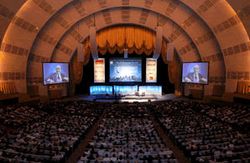
Orrin Woodward and I are attending World Business Forum 2009 at Radio City Music Hall, along with people interested in leadership from 54 countries. For a look at the lineup of speakers, click on the following link:
http://us.hsmglobal.com/contenidos/uswbfagenda.html#
Over the next two days I will be posting nuggets from this event.
Already this morning author Bill George said, “It’s better to have a bad day than a bad life.” This is a great reminder to keep one’s head during a crisis and to cling to core values when things get crazy, understanding that there are ramifications for every choice we make. In other words, don’t make things worse by losing your integrity.


