I had heard from friends that they were tearing down the old AC Spark Plug facility, affectionately known as “The Highway.” It had been over eight years since I’d even driven past the place. Then one day while in Michigan my oldest son and I were on an errand and happened to drive right down Dort Highway past the demolition. I stopped the car, got out my phone, and began taking pictures and videos.
-
There is something sad about a plant closing anyway, like the end of an era. But this particular plant held massive significance for me. My grandfather worked in that building for thirty-three years. During World War II, he tested machine gun munitions in the basement. When I hired in there in 1985 some of the windows were still painted black as protection against bombers from the war. Papa Floyd lived two more years, long enough to see me begin a career at “The A.C.,” and he was proud. It’s also where I met future business partner, friend, and co-author Orrin Woodward, when we were both young, snot-nosed engineering co-op students. There were lots of other great people there too, and my mind is literally filled with memories. My professional education as an engineer took place in that building, as well. I love cars, my first word was “car,” and I have a soft-spot in my heart for the auto industry to this day. Looking back, I guess I came of age in that facility; learning how to supervise production crews, run maintenance groups, and yes, eventually, do some engineering.I understand job shifting, I think. I have read all about the “flattening of the world” theory and how lower level manufacturing has moved off-shore and those jobs have been replaced by high-tech industry and services. I understand emerging third-world labor and the imbalances in exchange rates (don’t get me started on the Federal Reserve and why this is so!). I lived and studied in Japan for a brief period to understand how East Asia had emerged as a world manufacturing leader. I also know change is inevitable. And I understand the laws of competition and market forces (at least better than the Keynsian economists in our government. For more on this, read Orrin Woodward’s posting today about the Austrian school of economics). I was also directly involved with the struggle between the powerful union and the bureaucractic leadership.Still, it was painful to watch the dismantling of so many memories. Flint, Michigan, the home of the founding of General Motors Corporation and one of the Industrial Age’s largely unsung heroes, “Billy” Durant, is possibly a picture of bigger things. And these things are more serious, comlex, and less born of conspiracy than was suggested by Flint’s most embarrassing offspring, Michael Moore. Flint can represent what’s left over when one fails to compete. It can represent what happens when a population doesn’t change with the times. It can represent what occurs when entitlement sets into a culture. It can represent the last dying embers of an older way of life. It can represent those left behind in the dynamics of world politics and competition. It can represent a changing of the guard. It can represent the end of an era.Somewhere, somebody is manufacturing spark plugs, fuel filters, fuel level senders, instrument clusters, circuit boards, and fuel pumps. But they aren’t doing it in Flint, Michigan, anymore. Hopefully, the replacement industries and jobs will be finding their way into people’s lives soon. I know some good people in Genesee county who would be willing to give it another try. Perhaps that’s why General Motors decided to award the new engine plant for the new Chevy “Volt” to Flint.As I filmed the last portions of the main office being dragged down into rubble, I realized that the very section of the building I was watching come down was the exact spot where I had sat for my original interview so many years before. From youthful hope to dissimilation. The windows we had painted black to hide America’s industrial might from the enemy, we eventually tore down ourselves.
-
The Politically Correct Police are out and about this season. It's one of their favorites of the year. They receive their power from the tyrannical party of "they." You know, it's "they say" and "they won't like it" and "they know what's best." "They" say you'd better not call it Christmas or someone will be offended. "They" say it's best to call them Holiday Trees instead of Christmas trees.
Perhaps it might be helpful to realize that this politicization of Christmas is nothing new. After all, the moment word went out that the Son of God had been born, puppet king Herod the Great put out the word that all male infants were to be killed to eliminate such a threat. It's hard to imagine anything being more political than infanticide in the name of protection of one's power base! Then, as Jesus went about his ministry, many misunderstood his objective and thought he was going to provide political salvation. The oppression of Rome over client kingdoms such as Israel and Judah had rankled the oppressed for centuries. Wouldn't it be marvelous if someone able to do miracles right before our eyes would strive to set us free of the Romans? (But that mark was insultingly below the target for the Creator of the Universe). Finally, the execution of Jesus was done as a political move to protect Pilate's reputation back home in Rome, and to appease his client subjects the Jews, who in turn felt threatened by Jesus's power over the people who had usually been trapped under their yoke of "religiosity."So from beginning to end, Jesus's journey on earth was marked by politics. It should be no surprise to us that it continues to this day. Only we need not give it life. Instead, we should simply continue to proclaim his glorious gospel to a broken world, and live our lives in a way that shouts glory to His name. Let the pundits blab, let the politicians play for power. It's all laughable from an eternal perspective anyway. We have higher things with which to occupy our minds. -
There is one activity that seems unaffected by the slowdown in the economy. All one has to do is head out on the road system to see what I'm talking about.
It has to do with road construction barrels.
Most states I've visited display their barrels like a badge of honor. There are so many of them, and they are in such perpetual use, that I think I have uncovered a massive conspiracy. Are they really fixing the roads, or are they just having a competition for bragging rights between states to see which one has the most barrels? Another part of the competition involves seeing which state can set them up for the longest time without any of its citizens noticing that no work is actually being done. From what I have seen, Michigan and Ohio are duking it out for the championship, although Colorado would have to be a close contender, too.I think I might have a theory about where that missing $300 billion from the government grant to the finance industry went: one of the lucky recipients of that big fat government dole has a brother in the construction barrel manufacturing industry. See how it works? He gets federal government money to make barrels, then sells them to state governments, thereby taking money from the government at two levels! It's brilliant! Wish I'd thought of it myself, only I don't have a brother getting government contracts, he's too busy being stuck in traffic somewhere because of road construction.So there you have it! The best hedge against this worsening economy is to go get a job in the factory where they make those barrels! Strange thing is, nobody I've ever talked to seems to know where they're made! Millions and millions of them along the highways of America and nobody out there has any information on where they are manufactured? Hmmmm. I bet I can guess, though: Hangar 18, Area 51!Well, even if we can't find that factory to work in, we can at least all get jobs setting the barrels up along the roadways of America. That has to be the most secure job in the country! -
In the United States we are proud of our freedom. We salute our flag to honor those who have sacrificed to win it for us. We say a pledge to a flag which stands for the ideals upon which our nation was founded. We teach our children that they live in a free country and can grow up to do whatever they want.
Sure, ours is not a perfect country. Its founding ideals have never quite been matched by its behavior. In its early history this was most obviously marked by slavery, followed by genocide of the continent's natives, and discrimination that persists in some forms even to this day.While these stories are old and well-known, the new atrocities committed by our country are in the same category: the infringement of people's freedoms. Just as slavery and the wiping out of native Americans was so broad as to be institutionalized, so too are today's misbehaviors. Let's consider just a few of them.First is our government's incessant meddling in other countries. Yes, I understand that in many cases if the United States military weren't in some of those places (133 countries as of the time of this writing!) there would be anarchy and innocent people would suffer. I also understand the theory that our presence around the world is key to our security at home. However, our military is a weapon of destruction, and it is rightfully and thankfully good at it! Therefore, when it is interspersed around the globe at the whim of government officials over which the people of America have little or no control (and many times not even any knowledge), we are placing a match near the powder keg. The United States is not and should not be the Police of the world. We cannot afford it financially or politically. Thousands of incidents that go unreported to the American people serve to inflame populations against us. Some of these may arguably be necessary, but the vast majority are not. When an American G.I.'s life is in danger, and he or she has a near impossible task to distinguish friend from foe in a strange land, he or she cannot be blamed for the death of "innocents." The real question is whether or not the G.I. should be put into that position in the first place. If we are going to ask an American youth to be in such a precarious situation, we had better do two things: 1) be absolutely sure their life is worth risking by placing them there 2) defend them when they make the decisions we have trained them to make!This brings us to the trampling of our ideals in the name of the fight against terrorism. Again, don't get me wrong. I don't believe in using kid's gloves when dealing with thugs. But once we suspend the rights of habeous corpus and start eliminating the rights of United States citizens to trials, representation, and the rule of law, we have become as bad as the terrorists we fight, and have surrendered our principles in the name of protecting them! The ends never justify the means. President George W. Bush has done massive damage to American freedoms by trampling all over the rights of individuals for the sake of fighting terrorism. When the government decides that it can do away with the rights of one group of citizens to protect those of another, how can we ever be sure they won't change the equation of who is protected and who isn't? I personally feel very uncomfortable when our government tells us it is exercising an extra-aggressive privilege for the "greater good."Next comes the financial meddling by our government. The Federal Reserve "lowers interest rates" by printing more money. Each time this happens the money you and I have goes down in value. We can buy less with what we have. Meanwhile, the government contractors and financial institutions who receive this newly printed money get rich by receiving the money first and being able to spend it before prices go up. This effectively becomes just another "tax" on the honest, hard-working American who happens to NOT have access to government cheese. This same average American has to pay enormous taxes to finance not only the worldwide military complex mentioned above but to support the gigantic American entitlement-welfare state. This welfare state has grown up because politicians have gotten good at "selling votes" by promising special interest groups, campaign contributors, and inside dealers government programs that will "fix" their problems. Our federal budget is literally bulging with appropriations for things the government was never intended to do.Laws, laws, and more laws. Taxes, taxes, and more taxes. And each and every day Americans lose a few more inches of their freedom. The "Republicrats" in Washington collude together to make it all work. Anyone who comes along and calls a spade a spade gets hammered down like a heretic in a religious cult.Rome was originally a Republic. The structure of its government was able to contain its competing power factions for almost five hundred years. But finally, when the power struggle got too tough and dangerous, the people cried out for a savior. Tyranny to them was better than anarchy. So it became an Empire. Its people had traded freedom for security, and ended up with neither. Then the Empire collapsed, largely under the aggressions of populations it had surpressed, harrassed, and mistreated for centuries. At the same time its own people had lost their streak of independence and valor, having lived for centuries under totalitarian rule, til there was no population willing to fight for the preservation of something that had oppressed them in the first place. What began as a passionate Republic ended in tragic indifference. It is nearly impossible not to draw at least a small parallel between the history of Rome and the current United States. Such comparisons are not perfect, of course, but they offer warnings of at least some validity.If we look to government to solve problems it has created, we are like a hypochondriac taking more and more medicines to counteract the side effects of others we have already taken. Eventually, we become addicted and numb, with barely enough energy to put on our togas and make our way to the Campus Martius to vote for yet another droid promising "change." It is time to stop medicating our symptoms by taking more of what caused our ailments in the first place. We must address the problem at its roots.Freedom is under fire. Undefended, it cannot stand forever. Millions of Americans have died on bloody battlefields defending ideals we won't even protect at the voting booth. We have largely progressed from Republic to Empire. Now the "barbarians" around the world are agitated and spoiling for a fight. At the same time, apathy and gullibility are riding high at home. Meanwhile, the government grows in size and power, creeping, ever creeping . . . .I want neither a Caesar nor a Hun for my master.I want the Constitution. It was meant to restrain the government, not me. -
$700 Billion is a lot of macaroni! That's how much our all-knowing government just HAD to bequeth to the insurance and mortgage entities that had gotten themselves into trouble by taking just a little too much advantage of government-created boom cycles. It was an emergency, if you remember. The whole world would have collapsed if we hadn't rushed through that legislation. And ALREADY they are saying much of it has been squandered and they don't know where!
Excuse me?Then along comes the auto industry. "And just WHO do you think YOU are, coming in here and asking for money?" said the snobby congressional leaders. "We are not some kind of government ATM machine!" And the funniest statement of all, "We need to see your business plan!" (Like anybody in Congress would know how to evaluate a business plan)!"We are just asking for a loan," said the automakers. "Not a bailout like you gave your mistress the finance industry. Just a loan.""We'll have to think about it," said the all-knowing government bureaucrats. "We need to know how you plan to pay it back. We have a responsibility to be responsible with money around here, you know, because, well, er, um, we're responsible kind of folks."Some questions are just too obvious to ask, like, "Why was the $700 billion for the insurance and mortgage bailout not a loan? And why were they not asked to provide a business plan?"Things that make you go, "Hmmmm."Smells like a cover-up to me. And when you dig into things a little bit, you find out that's exactly what it was! The Federal Reserve Board, posing as the great savior in the bailout situation, was actually one of the biggest culprits in the entire mess! Can you say CYA?The auto industry really is full of a bunch of amatuers when it comes to getting government cheese. They should study how the rest of the world does it. You've got to get some sweatheart deals on the front end, get involved in government contracts (so when the FED prints its free money to "lower interest rates" they could be the recipient of the free money before it has its inflationary affect on prices), and just overall make sure the government is in bed with you from the beginning. THEN when things go sour, as they always do when the government meddles in the economy, the government will be required to perform a "bail out" to hide their own complicity. What the heck have the automotive industry lobbiests been doing in Washington all this time, anyway? They must not throw parties near as well as the folks over at AIG!Automakers, are you listening?Now for the rest of you out there who need a Bail Out package, I'm still working on a plan for you! -
Almost anything that can be said about the topic of attitude sounds like a cliche, as though it's all been said before. Still, I wonder, why is having a good attitude so rare in our society? We have the highest standard of living in the world, the highest of anybody in history, better health, better technology, better comforts, longer life-expectancy, etc. etc., but none of this seems to produce a spirit of gratitude.
Having a good attitude has to start with an understanding that we are blessed. We must take stock of the great things God has bestowed on us if we are to have a proper outlook on the one life we have to live.Further, a proper attitude shows respect for others. The "Accept, Approve, Appreciate" principles from Les Giblin's How to Have Power and Conrfidence in Dealing with People still apply. People have a basic need to be accepted by others. Then they seek approval. Finally, they want to be appreciated. Is this really so hard to give?Of course, attitude is also comprised of one's outlook about the future. Let's face it, pessimism is repulsive, plain and simple. Nobody likes to be around a person who is negative, who brings others down, and who points out what's wrong with the world. Worse to be around are the types that criticize, condemn, and complain about other people.Know-it-alls are really just people with bad attitudes about the competency of others. Do such people really think they have a lock on knowledge, or that they are that much smarter than others?When it comes down to it, people with bad attitudes just don't have a proper perspective on things. What this really demonstrates is a lack of wisdom. Wisdom comes from examined experience, reading the scriptures, prayer, and study. Unfortunately, most people partake in none of these. They assign blame to others for their failures instead of learning the lessons those failures have to teach. They don't pray, they don't read good books (no time, of course), and they certainly don't read the Bible. Being thus uninformed, they then see fit to take only their own counsel on matters in life, and then amplify their incorrect conclusions through their bad attitude. At this point, the rest of us are allowed to share in it!In the movie The Kid, starring Bruce Willis, the girlfriend of the main character finally gets fed up with his bad attitude. Turning around before walking away, she says, "Do you know what the saddest thing is? You could have been great!" That's how it is with bad attitudes. It's not so much that they bring other people down; although they do. It's not so much that they are a waste of time; although they are. It's that they deprive the person of greatness. They fill the void where greatness should reside. Rest assured that pessimism, negative thoughts, ingratitude, and critical spirits will never lead to greatness. And the saddest thing is that for everyone who has succumbed to the temptation of selling out to negative, "They could have been great!" -
On this day it seems most appropriate to express gratitude and thankfulness for blessings in our lives both large and small. As for me, I am thankful for:
1. God's saving grace2. family and friends who have been there for us through Terri's scary ordeal. We certainly learned who our true friends were! You know who you are!3. Business partners and leaders across the continent4. freedom5. opportunity6. all those who will stand up against bullies and fight for what is right7. good books8. blue skies9. fluffly snow10. smiles and hugs11. health12. the chance to write13. humor and laughs14. vanilla shakes15. popcorn16. horsepower17. speed18. honest people19. soccer20. cheesburgers21. all things eternal!What a mixed list! But blessings are like that. Life is like that. We can see wonder and grace in all sorts of places! May you never lose your sense of wonder and appreciation for God's gift of life to you! What are you thankful for on this day? -
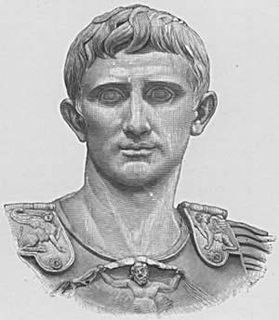
Gaius Octavius was born in 63 B.C.. Nephew to acting dictator of Rome, Julius Caesar, Gaius was (unbeknownst to anyone until after Caesar’s death) named Caesar’s adopted son and heir. Only eighteen years old at the time, he was instantly a wealthy man, and had the additional clout of his adopted father’s name. In ancient Rome, however, this was not enough. The country was not yet run as a dynastic empire, and birth was no guarantee of ascent to power. Competing factions in the senate and former advisors and consuls to Rome jockeyed for position. Nobody gave the young teenager much credit, and few would have predicted his determined rise to power. Eventually, Gaius Octavious, later known as Cae
sar Augustus (for which the month of August is named), became Rome’s first and longest ruling emporer. His efforts effectively killed the last remnants of Republican Rome and ushered in the approximately five-hundred year Age of Empire. The story of his patient, brilliant, and ruthless rise to his position as the most powerful man in the world is gripping and as racey as a soap opera. Leadership lessons abound in his long and storied career.One prominant feature of Augustus’s life is his incredible ability to hold the long-term view of things. While others sought short term fixes, Octavius was patient enough to manuever for long-term solutions. Opposed by powerful and ruthless men (and treacherous women working behind the scenes), Augustus was able to take one step at a time, carefully and deliberately, until he was literally the last man standing in the quest for power.Perhaps the biggest thing a leader can learn from the life of one of the world’s most successful leaders is Augustus’s ability to compound the effects of his actions over a long period of time. Augustus had the rare ability to pile one forward move on top of another, and spent very little time doing what most average men do in wasting their lives re-doing the same things over and over again. Augustus rarely squandered a resource or opportunity, and used every advance as a stepping off point for another one. Most people do not operate this way. Power-thirst and ruthlessness aside, Augustus is a great example for efficient use of our time and resources as leader.Our money, our time, our relationships, our connections, our reputation, our name, our education, and our abilities are all assets that can help us advance througout our lives. Sadly, however, many waste and squander much of this “capital” along the way. We blow our money, sabatoge our relationships, deconstruct our credibility, tarnish our name, refuse to continue or utilize our educations, and fail to manage and cultivate our connections. In so doing we find ourselve having to cover the same ground again and again. We have to earn money to replace that which we spent so unwisely. We seek new relationships because we haven’t been able to sustain or grow the old ones. We make new connections because people have stopped trusting us. We are forced to learn the same lessons over and over again. This is like an army that charges up a hill and successfully pushes the enemy off, only to endure a self-inflicted retreat back down to charge that same hill once again! As Orrin Woodward says, “Some people who have been doing something for thirty years with little to show for it cannot claim they have thirty years experience. They have one year’s experience thirty times!”The best leaders leverage all that they have to get everything they want. This requires a long term view, a respect for the assets in their possession, and an ability not to sabatoge their own progress. Life is too short to learn the same lessons over and over again, or to re-do what has previously been done. Consistency is also key. Effort upon effort, consistently applied over time, produces tremendous compound results. Conversely, inconsistency is one of life’s supreme inefficiencies.In the end, success is largely a matter of hanging on after others have been shaken off. It is also the accumulation of consistent effort over time. The best leaders build an edifice out of their lives, taking steps each day to add to previous accomplishments. The rest struggle in futile repeats. We only get one life. The choice is ours. -
Air travel is still one of the most effective ways to waste one's time when you are trying to get somewhere efficiently.
The first thing that is required is to save a lot of time by shopping for airline tickets on the Internet. By the time you do your airfare searches, type in all the details, select your seats, find out that the tickets are no longer available, then start the process over, only to find that the search website has timed out because you took too long to make your choice, then start the process all over again, confirm your purchase, and print your itinerary, having ample time between each of these activities to watch your computer's hourglass spinning away for long stretches at a time, you have used up exactly four times as much time as it used to take to call a travel agent.The next thing is the drive to the airport. Just be sure and leave a day or two in advance of your flight. This is because of traffic due to incessant road construction and the fact that police like to set up speed traps in and around airports because they know that most people are in a rush because they didn't leave the day before and now are about to miss their flight.Next comes parking. There are several ways to do this. First, you can park in one of those economy lots conveniently located in a neighboring state. After standing around for an hour or so, they will pick you up in a luxurious broken-down van stuffed with other travelers who are impatient and in a hurry because they didn't leave for the airport the day before like they should have. They will stare at you and barely make room for you as they look at you with their stern looks as if to say "hurry up, for crying out loud!" Somehow, the efficienty of these economy parking lot shuttles is computer controlled to make sure you are the last passenger to be dropped off. Another parking option is "long term" parking. This means that the lot is more expensive than the economy lot, and is much closer to the airport, by say, at least fifty feet. "Short Term" parking means you will only be able to afford it for a few minutes. Trying to actually leave you car in this lot for more than a few minutes might cost you a first-born child. Conveniently, though, this lot is located only about a few thousand yards away from the airport.Now you get to check in your luggage. You can either go inside and wait in a line as long as the Mason-Dixon line, or you can use the convenient sky caps at the curbside, where all you have to do is wait in a line as long as the Mason-Dixon line. You will then get to use the fast and convenient touch screens which accomplish the amazing feat of making it unnecessary for you to deal with a ticket agent any more. You see, in the olden days of airline travel, you would approach the counter, hand them your ticket, then your luggage, and they would check you in. In our modern world full of technological conveniences, now the process simply involves you using the touch screen, selecting all the relevant information, printing out your boarding pass, and then handing it to a ticket agent who then takes your luggage and checks you in. It's so much better the new way.Next comes security. This is where even men wish they had left their wire bras at home. Belts, jackets, coins, jewelry, knives, guns, and garden equipment must all pass through a little conveyor-belt driven MRI machine. While your carry-on baggage is thouroughly checked for dangerous, life-threatening items such as hair gel and tweasers, you get to walk through a small archway and hand your boarding pass to the third person to see it so far. It is at this point that the security official (and there is apparently a federal law that there must be as many security officials working the area as there are people in line) will randomly determine if you should get "wanded" or not. Unless you are a small child or an old lady, the most common type of terrorists, apparently, you probably won't have to worry about this one. At the other side of security are large areas where people are getting themselves dressed again, and, of course, hurrying because they are late because they didn't leave for the airport the day before.Now you get to find your gate and wait. For your comfort, most airports have installed as many as four chairs for all the passengers on your flight to sit in, and some of the finest airports have televisions blaring negative news on full blast.Finally, the gate agent will use the P.A. (which stands for "probably awful") system, which will be extremely loud and annoying for every flight except yours, and when it involves your own gate, you will barely be able to hear it. You will be called to board the airplane where, you guessed it, you get to show your mighty boarding pass again!Once aboard the airplane, you will find that you have to wedge yourself in next to the biggest human being you have ever seen. This person will always be seated next to you. It's just kind of a rule. Also, the person with the worst hygiene will also be seated very nearby. Carry-on baggage will also be a challenge, as four hundred people will have already filled the overhead bins before you got there. Apparently they came to the airport the day before and accomplished this task. The flight attendant will then look at you disapprovingly as if to say, "You idiot! What did you bring that thing on board for?"Finally, if all goes well and there are no delays, lineups at the runway, or inclement weather, your flight will take off smoothly, delivering you to your destination in the world's most advanced, efficient fashion. You will arrive almost exactly at the same time you would have had you driven. Well, mostly. Sometimes driving is faster. -
The older I become the more I learn, and that's a good thing. However, some things I learn I really didn't want to learn. I believe its instructional that the fall of the human race occured with the eating of the fruit from the tree of the knowledge of good and evil. As it is quoted, "with much wisdom comes much sorrow."
But then, I overstate things a bit. Perhaps the best way to explain the concept is to relate the illustration of a tractor pull. Somewhere, way back in my teenage years I attended a county fair. At that fair they featured a tractor pull. The process was fascinating. Grease-monkey gear-heads from all around turned out to display their souped-up horsepower firewagons, and pit them against each other in the tractor pull competition. If you've never seen one yourself, here's how it works: a tractor starts out pulling a heavy drag sled across dirt or gravel. As the sled slides forward, a blade gradually digs deeper and deeper into the ground, thereby increasingly increasing the resistance that must be overcome by the tractor. Eventually, the resistance becomes too much for even the most capable tractor, and the progress is marked in the dirt for all the other competitors to surpass.I know you've already seen where I'm going with this. When I study history, as is one of my passions, I can almost see each stand-out leader as a tractor pulling against the sled, struggling against opposing forces with all his might. At the end of the leader's life historians mark his spot of forward progress and assess and compare his performance. Not a very inspiring sight, but accurate to a degree, I'm sure. As one ascends the ladder of success, rising higher and higher, responsibility also increases, sometimes even disproportionally (a drag sled out of control). As I've often said, "Leaders often carry an unfair load." Unfair to an average performer, perhaps, but not so the leader. That is because the bright side of the increase of resistance and responsibility is an increase in influence and results. Significance and fulfillment also increase exponentially.This is where my illustration breaks down a bit. There is no way a tractor struggling along, belching out smoke, straining harder and harder in a futile battle can be a totally accurate picture of leadership because it doesn't illustrate the increasing rewards gained by the leader for his or her efforts. Further, and perhaps most importantly, the leader has the capability to do something along the way that the tractor cannot do: increase their horsepower! While a tractor in a pull shows up for the competition with all it's got and can gain no more, a leader can always grow in the process!A leader can read, learn from experience, mentor with someone, and grow stronger because of the struggle. This surprising and almost intimidating fact is extremely inspirational. Truly, there is no defeating a leader who is committed. No matter what happens, what failure, setbacks, or obstacles confront them, they continue to morph into something bigger, better, and stronger than they were before. To be certain, this type of development is only accomplished by the rarest type of person. But then again, leadership at that level is uncommon, commitment of that magnitude is unusual. It's available to everyone, but exhibited by only a few. This is why leaders are such interesting people and why their stories are so popular. There is something in the human spirit that loves achievement, overcoming of obstacles, and beating the long odds.Every time a leader overcomes challenges and rises to fight again she is stepping closer to fulfilling her destiny and maximizing her potential. The key is to improve and grow faster than the resistance increases. If not, the leader's progress peaks right at that level. The track officials might as well mark it in the sand because the pull is over.So each of us should make sure we are doing everything we can to grow in and through the process of struggling upward toward our destinies. Remember, we can't take our same old self into a bright new future, if we did, we would simply darken it! Instead, we need to be made better and stronger through the resistance so that we can handle the higher level as well as the rewards. Why? Because we are tractors, and tractors were built to pull.