Welcome to
Chris Brady’s
Blog

“The only way to be happy, is to give happy.”

  • They rise up out of the sand and butcher someone in the name of some crazy god.  Religious zealotry is explained by its adherents as loyalty and faith and duty.  Anyone believing anything else is proclaimed an "infidel."  It is an old story, one that grinds us down and defies explanation, demonstrating "man's inhumanity to man" in the name of religion.  History offers us so many examples of this throughout its pages that we take it for granted that this travesty, as everything else, also had a beginning.

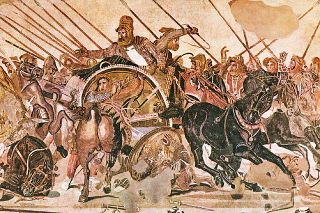
    The first "holy war" was invented by King Darius, the despot of the Persian empire who gained his throne through regicide.  A ruthless murderer, Darius held the enormous collection of subject peoples within his vast empire in check by force and violence.  Although a departure from the strategic clemency shown by the earlier Persian ruler Cyrus the Great, Darius's methodology was certainly nothing new.  Force and violence were, even at that early date, ancient tactics for subjugation.  What was new was something Darius concocted in 520 BC when the Elamites revolted against his rule.  No one knows what inspired him, but Darius was recorded to utter, "Those Elamites were faithless, they failed to worship Ahura Mazda."  Using this as a reason for conquest, Darius put down their rebellion in the normal butcherous fashion.  His innovation, however, would live on throughout time and become the bane of much of world history.  The features of his creation involved the concept that foes could be put down in the name of a religion (the fact that they had never practiced, or in some cases even heard of the religion made no difference), that warriors might be promised rewards in paradise for faithful acts of violence, and that conquest in the name of god (as proclaimed by the despot) was indeed a moral duty.  

    Darius may or may not have realized what he created.  His new device, however, would catch on quickly and find its way into the arsenal of many of history's most haneous dictators, and eventually into entire movements between civilizations (the Crusades spring most readily to mind).  In many cases today, entire religious sects claim the weapon as their own, the tool outreaching any lone despot.

    Today, the so-called "war on terror" is actually a determination to combat groups who adhere to Darius's device.  The challenge is that the adherents of this 2500 year old custom are varied and fanatical.  How is one to discern who is a "radical" and who is a "peaceful nominal adherent?"  What do we make of those "peaceful" worshipers who, nonetheless, dance in the streets when the radicals make a newsworthy strike (understanding that not everyone does this, of course)? 

    These are important questions, and particularly relevant at this time because we have just elected new leadership to our country.  One thing is a clear fact: the United States has not had terrorist strikes on its soil since the strong response to September 11th.  As one military friend of mine said, "Done correctly, it's better to take the fight to them then to allow them to bring the fight to us."  What will be the policy of the West moving forward, as it seeks to combat an enemy that presents itself as little more than "smoke to be grasped," or, in the words of Ronald Reagan, "curd jelly [to be nailed to a wall]?"

    Terrorism is unjustified no matter what perceived slights, mistreatment, western arrogance, national hubris, or journalist-declared poverty are given as explanation.  Evil in the name of any religion is still evil.  Do we treat with the murderers of children?  Do we try to behave like kowtowers so that they might like us more?  Should we honor them as victims and thereby justify their atrocities, all in the name of "understanding them" and appeasement (visions of Jimmy Carter tromping around with Fidel Castro at a Cuban baseball game come to mind)? Or do we meet strength with strength?  Do we strike preemptively to nip the problem at its source?  And in so doing, how do we avoid prolonged occupations and casualties of war?

    These are somber questions, and must be addressed by America and her leadership.  In this hour of change in our nation, may we have our eyes open to the reality of evil in the form of fanaticism, and remember the words of Will Durant, "Love peace, but keep our powder dry."
    Darius

  • Being a student of history has its advantages and disadvantages.  In a way, when things happen in current event that mirror events of the past, the student of history sees patterns and repetitions that he feels should be obvious to others.  This pattern of repeating history can lead to either pessimism or optimism.

    For instance, in this recent election, conservative principles were not really defeated, they weren’t even represented.  If the conservative principles espoused by the majority of the American population had been represented by the candidates in the Republican party, it is possible that the election could have gone differently.  But a president so quick to spend massive amounts of money on “finishing his daddy’s war” in Iraq and on insane “bailouts” following national disasters and government-spawned financial problems may call himself anything he wants, but in truth he governed as a big-government Democrat.  If the world thought his was an example of “conservativism,” no wonder they became disheartened with it! An analysis such as this can certainly lead to pessimism, realizing that when a candidate campaigns from one position and governs from another he weakens his whole party.

    On the contrary, history is replete with examples of dangerous cycles followed by revival.  For instance, when I was born the United States was embroiled in a messy “police operation” in Viet Nam and the civil rights movement was in full swing with riots in the streets.  This was followed by the OPEC oil embargo, then Watergate.  Quickly on the heels of these good times came Jimmy Carter and the Iran hostage crisis.  All in all, this was a pretty bleak stretch in American history.  However, Ronald Reagan arrived with a real set of principles that gained national acclaim and he was elected by a massive landslide victory.  He then proceeded to govern upon the same principles upon which he campaigned, successfully exposing Communism as the fraud it is and reigniting a doomed American economy.  The Reagan Revolution effectively rolled the wheel back, reinstituting the principles of freedom and setting the United States on course for more prosperous years.  There is certainly a lot more to the story, and much more analysis to be understood, but effectively a tide of shame and failure in United States governance (brought about by BOTH parties, by the way) had been stemmed and reversed.

    So, pessimism or optimism?  What do times such as ours call for?

    I would posit that we need a dose of each.  Allow me to recommend that you read an article posted by my co-author and business partner Orrin Woodward(click here to see the article). In this post, Orrin comments upon one of the most fascinating pieces of political commentary I have ever read: Alexander Tyler’s Cycle of Democracy. To me, Orrin’s comments are spot on.  We can gain a better perspective by understanding history and being wise to the fact that any nation that loses its principles will soon lose its freedom.  There are no guarantees.  But we can also take stock in the fact that God is sovereign, and throughout the course of history He has raised people up to shape events.  And always, these people who do so much for the cause of freedom in the lives of others must battle fiercely for it.  This is because freedom isn’t free.  It requires “eternal vigilance.”  It is a sacred flame that warms many, but is not beyond being snuffed out. My hope is that I can do my part to protect that flame, so that future generations may live under the benefit of its warmth, as I have.    
  • "Hurray for our side!" they yell with screeched voices.  "Think like us or be wrong," they imply with barely veiled anger.  Signs are stuck in front yards, bumper stickers adorn cars, and "neutral" commentators and newspapers are making their "neutral" statements that seem to support one side way more than the other.


    What is the cause of all this?  Ah, yes, my friend, it's election time again in the good ol' US of A.  


    So what is a normal, emotionally stable, average everyday person supposed to do in the middle of this firestorm?  As far as I can tell there are several options.


    1. go on a television talk show and use your best interrupting skills.  Smirk and shake your head, and just as your host is about to make a point, raise your voice and act all offended.  


    2. figure out how to cheat.  Get involved in a campaign to register dead, drunk, or mentally disabled voters and volunteer to drive herds of 'em down to the voting booths come Tuesday.


    3.  pepper the polls with false results so your side can proclaim an early victory and dishearten the other side from even showing up


    4.  help raise money from famous people so your side can make annoying infomercials that last forever and show all the time


    5.  find special interest groups to make promises to and thereby broker for blocks of votes.  


    6. fan the flames of hate, envy, or greed, being sure to divide people into "groups" and make them feel like victims.  This can be done in many different categories, such as race, sexual orientation, class, income level, decendancy, gender, and many other fine distinctions that can be found to divide people.


    7.  do your best to make the election about a choice between personalities, being sure to steer the discussions far away from those dangerous things like "the actual issues" and "realistic plans and strategies."  


    8. get involved in name calling and character assassination.  This again is much safer and easier than having an actual intelligent position on any issues.


    9.  Use broad words such as "hope" and "change" and "vision" 


    10. make sure that people do not vote their Bibles or their beliefs.  Keep them embroiled in partisan politics, voting the way "they are supposed to."


    And while these may be the actual activities of some, thank GOD that most of you out there will simply do the most massive thing on Tuesday, and that is . . .


    VOTE!!!!!!!!!!!!!!!!!!!!
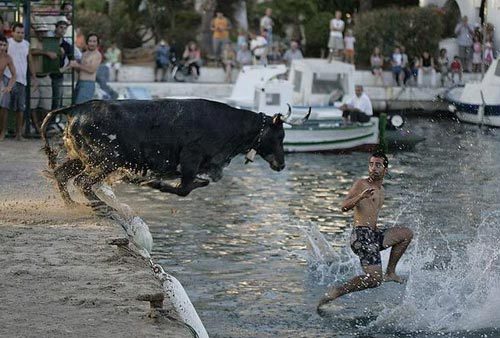
  • When I saw these photos (and others that were too graphic to post!) I just thought of the saying, "Sometimes the dragon wins."  

    File005File002File007File006File001

  • Okay, that's enough serious stuff on this blog for a while.  It's time to have some fun.

    Erik Weihenmayer, an extraordinary individual, is an author, speaker, and a mountaineer who has climbed the top seven highest peaks in the world.  He's also completely blind.  I had the pleasure of hearing him speak at a recent convention and laughed and cried at his story. One of the things he touched on made me chuckle, and every since I haven't been able to avoid using such statements in my daily life.  This has been a lot of fun (and perhaps annoying to those around me).

    Here's the concept:  Erik said he has a climbing partner who utters what he calls "Positivie Pessimisms."  I didn't understand what that meant, at first, either.  But once Erik explained it, I couldn't stop laughing.  Erik said in the middle of some difficult passage on the mountain, at just the right moment, his friend would utter something like the following:

    "Well, it might be freezing cold out here, but at least its windy." 

    or

    "Erik, you might be out of shape, but at least you're slow."

    Get it?  Statements that are positively pessimistic!  Just the kind of thing I hate to love!

    Anyway, since trying my hand at this little word game, I have heard the following:

    "We might be about to elect a man to the Whitehouse that hates America, but at least he doesn't have any experience!"

    and

    "One of the candidates for president is pretty old, but at least he doesn't have any personality!"

    and

    "Your momma may be ugly, but at least she's mean."

    You get the idea.  So, in the spirit of collaboration and having just a little fun once in a while, I JUST KNOW that all three of you readers out there will be able to come up with some good ones! Please, let us hear it!  Just how "positively pessimistic" are you? 
  • I received this comment from a reader, Brett Oyer.  I found it so interesting that I read it again and again.  I wanted to post it here so everyone would have a chance to read it and comment upon it.  Very interesting!  (Thanks Brett, for passing it along).  By the way, I like the first sentence the best!

    545 PEOPLE… by Charlie Reese
     
    Politicians are the only people in the world who create problems and then campaign against them.
     
    Have you ever wondered why, if both the Democrats and the
    Republicans are against deficits, WHY do we have deficits?
     
    Have you ever wondered why, if all the politicians are against
    inflation and high taxes, WHY do we have inflation and high taxes?
     
    You and I don't propose a federal budget. The president does.
     
    You and I don't have the Constitutional authority to vote on
    appropriations. The House of Representatives does.
     
    You and I don't write the tax code, Congress does.
     
    You and I don't set fiscal policy, Congress does.
    You and I don't control monetary policy, the Federal Reserve Bank does.
     
    One hundred senators, 435 congressmen, one president, and nine
    Supreme C ourt justices. 545 human beings out of the 300 million are directly, legally, morally, and individually responsible for the domestic problems that plague this country.
     
    I excluded the members of the Federal Reserve Board because that
    problem was created by the Congress. In 1913, Congress delegated its Constitutional duty to provide a sound currency to a federally chartered, but private, central bank.
     
    I excluded all the special interests and lobbyists for a sound reason. They have no legal authority. They have no ability to coerce a senator, a congressman, or a president to do one cotton-picking thing. I don't care if they offer a politician $1 million dollars in cash. The politician has the power to accept or reject it. No matter what the lobbyist promises, it is the legislator's responsibility to determine how he votes.
     
    Those 545 human beings spend much of their energy convincing you that what they did is not their f ault. They cooperate in this common con regardless of party.
     
    What separates a politician from a normal human being is an
    excessive amount of gall. No normal human being would have the gall of a Speaker, who stood up and criticized the President for creating deficits. The president can only propose a budget. He cannot force the Congress to accept it.
     
    The Constitution, which is the supreme law of the land, gives sole
    responsibility to the House of Representatives for originating and approving appropriations and taxes.
     
    Who is the speaker of the House?…She is the leader of the majority
    party. She and fellow House members, not the president, can approve any budget they want. If the president vetoes it, they can pass it over his veto if they agree to.
     
    It seems inconceivable to me that a nation of 300 million cannot
    replace 545 people who stand convicted — by present facts — of incompetence and irresponsibility.
     
    I can't think of a single domestic problem that is not traceable
    directly to those 545 people.
     
    When you fully grasp the plain truth that 545 people exercise the
    power of the federal government, then it must follow that what exists is what they want to exist.
     
    If the tax code is unfair, it's because they want it unfair.
     
    If the budget is in the red, it's because they want it in the red.
     
    If the Army & Marines are in IRAQ , it's because they want them in
    IRAQ.
     
    If they do not receive social security but are on an elite retirement plan not available to the people, it's because they want it that way.
     
    There are no insoluble government problems.
     
    Do not let these 545 people shift the blame to bureaucrats, whom
    they hire and whose jobs they can abolish; to lobbyists, whose gifts and advice they can reject; to regulators, to whom they give the power to regulate and from whom they can take this power.
     
    Above all, do not let them con you into the belief that there exists
    disembodied mystical forces like 'the economy,' 'inflation,' or 'politics' that prevent them from doing what they take an oath to do.
     
    Those 545 people, and they alone, are responsible.
     
    They, and they alone, have the power.
     
    They, and they alone, should be held accountable by the people who are their bosses provided the voters have the gumption to manage their own employees.
     
    We should vote all of them out of office and clean up their mess!

    Brett Oyer

  • I thought it might be appropriate to share here the great news that Terri's brain surgery went very well and she is presently in ICU beginning the road to recovery.  Continued prayers are asked for as infection, bleeding, and leaking of the brain's fluid can still occur.  Also, she will have significant pain and muscle stiffness as she presses through the coming days.

    The outpouring of friendship, cards, letters, emails, blog postings, and prayers has been truly overwhelming!  I thank you all from the bottom of my heart.  We could not have gotten this far in this ordeal without God, to Him be the glory, and without all of you and your warm friendship and encouragement.  We have learned who our true friends are, and they are legion!     

    Thank you all once again!  

  • Update:  Once again, reader input on this topic has been excellent and thoughtful.  Please be sure to read the comments below!

    Reader input has been overwhelming, and the comments have been informative and thoughtful since I decided to post a few politically-minded articles on this blog.  This is quite a change from the normal pace, what with the marvelous literary content and Pulitzer Prize-worthy content normally to be found here.  But hey, I get it.  So here’s one more thing to think about, and should you have intelligent contributions to make to this discourse, by all means, let’s hear what’s on your mind!

    Question #1: Why do we have a two-party-only system in our government? 

    Question #2: What if those two parties aren’t far enough apart?  (i.e. Would that mean we really only have a one party system)?

    Question #3: What would your ideal political party platform consist of?

    I can’t wait to read your inputs.  Too bad we can’t get answers to these kinds of questions to show up in the way we place our votes!

    Thanks for participating!

  • Many conservatives feel duped by George W. Bush, who campaigned from a position more to the "right" than where he governs (in particular when it comes to massive government bailouts and grants).  In short, he is more of a Democrat than most Republicans bargained on.  Someone said the same thing to me the other day about Barrack O’Bama; he is more to the left, and much more of a liberal, than most Democrats desire. One could make the argument that today’s Republican party holds about the same position the Democratic party held forty years ago.  Meanwhile, the Democratic party has moved way to the left.

    Based on the last post and the very intelligent and interesting comments that resulted, I thought I would once again ask for reader input.  Here is the question(s): Is America moving consistently to "the left?"  And if so, why?  Finally, how is such a thing possible in a country where the average person polled is "center to right-of-center?"  Let me hear your thoughts.

  • UPDATE: Please read the very thoughtful and informed comments that are coming in on this post.  Very helpful. 

    Second UPDATE: I would like to hear from you all what you think should be done, as opposed to what is being done (or not done).  Seems like we need the voice of the people on this one before the men behind closed doors scamper off with our constitution at a moment of national panic.

    I’m not the biggest current affairs expert on the planet.  I’m not the guy reading five newspapers and watching CNN and C-Span constantly.  I don’t yell at my opponents and I don’t interrupt. 

    I do, however, think our current financial crisis is serious.  Individual people are being hurt by what’s happening. ARM mortgages matched with declining property values have left folks upside down and scared.  In most parts of North America the job market is not that great.  The value of the dollar is pathetic compared to international currency.  Competition from abroad is stiffer than ever.  Oil is getting more and more pricey, and the proceeds go to fund our terrorist enemies.  And to top it all off, Tom Brady is injured and will have to sit out the whole NFL season.

    Smarter economic minds than mine have argued both sides of the Bail Out idea.  Congress and the President are staying up late arguing about it.  From what I can gather, it kind of goes like this:  If these financial institutions (which is a fancy name for companies that make money off off people by playing with their money and/or loaning them money at a higher cost than they could have earned it for themselves in the first place) fall, they will take down a lot of us little people with them.  That’s because if these financial institutions fall, they will take our money down with them.  If they take our money down with them, we won’t be able to get it back from them.  And if we can’t get it back from them, we won’t have it.  But we need it.  Badly.  Problem is, these companies are in trouble because they’ve already lost our money.  It’s gone amissin’.  That’s why a Bail Out is needed.  So the government Bail Out is basically the idea that the government will rush in and give the financial institutions money to replace the missing money that we gave to them in the first place.  Then they will have it and they won’t fall.  Since they won’t fall, they won’t take our money with them.  If they don’t take our money with them, then we won’t lose it.  Therefore we won’t fall.  Everybody lives happily ever after.

    Only question is: Where did the money go in the first place? 

    Maybe the "financial institutions" left it in their Armani suits or corporate jets and just forgot where they put it.

    And the only other only question is: where is the government going to get the money to give to the financial institutions? 

    If the government doesn’t actually "earn" money, that means that they will be coming to us to get it (the technical term, I believe, is called "taxes.")

    But we don’t have it.  The financial institutions took it and lost it someplace.

    So the government is going to come to us to get more money to give to the people who lost our money so we won’t lose our money.

    Whew.  I feel safe. 

    I know, I’m probably being too simple-minded.  This whole thing probably involves some pretty complicated economics somebody needs to explain to me, which can probably only be done by a politician.