(For those who missed Part I, you can view it here.)
Sincerely,


“The only way to be happy, is to give happy.”
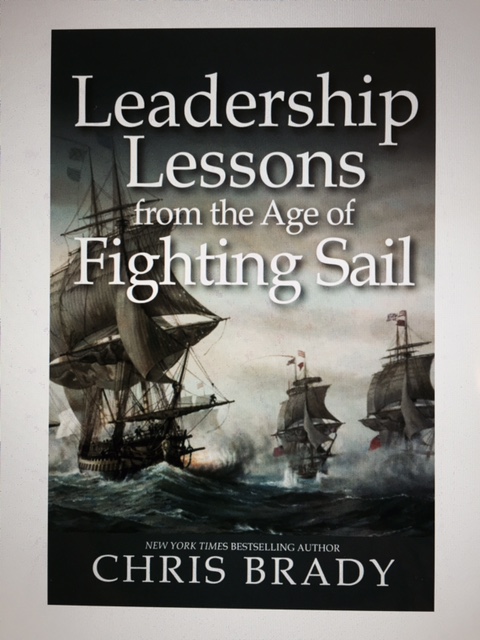 With just about the lowest amount of fanfare possible, my new book Leadership Lessons from the Age of Fighting Sail was released this month. I have been so busy with my duties at Life Leadership that I was able to give exactly zero thought to the launch and promotion of this book. My efforts in that direction will probably involve nothing more than this blog post.
Therefore, since this is the only crack I'm taking at shamelessly promoting my own work, I thought it might be appropriate to give just a little background into how the book came into existence.
Over ten years ago I received a piece of junk mail that actually caught my eye. I have no idea why it came to me, or why it grabbed my attention, but there I stood in my kitchen amid the normal frenzied paper-pitching that takes place when sorting the mail into piles of bills, more bills, junk, and more junk. It was a mass market catalogue of various books for sale. Toward the center was a section featuring the novels of Patrick O'Brian, the English novelist who by that time had received worldwide acclaim for his "Aubrey-Maturin" series of historical fictions. His popularity, however, had not until that point reached me. I had never even heard of him. But the descriptions of the books, the many testimonials by avid readers, and the wonderful paintings of ships at sea and in pitched battles among tumultuous waves (painted, I later learned, by Geoff Hunt), made me decide to order the first book in the series and give it a read.
I was blown away (sorry, my love for puns is well known to all three of my fans).
Master and Commander, the first book in a series of twenty, was singularly excellent. Geographically precise, historically accurate, botanically and medically expert, and nautically steeped, the biggest draw was the depth and reality of the main characters. I quickly fell deep into the classic genre of the "buddy story." As I continued to read through the remaining twenty volumes over the next many years (intentionally going slowly to deepen the enjoyment), I would often find myself between books wondering what those characters were doing at the moment! They seemed so real as to be existing somewhere simultaneous to me.
And just like that my interest in a particular period of history (the span from the Spanish Armada in 1588 to roughly the end of the Napoleonic Wars in 1815) was born. As a result, I began reading extensively on the history of the period and the details of wooden, square-rigged sailing ships, and soon discovered that O'Brian was a master historian as well as a novelist. The settings, events, and environment captured in his novels were intimidatingly accurate. In my reading of the straight history books of the period, I was exposed to colorful real-life figures and immense examples of the leadership principles I teach every day in my work, applied against a most interesting backdrop. It wasn't long before I began highlighting these examples in a manuscript of my own.
I raced through the creation of nine or ten chapters during the course of about the first two years. But as it often does, life intervened with other responsibilities and distractions, and soon work on the project slowed first to a crawl, and then to a stop. The book was dead in a drawer (or, more accurately, a Word file).
From time to time I would dust it off (open the file on my laptop) and begin once again with the greatest of intentions to finish a work that had begun amidst fire and passion. But the embers wouldn't rekindle and eventually, I gave up. In my mind, as I wrote other books, started companies, and built businesses, my little pet project all but died stillborn.
Recently, however, I determined to resurrect it, quickly discovering that a work once laid aside is not the easiest thing to pick back up again. I wrestled and wrestled, stopped and wrote another book, and then made one final push to bring this one back to life. The difficulty stemmed from the massive amount of research required in order to write almost every sentence. I quickly gained respect for writers of history. And slowly but surely, my love of the subject matter refueled my determination to extract the image I'd always had of the finished product out of my head and affix it to the page. Chapters were rewritten, some were discarded, examples were rearranged, and by the end, I was becoming as proud of this work as any I'd done before. The characters had come back to life, the battles rang again in my ears, and the wind and waves spoke to me all over again.
It is my sincerest hope that they will do the same for the reader.
This book, tougher than all my others to create, is now out there for you to experience. May it bring you as much joy in the reading as it ultimately did me in the writing. I know, that in putting together these true illustrations of incredible leadership examples, that in the process I also became a better leader. I hope that you do, as well. (I have posted the Preface below)
God bless!

PREFACE to Leadership Lessons from the Age of Fighting Sail
You’re cold. The salty wind bites right through your thick wool coat, and even finds its way past your waist coat. You hold your hat firmly to your head and squint at the gray horizon, thinking that your eyes aren’t as sharp as they used to be. The deck pitches beneath you but you barely notice, and your ears picking up the sound of the wind in the rigging subconsciously tell you that everything is trimmed just as you like. The ship, the sails, the weapons below deck, the wind, the waves, navigation, stores, it’s all part of your natural environment, it’s all a matter of course for you. You manage them all with the cool proficiency that comes only with years of experience.
You know, however, that there is way more to victory than proficient management. You know this well. As you stare at the bodies swarming up the ratlines and around the myriad of obstacles on deck, you think of the crew. It’s the men, and the leadership they follow, that makes all the difference. As if on cue with your thoughts, one of them breaks the silence and stands at attention in front of you, rain dripping from his whiskers. “Orders, sir?”
You are in command. Your job is so challenging, so complex, so never-ending that most people could never come close to understanding the load you carry. You are thrust into impossible situations with little time and usually even less information upon which to make a decision. And you are entirely responsible for the outcomes, good or bad. You will be subject to critical analysis and scrutiny from people not engaged in the heat of the moment, not under the pressure of responsibility, and not in your boots. They will pick you apart and be quick to judge every little thing you do. But that’s leadership, you think. It’s what you love.
“Orders, sir?” the man repeats, and you detect a measure of impatience or panic in his voice. He needs your decision, and he needs it now. Everyone aboard is waiting for it, counting on it, depending on it to be right. And as always, there is no time to lose.
You make your choice, and pray that it’s right. Then you do all in your power to make it right, knowing that there is no turning back. In sum, you do what is expected of you; what you expect from yourself – you lead!
Related articles
There is much to learn from everyone. In particular, when someone has achieved phenomenal results in life, much can be gained from a study of their triumphs and tragedies. Over the course of the past 18 months, I have been consistently studying the lives of many different high achievers. These have ranged from musicians and entrepreneurs, to sports stars and inventors. Much of what I've uncovered has been produced by Life in their popular Launching a Leadership Revolution subscription series. I would like to thank the many customers who have provided kind reviews on this material. I am truly glad that you've found it not only interesting, but helpful.
One of the more fascinating characters I've studied is the record-shattering painter, Thomas Kinkade. His life was filled with tremendous success, but also some colossal blunders. What follows is the first in a series of quick video snippets of my delivery of some of this information in front of a live audience. I cannot even remember where this particular talk was given, and I have no explanation for the jungle motif behind me. If you can take your eyes off of the poisonous plants long enough to pay attention to what's being said, I think you might find a nugget or two to help you in your own leadership journey.
May you prosper and serve!
Sincerely,

Excellence is beautiful in any genre, and what could be more illustrative of the concept than motorsports? I’m not sure if the driving, filming, or creative course are my favorite part of this, because I love it all. But let this stand as a picture of what creativity and mastery are all about.
Enjoy!
Success leaves clues.
For that reason, I've long been interested in studying individuals who have managed to make something of their lives and contribute value in this big complicated world. Whether it's historical figures or contemporary business celebrities, I never tire of digging into their lives and decisions to see what can be gleaned.
But one thing always brings me up short: the why behind the what.
It's one thing to read about a decision someone made, but it's another entirely to understand why they made that decision, and just how they knew to make that particular choice.
The question I often find myself asking is, "How did they know to do THAT!?"
Recently, I was reading about the Jeff Bezos, founder of Amazon, and how he pushed the concept of Whispernet through his organization so that when they released the Kindle e-reader, the device would be instantly connected anywhere and ready to immediately download a new book purchase. Only through much pain and expense was Bezos able to make this happen. How, I wondered, did he know to press so hard for its implementation, when it appears that nearly his whole staff was opposed to the idea? With everyone against his revolutionary concept, which some warned could swamp the entire company, Bezos mercilessly forced it through.
 How did he know to do that?
For wouldn't you know it, Whispernet and the possibility of instant book purchases was the very idea that broke the dam of resistance on the part of the big publishers and convinced them to invest the money required to digitize large quantities of their physically published book titles.
Bezos had made the right choice. He's a smart guy, brilliant really, and that's just how things work. Super intelligent egg-head types make fantastic decisions and that's why they win.
Not so fast.
Because if you study further, with a more scrutinizing eye, you'll quickly discover that the brilliant people of the world are no more clairvoyant than the rest of us. In fact, they don't see around corners any better than anyone else. What you really find out is that they don't predict the future as much as they create it.
But how?
Decision making, while important, is not the key. Instead, it's the mindset they're in when they make the decisions that counts. Because, and here's an important point: it's not so much that we make the right decisions, but rather that we make decisions and then work to make them right.
This requires the right mindset, what we'll call the "Mindset of a Champion."
Where does this mindset come from?
I was given a clue to this answer in an interview I read of one of Jeff Bezos's high school girlfriends. In it she stated that the reason Bezos was building such a huge company wasn't for any of the reasons Wall Street was measuring, but rather for the purpose of "getting to outer space."
Say what?
Yep, apparently Jeff Bezos has had the dream since boyhood of exploring outer space and even colonizing Mars. His purpose seems to be way beyond selling books, launching a successful startup, or dominating the internet. Behind all of his successes (which have eclipsed the mere sale of books, by the way, including big data and cloud computing, and now involves even the concept of drones delivering packages to individual addresses), lies an enormously outsized dream to do what no one has done before.
And here lies the real key to his success.
It's not Bezos's poignat decision making per se, but rather what lies behind those decisions. It's the Mindset of a Champion, guided and driven by an over-arching dream and vision so big that most people can't even relate.
This dream evokes a passion, and that passion drives the decisions, good or bad, so that even if a decision isn't exactly the "right" one, it is quickly learned from and immediately used to inform the next decision to be made.
In this way we can see how it works for the wildly successful. They are visionaries and dreamers and feel the magnetic pull of what should be, so strongly, that the passion pushes them through all manner of proper and improper choices, each one course-correcting and aiming ever more effectively at the ultimate target.
This way of living could be no more different from the life of the "average" person who occupies the days of his or her life with television, sports, earning a basic wage, and living for the weekend. The Jeff Bezos's of the world don't live for the weekend, they're preparing for the world's end. The scope is so different it's nearly incomprehensible.
And so we see the real secret of outlandish success: a powerful vision of what can and should be.
This provides the passion . . .
that drives the decisions . . .
that makes those decisions right . . .
over time.
And by the way, Bezos's space company Blue Origin is already well on its way toward accomplishing his dream of "getting to outer space!"
Rock on, Jeff!
Sincerely,

"Interconnectivity" seems to be the category in which most technological advancement is directly impacting our lives. There appears to be an over-abundance of companies, methods, and means by which we can communicate. All this advancement has changed things – radically – some for the better, some for the worse.
What hasn't changed, however, is the importance of communicating well. No matter who you are, what you do, and what you plan on doing, you will likely benefit from becoming better at communicating.
Consider how many different means by which we can interact with one another:
– Face-to-face
– Telephone
– Telephone messages
– Voice message applications
– Texts
– Emails
– Video conferencing
– Social Network Sites
– Chat rooms and forums
– Letters
– Greeting Cards
– Video platforms
– Photo platforms
– Addressing a meeting or small gathering
– Carrier pigeon
– Smoke signals
Given the preponderance of communication media, and the growing amount of communicating we do, I would recommend that we begin to consider communicating to be one of the "categories" in our lives. We tend to think in terms of categories such as fitness, finances, and family. Perhaps it's time to add Communication to the list. What I am suggesting is that it becomes an area in which we intentionally monitor our performance, and hold ourselves accountable for improvement.
Let's start with big picture stuff:
Communication should be Clear – how many inscrutable emails do we get?
It should be Often – don't make people wonder, especially in areas of problems (creditors, for instance) or intimacy. Stay in their minds.
It should be Honest – you are only as good as your word. Old fashioned, maybe, but truer today than ever.
It should be Professional but Fun – in today's casual world, it is still okay to be proper, correct, and upstanding in your messaging. However, don't forget to pump your personality into it, too. Nobody likes boring!
HOW you communicate something is critical! You can have the right words, but say them or communicate them in the wrong way, and you've done more harm than good.
Listening will always be a big part of good communication. When it comes to listening, be active, sincere, engaged, with good eye contact, and avoid interrupting. If necessary, have people repeat things back to you, or even summarize key points back to them.
Remembering names is another critical area of good communication. There is no excuse for being bad at this. One of the hottest tips I can give in this department is to always try to be first to introduce yourself, whether to a lone individual, or in a crowd. The reason for this is that you are informed ahead of time, so to speak, that a new name will need to be remembered, and you won't have to be caught off guard. Walk up to the person(s) and initiate, eagerly listening for the name(s). Then, immediately, repeat it back to yourself multiple times as the small talk flies. The name is, by far, the most important thing you need to take away from this initial encounter. Also, repeat it aloud once they've said it. This will both help you remember it because now you're hearing it a second time, and the other person always likes to hear her name spoken anyway. Plus, it shows that you care enough to make a point of remembering it.
Now, when it comes to all those methods of communicating listed above, there are several things to know.
1. Be sure and use the appropriate means to match the situation. For example, don't handle conflict with voice mail, email, or text. It's best done face-to-face.
2. In most cases, your relationship with another person will require a mix of several of the above.
3. Understand that response times have decreased, and people almost demand to hear back from you right away. You can fight this a little bit by establishing "policies," as in, "It's my policy to answer emails within 24 hours." In this way, no one can complain if you don't respond to one in four milliseconds!
4. Think about your privacy rights, and those of your children. Anything and everything you post becomes public and permanent (with the exception of a few questionable app services which are trying to correct this). Do you really want those private moments on display for the whole world? Will your children want that record of their "awkward years" out there forever? Are the photos you're posting causing a security risk because the world knows exactly where you are and who you're with? Is it obvious your house has been left unattended? Did you just inadvertantly alert the world to the location of your child? Just give it some thought and establish some boundaries for yourself.
5. Also think about legalities. Most people don't realize that all of their communication can be subject to a court order of discovery and can be used against them. It may be unlikely, but if it's ever happened to you, it will forever change how flippant you are with what you communicate, to whom, and how.
I could go on for pages and pages in each of these areas, but mostly just wanted to open up the subject here at a high level. The overall goal is to make communication a category in our lives, and strive to be intentional and excellent at doing it.
Ultimately, communication is simply expressing to the outside world who you are at heart. So, when it comes to communication, always try your "heartest."
Sincerely,
 Ideas are funny things, and everyone seems to have some sort of idea about ideas.
For instance, one famous quote (usually attributed to Ralph Waldo Emerson, but which is actually a misquote of an earlier statement by him) goes like this:
"Build a better mousetrap and people will beat a path to your door."
But a more accurrate quote, which I'm sure all of you who've had good ideas can agree with, goes like this:
"Don't worry about people stealing your ideas. If your ideas are any good, you'll have to ram them down people's throats." –Howard Aiken
Take wheels on suitcases, for instance. Now there's an idea so good, as soon as you see it you can't imagine how anyone ever got along without it. But would you believe that we put a man on the moon a full two years before we put wheels on suitcases? Probably because we didn't have an American President making speeches and compelling a nation to pull together and fulfill the grand vision of figuring out a way to "make our baggage more mobile within a decade! Ask not what your country can do for you . . . ."
But one man, Bernard Sadow, had the idea for wheeled luggage, and (would you believe it?) he actually had trouble selling his idea! You can read about him here.
In studying this topic and giving some talks about it recently, I have decided to add to the already enormous body of thought on the subject. It might not be a good idea to do so, but hey, good ideas are hard to launch. So a not-so-good idea? I figure I may as well give it a try. So here goes:
An idea goes through many stages on its journey to fruition:
1. Realization – you see the problem to be fixed, clearly, and perhaps for the first time
2. Mechanization – the method by which you "think it up." It may be a brainstorming session, a conversation with someone, or an accidental occurrence (the invention of Post-It notes comes to mind)
3. Assimilation – the combining of previous ideas into a new one
4. Inspiration – the catalystic spark or insight that puts it together for the first time, and the desire to change the status quo that pushes the process along
5.Germination – most ideas are not hatched fully formed, instead, they need to grow and blossom under more thought and consideration (and even discussion)
6. Elation – the passion that arises when pursuing a real improvement or breakthrough
7. Confirmation – when you first begin to realize you've got it, and evidence suggests that it really will work.
8. Dissemination – the act of forcing your good idea down other people's throats!
Of course, there are many additional "ation" words we could throw at this, but, um, that wouldn't be a good idea.
What's helpful in this is to realize there's a process by which most good ideas come to life, and by considering these steps, we can put ourselves in a position to be more creative and better at problem solving. Let's look at the 8 steps again with an eye to how to apply them:
1. Make sure you have invested the thought time to clearly identify and classify the problem, truly understanding it as thoroughly as possible. Be sure to work toward the root cause and avoid being misled by the symptoms.
2. Take steps to actively generate possible solutions. This may involve gathering with others, making sketches, having a brainstorming session, benchmarking the competition, or just playing around with things.
3. Realize that most new ideas are just combinations of previous ones, and ask questions such as, "What could we combine that has never been combined before?" and "What do we already have available or have already done that could be synthesized into something new here?"
4. Provide motivation to yourself and your team by visualizing and vision-casting success and a new, desired reality that will be brought about by the solving of this problem or the creation of a breakthrough idea.
5. Provide healthy nurturing and incubation for your ideas, allowing them to be considered openly without having to survive the negative attacks of "It'll never work" and "Not my idea." Keep egos and reality tests away from your new ideas when they are young and give them time to morph into something real.
6. Enjoy the process and refuse to become frustrated, which often shuts down creative channels. Instead, foster the enthusiasm of a treasure hunter nearing the red X on a map.
7. Carefully test your new ideas to verify their validity, and have an open process for analyzing how effective they might actually be in the real world.
8. Have a process for sharing your idea outward into your organization (or the world) that allows it to first be received by those who stand the most to gain by it, thereby gaining momentum and strength before it attracts critics and detractors.
But the most important thing to know is this: the future can be whatever you want it to be, you merely have to think it up!
At least that's the idea.
Sincerely,

When I am an old man
I want to sit in Italy
On a bench in the sun,
With a view behind me
And the town before,
The reverse of my life.
I will watch it all:
The birds and the buses
And the old Bitties,
And of course the weather.
I’ll wonder why I began
In a cold northern town
When places like this existed
And took a lifetime to find.
I’ll think about time
And how much I once had
And wonder how much
Might still remain.
But I won’t worry
And I won’t hurry
And I will never serve again
A To Do list or a goal
And will no more
Monuments make.
I’ll wonder why
(You know I will),
I never really did it
What I was built to,
And dabbled instead
At the edges of it all
Like a child scared of a pool.
But I won’t regret it,
No, not for a bit,
Because I’ll be old –
So crotchety old –
In Italy, no less,
Where every old man
Should get to sit.
Sincerely,

Time spread too thinly across too many activities is a killer for anyone truly seeking mastery. There simply isn't enough time to become a master at more than one or two things in life. Time doesn't wait forever. Health doesn't last forever. Windows of opportunity don't remain open forever. Relationships will not wait forever. Time lost is time lost. Period. Mastery is only available if given enough time, and delaying or restarting Immersion or spreading oneself too thin both deprive one of the time required for mastery.
Also, one can easily observe that attempting to compete part-time with someone who has dedicated himself full-time to a profession is likely an exercise in futility. Sooner or later the person with the most focus, the most commitment, the most "skin in the game" will win.
In order to take the fullest advantage of life immersed in a worthy pursuit, one must focus. We are all busy. There are many, many different responsibilities in life. We have family obligations, work responsibilities, friendships and other interests. However, mastery requires concentrated immersion in the subject at hand. The more concentrated our focus, the more quickly proficiency and expertise will result. That means throwing ourselves all the way in. There is no partial immersion. Immersion works because, like the Hokey-Pokey, it requires us to throw our whole selves in.
Sincerely,

Related articles


