

-
Author Alan Axelrod recently wrote an interesting sidebar about founding father John Adams:
"'For my part,' John Adams remarked, 'there was not a moment during the Revolution when I would not have given everything I ever possessed for a restoration of the state of things before the contest began.' This is perhaps the most extraordinary confession of the entire war. It tells us that debate, doubt, and even regret were active at the very core of the Revolution, that the idea of reconciliation was at least as powerful as the idea of breaking away, and that words and ideas would be as important in shaping the conflict as powder and lead. If King George III and the conservatives in Parliament had been even a little more conciliatory, or if men like Thomas Paine had been a little less persuasive, it is likely that the Revolution would have been averted or settled amicably."

We read and talk all the time about the brave defiance to tyranny the colonies exhibited during the Revolution, we see how they risked their "lives, their fortunes, and their sacred honor" to stand up for what was right, and we know that they fought a long and bloody war and ultimately survived to birth a free nation. But it is easy to forget that they attempted, repeatedly, to offer the "olive branch" to King George III and Parliament, we forget that they also had a yearning, deep down in their breasts, for peace and harmony.
Why was the natural inclination for peace and appeasement not heeded? Why was the wish to avert armed conflict not satisfied? In my view, it was because God had other plans. Although it would have been nice to have averted war and found a way to maintain peace, it wouldn't have been right. Although it would have been easier to keep the status quo and preserve tranquility, it wouldn't have been just. And because these people were willing to sacrifice to stand firm for what was right, a great and mighty result was accomplished that has benefited hundreds of millions, living in a free society, ever since.
This brings us to, perhaps, one of the most difficult things for good-hearted, peace-loving people to understand:
Without justice, there can be no peace.
Who among us wouldn't desire peace over war? Who among us wouldn't wish tranquility over violence? Who among us wouldn't ignore some small offense for maintenance of the status quo? Who among us, in the heat of battle and at the height of sacrifice, wouldn't, like John Adams before us, wish to turn back the clock and return to simpler, quieter times?
This reminds me of a scene from the movie Lord of the Rings, in which Frodo becomes weary and scared of his un
 solicited burden of carrying the ring back to Mordor. In speaking to Gandalph, Frodo basically says he wishes he'd never been given the ring to carry. Gandalph's answer is beautiful, and to me, entirely correct. Paraphrasing, Gandalph basically says, "That's how everyone feels when they find themselves in a position of great responsibility (where their peace and affluence have been wrecked by a fight for justice), the only question is, what are you going to do with the time you've been given?"
Why does Gandalph answer Frodo by talking about time? Because how we use our time goes straight to the heart of the matter. Frodo was longing for bygone days of peace and solitude. Frodo had grown weary in well-doing. But Gandalph reminded him that he still had a choice. He could continue his fight for good, his pursuit of justice against the dark forces of evil, or he could return to his solitude and peace. The choice was clear, Frodo could either serve his sense of justice, or he could serve his desire for peace. But at that moment, he could not choose both.
Peace and irrelevance?
or
Struggle and justice?
And so simplifies the choice faced by every hero who ever lived.
Who wouldn't want to avert conflict and loss? Who wouldn't want peace and affluence? But the question remains: at what price?
Peace and affluence should never be chosen over justice.
So as John Adams and Gandalph both knew:
Some fights are worth making.
-
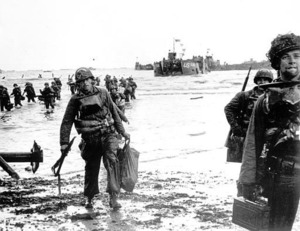 The famous quote, "Tyranny, like Hell, is not easily conquered," comes from Thomas Paine’s The Crisis, written during the American Revolutionary War. The saying was galvanizing to those who sacrificed in the great cause of independence. Later generations would take comfort in those same words, coming to realize what we have been discussing on this blog for a while now, namely that "Freedom isn’t free."
 In an Australian news article from summer of 2004, the 60th anniversary of D-Day during World War II, I found it interesting that Australian Prime Minister John Howard echoed the words written by Thomas Paine more than two centuries previously and a world away. Here is a brief excerpt from that article (taken from the Sydney Morning Herald, June 7, 2004):
Australians were willing to fight in wartime because they knew their freedom could not be delivered by others, the Prime Minister, John Howard, said in a speech commemorating the 60th anniversary of the D-Day landings yesterday. In a clear parallel with current events in Iraq, Mr Howard said D-Day was significant "because it’s a reminder that tyranny, like hell, is not easy to conquer". He said one of the Australian characteristics was that we always helped others in wartime. "We’ve always accepted a responsibility to do our bit and we don’t think our freedom and liberty should be delivered by others. We think we have to play our part in delivering our own freedom … and we’ve never profited from the sacrifice of others to deliver the sort of life we have today." The Prime Minister was in Normandy with 17 other leaders, including the US President, George Bush, the Queen and the British Prime Minister, Tony Blair, to remember, mourn and celebrate the sacrifices made on D-Day – the turning point of World War II in Europe. About 30,000 soldiers were deployed to protect the dignitaries. Advertisement Advertisement Mr Howard’s comparison with today’s events was echoed by Mr Bush, who said: "We … remember the timeless lessons that D-Day teaches, that sacrifices must always be borne in the defence of freedom, that free nations working together can overcome danger …" The French President, Jacques Chirac, said the occasion was "an opportunity to say to America and to Americans just how deeply grateful we are to them today".
All in all, a touching commentary about heroes and heroic principles that saved the world, at least for a time, from the fangs of tyranny.
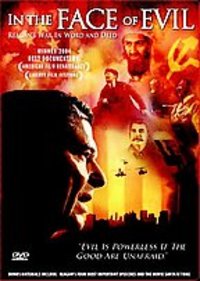
One of my all-time favorite documentaries is called In the Face of Evil. It was inspired and based upon the book entitled Reagan’s War by Peter Schweizer, which I would also recommend. Throughout the documentary, the narrator referrs to the forces of tyranny, whether they be Trotskyism, Bolshevism, Marxism, Communism, Naziism, or Radical Fundamentalist Islam and its terrorists, as "The Beast." I thought this labeling very clever and effective. After all, oppressive power in the hands of evil can be considered as nothing other than "beastly." Through a touching chronicle of the struggle of good versus evil, the documentary shows how, time and again, the forces of good banded together to fight back the oppressive forces of the Beast.
May those of us that treasure freedom always be willing to fight the Beast in its every form; whenever it presents itself at our towers, our Marine barracks, our airports, our bus stations, our subways, or wherever it may be found. The Beast manifests itself as oppressive governments, terrorist theocracies, and corrupt corporations – but the root of the Beast is always the same: power lust, greed, pride, envy, and hate. And the Beast always feasts upon the same thing – weakness, ignorance, and indifference. Therefore, the best way to constantly stand in the way of the Beast is to be strong, informed, and involved.
As Edmund Burke said: "The only thing necessary for Evil to flourish is for good men to do nothing."
-
 In a previous post we discussed the origins of the foundational ideas that the United States was built upon. We discussed the common education and understanding of guiding principles shared by the founders. This understanding and knowledge came from the minds of many great men who had thought and written years before America's birth. We already talked about Cicero. Now let's look to some others that inspired the founders.
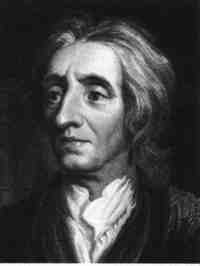
If Cicero provided a foundation that there is a concept of Natural Law delivered by the hand of a Natural Law Giver, then others expounded upon what rights are inherit under that law. One among these is the Englishman, John Locke. Locke wrote:
"The state of Nature has a law of Nature to govern it, which . . . teaches all mankind who will but consult it, that being all equal and independent, no one ought to harm another in his life, health, liberty or possessions; for men being all the workmanship of one omnipotent and infinitely wise maker; all the servants of one sovereign master, sent into the world by His order and about His business; they are His property . . .And, being furnished with like faculties, sharing all in one community of Nature, there cannot be supposed any such subordination among us that may authorize us to destroy one another." (Second Essay Concerning Civil Government, Great Bookos of the Western World, vol. 35)
Notice what Locke is saying here:
1. those of us in Nature have been given a set of Laws which govern our behavior
2. we are all equal and independent under that law
3. we are all created by the same all-powerful Creator
4. we are the servants of the Creator
5. we are here by the order of the Creator
6. we are here to do the Creator's business
7. we are the property of the Creator
8. as such, we are not free to harm each other by the exercise of our own personal freedoms
To get to the details of the rights that are inherit within this structure of Natural Law, we look to William Blackstone, who wrote:
"Those rights, then, which God and nature have established, and are therefore called natural rights, such as are life and liberty, need not the aid of human laws to be more effectually invested in every man than they are; neither do they receive any additional strength when declared by the municipal laws to be inviolable. On the contrary, no human legislature has power to abridge or destroy them, unless the owner shall himself commit some act that amounts to a forfeiture."
This is what is meant by our founders when they say "unalienable" rights: they are given to us directly by our Creator and are therefore to be respected, protected, and never tread upon by humans or human government
 s. They are "natural" rights.
Then, barely a decade before the Declaration of Independence was written, Blackstone penned the following:
"And these natural rights may be reduced to three principal or primary articles: the right of personal security, the right of personal liberty; and the right of private property; because as there is no other known method of compulsion, or of abridging man's natural free will, but by an infringement or diminution of one or other of these important rights, the preservation of these, inviolate, may justly be said to include the preservation of our civil immunities in their largest and most extensive sense."
So Blackstone summarizes man's natural rights into three main categories:
1. personal security
2. private property
3. personal liberty
Any time a government, individual, or body of any kind infringes upon these three basic, God-given rights, according to Blackstone, a violation of God's laws themselves is occurring. It certainly makes one wonder about the current state of affairs in our country today, where the government, the court system, and other powers that be are allowed, under the law, to infringe on each of these.
One can see a clear progression of thought here. Going from Cicero's declaration that there is a Natural Law provided by a Natural Law Giver, and Locke's testament that we have rights that are inherent under that Law, and Blackstone's delineation of what those specific rights are, we can see the philosophical thread, congruent with a scriptural world view, that took shape to form the basis of America's founding.
-
 My name is OBSTACLES, and for you English speakers it’s Greek, so it’s pronounced “Ob-stock-a-leez.”
 I am your worst enemy. It is my pleasure and privilege to haunt your every move toward self-improvement and success.
I have many weapons I can use against you. And I am so confident that they are superior to your pathetic little assaults on success that I can even tell you about them and it will make no difference. So here they are. (Maybe by knowing them, you can at least make it a contest between us. I’m getting rather bored. After all, there have been very few Tim Marks to come along and really beat me despite my best efforts to do my worst).
· Criticism: This is one of my favorites! I am always surprised how much you ambitious ones are slowed down by the negative inputs of bystanders! It cracks me up, actually. If you spent half as much time worrying about your own future as you do about what others think you would be stinking millionaires!
· Self Doubt: This one is fun, too. I can convince you that despite all those other great things you’ve done in your life you are not worthy of your latest endeavor. This is the one you should see right through immediately, but, alas, many of you don’t.
· Discouragement and Frustration: These are a joy to use. They stem from the most common of human indulgences: self-pity. If I can get you thinking you’ve paid a high price for very little gain, you will slow down and start thinking about yourself instead of the task at hand.
· Complacency: This is one of my most sneaky. It basically involves convincing you that you are already doing “pretty good”. After a few doses of this, you will be lucky if you can even get yourself off the couch.
· Distraction: Oooooh boy do I love this one. You get running toward success with all kinds of enthusiasm and then wham! Off to the side you go, chasing some little this or that which will add up to nothing in the long run. I can throw this one at you in the form of family changes, a promotion at work, a sports team that does well, a fight with your spouse, it’s pretty easy, actually. And then years pass and it’s too late! I love it.
· Arrogance: Yep, this is another reverse-screen-play. Sometimes you guys actually resist many of the above devices and make it this far into my defenses. That’s when I hit you with cockiness. It’s pretty easy, actually. Because if you make it through all of the above then you probably have a pretty secure self-image. It’s a lot like martial arts where one opponent uses the weight and momentum of the other opponent against him. Here you come charging ahead, all gung-ho for success, full of confidence and focus, and then I release it. You puff up like a peacock all sure that you are the end-all know-it-all. And you know what they say, pride cometh before the fall. Ooooh boy, how I love to watch them fall!
· Suspicions: If I can’t get you to doubt yourself, and then if I fail to get you cocky and overconfident, then almost certainly I can throw a little ‘blame’ temptation at you. Just how much do your mentors really care about you? Can’t you see, after all, that they aren’t perfect? Yep sir reee! This one is a real hoot. It’s great!
Well, that’s probably enough for now. Don’t want to give away all of my trade secrets in one blow. No matter, though, I’m confident I can still decimate the masses that think they’re heading towards their goals and dreams. In no time at all I can send them back to their previous 95% lives, watching television and heading nowhere.
I am the unstoppable!
I am OBSTACLES!!!!!
Come on, you guys. JUST WIMPIFY!!!!
(You know you want to!!)
-

 There is a flurry of activity on the Internet this morning. My buddy and long-time business partner, Orrin Woodward, has decided to pour out his heart. On his leadership blog, Orrin has posted a couple articles to start a series in which he is telling all about his history in the Amway/Quixtar business.
 It is nostalgic for me to read; remembering all the hundreds of thousands of miles we drove in those days, the nights we stayed up late with people, the tears, the frustrations, the joys, the relationships, the excitement, the disappointments, the victories,
 the defeats, the re-awakened dreams, the personal growth, the 5,000,000,000 cassette tapes we listened to (or thereabouts!), the seminars we attended, the cramped hotel rooms we stayed in, the "No’s" we heard, the "Yes’s" we heard, the things we learned, and the personal growth we experienced.
 I guess everything that happens in your life is a part of who you become. I have met thousands of people in their living rooms, at their kitchen tables, and one or two on their picnic tables out back! I have found and forged friendships that will last a lifetime. I have met some of the greatest people on this planet through my involvement in this industry, and I am thankful for all of them being in my life. Additiona
 lly, I have experienced some of the funniest stories one could ever imagine:
1. people with food stuck in their beards the whole time we talked business
2. two different occasions where women told me their dream was to get breast im
 plants
3. the husband and wife who got into a screaming match right in front of me and wouldn’t let me leave because they wanted me as a witness
4. the guy that wanted to make a bunch of money so he could open a strip, shoot, and drinking establishment
5. the play group made up of a bunch of moms that one-by-one left the room until I turned around and found that I was talking to nobody!
6. the kid that hid in a pantry to be near me and listen to the plan, and how frantically his p
 arents were searching for him, thinking him missing! The whole time, I didn’t know what was going on, and all I saw was the parents swooping in and out of the kitchen, frantically but quietly, as I continued to show the plan
7. the c
 ar accident that occurred when people left my driveway one night after a meeting and ran into each other
8. the family that had a pet pig under the table when I sat there with them talking business
9. the couple that stopped our conversation and insisted we all begin praying together because the dogs had just begun mating under the table and they had been wanting that to happen for a long time
10. the drunk guy that crashed into one of my house plans and decided to "help me" by pitching in his comments
11. the guy that decided he could do a better job than me of showing the plan, so he got up and took the marker out of my hand and started answering everyone’s questions
12. the young couple who had just shillacked their kitchen chairs and neglected to tell me. After an hour of talking with them, my dress shirt was stuck firm to their chair!
13. the mobile home that had a two-foot diameter hole in the floor under their carpet right in front of the white board where I was standing. I fell into it over and over throughout t
 he night as I tried to explain the business to their friends.
14. the plan I drew out in the snow on the trunk of someone’s car
15. the time I showed the plan in a dog grooming shop in Miami (and itched for weeks afterwards!)
16. the very, very, very tiny dog that bit like a German Shephard and wouldn’t let go
17. the Dalmation that wouldn’t keep its nose out from under Terri’s skirt

18. the guy that wouldn’t get in the business because the checks came in the mail and that would be "one more piece of mail I’d have to handle."
19. the guy that wouldn’t get in because Quixtar didn’t have canned peaches
20. the guy at work that told me he’d decided not to join because he just got a new puppy
21. the tropical bird that squawked so loud behind me during a house plan that he nearly gave me a heart attack
The list could go on for pages!
I have met people interested in everything you can imagine: NASCAR fans, basket
 weavers, Native American enthusiasts, wood-carvers, coin collectors, motorcycle racers, horse-showers, dancers, DJs, photographers, model ship makers, gun collectors, boaters, sailors, pilots, painters, readers, body builders, fish collectors (his whole house was full of fish tanks), opera singers, recording studio hobbiests, bell choir enthu siasts, and wine connoisseurs.
I have met people of almost every occupation: doctors, lawyers, nurses, teachers, engineers, small business operators, maids, nannies, tow truck drivers, firemen, police, soldiers, hairdressers, professors, real estate agents, mortgage brokers, manicurists, salesmen, managers, line workers, factory workers, electricians, millwrights, plumbers, consultants, and even a wine taster.
I have been in rich people’s homes and poor people’s homes, rural homes and urban homes, apa
 rtments and condos, farms and ranches. I have been in homes of people from every ethnic and geographical background. I have been in homes that practiced nearly every religion one could think of. I have been in single parent homes, happily married homes, not-so-happily married homes, broken homes and several other types of homes.
I have see
 n people beat their alcohol addiction, give up smoking marijuana, get off drugs, stop gambling, and stop abusing others whether verbally or physically. I have seen people come to faith. I have seen people reunited with loved ones they hadn’t spoken to in years. I have seen siblings grow closer to each other, parents grow closer to their children, and visa versa.
 I have seen people change.
No matter what happens, no matter where I go, no matter where life’s journey takes me, I will forever be enriched by these experiences with these people. It has been an education and a blessing that defies description.
It has been a Crazy Journey.
And it has only just begun!
-
 I was asked to expand upon reference I made in a recent talk about the trail of writings that lead to the founding documents of the United States. To begin the discussion, I want to borrow an excellent graphic from W. Cleon Skousen, the founder of the National Center for Constitutional Studies (see A Miracle That Changed the World: The 5000 Year Leap). At the extreme left end of the scale is 100% Tyranny and what is called "Ruler's Law." At the extreme right end of the scale is 100% Anarchy and is called "No Law." According to Skousen, somewhere in the middle is the sweet spot and is called "People's Law." It is this People's Law that the founders of the United States enshrined in the constitution to defend the people from oppressive government while at the same time protecting them from each other.
 Communism and fascism, although sometimes confused as being extremes from opposite ends (one at the extreme "left," the other at the extreme "right"), are actually different names for the same thing: tyranny. They both involve police state control of people's lives. Dictators, Marxists, redistributionists, and Islamic Theocracies all live at this extreme end of the spectrum. Ultimately, the "Ruler's Law" extreme involves control of the people by force for the benefit of the state.
Anarchy and chaos live at the other extreme, where there is no law whatsoever. While this may at first seem to be the purest form of freedom, it takes only a little consideration to see that when everyone is free to behave entirely as they like, nobody is free. This is because everyone's freedoms infringe upon each other.
To officially establish a government in the middle of the two extremes, the founders of the United States drew upon the writings and philosophies of a great many minds. Interestingly, given the very similar style of "classical education" most of the founders received (see American Creation, by Joseph J. Ellis) the founders had similar foundations in literature. (It is a shame that this has virtually disappeared in our society today). This produced a collective knowledge that allowed extremely well-informed debate, and ultimately resulted in the most incredible and unique creation of a government, by the people, for
 the people, that the world had ever seen.
 The basis for "People's Law" can be traced back to the original Anglo Saxons which began occupying the island of England somewhere around 450 A.D., who in turn based many of their ideas upon ancient Israel (before the monarchy). This concept became known later as "English Common Law:" called Common because it was assumed that it was commonly understood by all to be true, and commonly distributed to all.
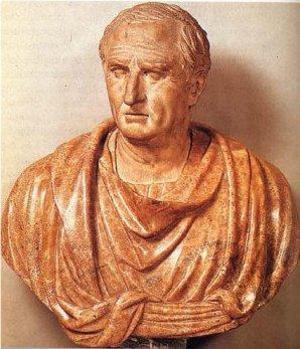
This concept of a law common to all came, in part, from the writings of the Roman lawyer and statesman, Cicero. According to Skousen, Cicero expounded upon " . . . the brilliant intelligence of a supreme Designer with an ongoing interest in both human and cosmic affiars. Cicero's compelling honesty led him to conclude that once the reality of the Creator is clearly identified in the mind, the only intelligent approach to government, justice, and human relations is in terms of the laws which the Supreme Creator has already established. The Creator's order of things is called Natural Law." In the words of Cicero himself (Quoted in Ebenstein, Great Political Thinkers, p. 133),
"True Law is right reason in agreement with nature, it is of universal application, unchanging and everlasting; it summons to duty by its commands, and averts from wrongdoing by its prohibitions . . . . It is a sin to try to alter this law, nor is it allowable to repeal any part of it, and it is impossible to abolish it entirely. We cannot be freed from its obligations by senate or people, and we need not look outside ourselves for an expounder or interpreter of it. And there will not be different laws at Rome and at Athens, or different laws now and in the future, but one eternal and unchangeable law will be valid for all nations and all times, and there will be one master and ruler, that is God, over us all, for he is the author of this law, its promulgator, and its enforcing judge. Whoever is disobedient is fleeing from himself and denying his human nature, and by reason of this very fact he will suffer the worst punishment."
Cicero concluded that man must rid himself of the depravity that came from relying upon himself, and should instead return to reliance upon "Natural Law." In effect, Cicero predicated that all Law should be measured against God's Law.
The founding fathers of the United States established their new government upon the foundation of Natural Law, summoning harmony with the law's of "Nature's God." How sad that our citizenry have forgotten this great truth.
I will post further installments on this theme, exploring more of the writers and philosophies that fueled America's beginning.
-
 Ever stop to consider what the word "Freedom" really means? Ever wonder what is truly meant by liberty, and those "Unalienable rights of life, liberty, and the pursuit of happiness" that were spoken of by the United States' founding documents? I certainly have. Consider this:
"Single acts of tyranny may be ascribed to the accidental opinion of a day; but a series of oppressions, begun at a distinguished period, and pursued unalterably through every change of ministers, too plainly prove a deliberate and systematical plan of reducing us to slavery." – Thomas Jefferson
When I read history, I see one long, painful struggle of men trying to exert their control over others. In many forms, this resulted in tyranny. Tyranny is defined as 1) oppressive power, or 2) a rigorous condition imposed by some outside agency or force.
As Jefferson said, these acts, over time, constitute a deliberate plan of enslavement. It was this continuing oppressive behavior by the English government that led the thirteen colonies to revolt, and resulted in the loss of Great Britain's most valueable territory. Great Britain could have held the territory if it had won the hearts of the people. Instead, she bullied the people, threatened the people, encroached upon her freedoms, and pushed them to the point of open rebellion.
Sadly, in our society today, we are losing many of our personal, economic, and spiritual freedoms. We must meet the oppressors at the point of encroachment, and fight to preserve what we have, even pushing back the tide, if we can. As Lawrence Patton McDonald wrote:
Early "Americans adhered rather closely to the free market ideal that people should remain free to find their own solutions for economic problems, whether caused by industry or by nature. The force of government would be used, if deemed necessary, only at the local level, under local control, to meet local needs. And as a result, America became a new promised land.
"We later Americans have all but forfeited the great charter of liberty that made possible the miracle of America. It still exists for us to examine. If we still like it, we can reestablish it. Doing that will require as much persistence and dedication and plain hard work on our part as was required of the eighteenth-century gentlemen who created it. It will require as much labor to regain it as it did to create it, but thankfully not more."(Lawrence Patton McDonald, We Hold These Truths, p. 14-15, ‘76 Press, 1976)
Otherwise, I feel, the oppression of the common man, the infringements on his freedom by bigger, more powerful bodies, and the loss of something special will come to pass. As Ronald Reagan said,
"Freedom is never more than one generation away from extinction. We didn't pass it to our children in the bloodstream. It must be fought for, protected, and handed onto them to do the same, or one day we will spend our sunset years telling our children and our children's children what it was once like in the United States where men were free."
Never take for granted the freedoms we still enjoy. On the other hand, never forget that those freedoms will always be under attack by some force somewhere who either wants to see it taken from you, or simply wants it for itself. Greed, jealousy, power lust, hatred, pride, and covetousness are behind nearly every example of tyranny in history. This has not changed.
Stand at the ready. For there is always a wolf at the door.


