They rise up out of the sand and butcher someone in the name of some crazy god.  Religious zealotry is explained by its adherents as loyalty and faith and duty.  Anyone believing anything else is proclaimed an "infidel."  It is an old story, one that grinds us down and defies explanation, demonstrating "man's inhumanity to man" in the name of religion.  History offers us so many examples of this throughout its pages that we take it for granted that this travesty, as everything else, also had a beginning.

The first "holy war" was invented by King Darius, the despot of the Persian empire who gained his throne through regicide.  A ruthless murderer, Darius held the enormous collection of subject peoples within his vast empire in check by force and violence.  Although a departure from the strategic clemency shown by the earlier Persian ruler Cyrus the Great, Darius's methodology was certainly nothing new.  Force and violence were, even at that early date, ancient tactics for subjugation.  What was new was something Darius concocted in 520 BC when the Elamites revolted against his rule.  No one knows what inspired him, but Darius was recorded to utter, "Those Elamites were faithless, they failed to worship Ahura Mazda."  Using this as a reason for conquest, Darius put down their rebellion in the normal butcherous fashion.  His innovation, however, would live on throughout time and become the bane of much of world history.  The features of his creation involved the concept that foes could be put down in the name of a religion (the fact that they had never practiced, or in some cases even heard of the religion made no difference), that warriors might be promised rewards in paradise for faithful acts of violence, and that conquest in the name of god (as proclaimed by the despot) was indeed a moral duty.  

Darius may or may not have realized what he created.  His new device, however, would catch on quickly and find its way into the arsenal of many of history's most haneous dictators, and eventually into entire movements between civilizations (the Crusades spring most readily to mind).  In many cases today, entire religious sects claim the weapon as their own, the tool outreaching any lone despot.

Today, the so-called "war on terror" is actually a determination to combat groups who adhere to Darius's device.  The challenge is that the adherents of this 2500 year old custom are varied and fanatical.  How is one to discern who is a "radical" and who is a "peaceful nominal adherent?"  What do we make of those "peaceful" worshipers who, nonetheless, dance in the streets when the radicals make a newsworthy strike (understanding that not everyone does this, of course)? 

These are important questions, and particularly relevant at this time because we have just elected new leadership to our country.  One thing is a clear fact: the United States has not had terrorist strikes on its soil since the strong response to September 11th.  As one military friend of mine said, "Done correctly, it's better to take the fight to them then to allow them to bring the fight to us."  What will be the policy of the West moving forward, as it seeks to combat an enemy that presents itself as little more than "smoke to be grasped," or, in the words of Ronald Reagan, "curd jelly [to be nailed to a wall]?"

Terrorism is unjustified no matter what perceived slights, mistreatment, western arrogance, national hubris, or journalist-declared poverty are given as explanation.  Evil in the name of any religion is still evil.  Do we treat with the murderers of children?  Do we try to behave like kowtowers so that they might like us more?  Should we honor them as victims and thereby justify their atrocities, all in the name of "understanding them" and appeasement (visions of Jimmy Carter tromping around with Fidel Castro at a Cuban baseball game come to mind)? Or do we meet strength with strength?  Do we strike preemptively to nip the problem at its source?  And in so doing, how do we avoid prolonged occupations and casualties of war?

These are somber questions, and must be addressed by America and her leadership.  In this hour of change in our nation, may we have our eyes open to the reality of evil in the form of fanaticism, and remember the words of Will Durant, "Love peace, but keep our powder dry."
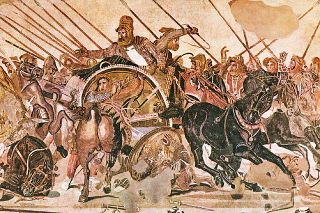
Darius

Posted in

9 responses to “When There Was Something New Under the Sun”

  1. Cathy Avatar
    Cathy

    Chris,
    Thank you for your well-thought and well-researched comments. Persecuting others in the name of religion is horrific, no matter what religion is used as the basis of justification.
    A few things must be remembered. Religious zealotry is an excuse used by people to persecute others. Whether it was done by Christians in the Crusades or by the forces of the Islamic empires as they first conquered the Middle East a hundred or so years before, the justification is invalid in the face of simple human decency. For Christians in particular, who are called by Scripture to love those of other religious faiths, and thereby win them, this is particularly heinous.
    I agree with you that terrorism in any form must be stopped at its source. However, how do we find its source? The problem we dealt with in the past was to find their nest, learn who their leaders were, and stop them.
    Today’s hydra of terror has no nest. It is world-wide. Its leaders are a multitude, in cells all over the globe. They recruit children and young teenagers with promisses of paradise (and virgins there!) to do their dirty work. We as Western adults find it culturally an anethema to fight wars against children, and they regularly use it against us. These are facts that must be objectively realized and understood.
    I have studied the Islamic religion and Moslem culture. There are factions, wide and diverse factions, of it that are peaceful believers who only want to do as we do, and practice their religion and live out their lives in harmony with others. These are the Sunni Moslems, and they are the majority. These are the leaders in Middle Eastern countries who want to work with the West and find peaceful solutions to the world’s problems. They point to passages in the Koran that refer to Christians and Jews as “the people of the Book,” (direct quote) meaning brothers of old despite differences, and seek to live in peace.
    Then there are the Shiite Moslems. These are the ones we hear about on the news. They take obscure texts of the Koran, which the Sunni believers discard as being inappropriate and unworthy of a true believer, and run with it. It is these texts of the Koran that specifically mention Jihad, the forceable conversion of “infidels,” or non-believers. And to a true Shiite, an infidel is any who doesn’t believe as his sect does, including a Sunni, though the Sunnis are last on the list, after Christians, Jews, Buddhists and the rest of the world’s religions. These are the source of the world’s terrorists, the killers of our people, the recruiters of children to do their dirty work and people God loves just as much as He loves us.
    This, then is the problem the world faces. We want to protect our people and our culture. We can’t fight like terrorists do, because it is against our conscience and culture inbred into us into the Judeo-Christian West, despite this being an actively post-Christian society. We can’t find them because we don’t look like them, talk like them or even think like them. The Sunni’s are unwilling to help for the most part, because they know the reprocussions on their people will be swift and sure if they do. While action is always the best and most preferred course, reaction is all we are left to, unless we make the horrible choice to deny ourselves and our collective consciousness, and thus become like those we call our enemies. If that unthinkable scenario were to take place, we would then have no greater justification for our acts than they do.
    Welcome, my friends, to the proverbial rock and a hard place. Welcome to the 21st century.

    Like

  2. Phyllis Hoff Avatar
    Phyllis Hoff

    Chris:
    That was so beautifully written.
    I really think this piece should be sent to the White House right before January 20th.
    You always speak straight from your heart, but it is always so profound.
    Thank you, for letting us know that there are leaders like you and Terri, Orrin and Laurie, Tim and Amy and all the rest who truly care and feel deeply about what happens to us and our country.
    Phyllis

    Like

  3. Wes Avatar
    Wes

    Chris:
    Coming out of an election “season” it’s easy to either be jubilant about what our new leader can do for us, or be discouraged by a new direction that we have differences with. While those are legitimate sentiments, this story illustrates well that the real service or “change” we can make in this country is what we do for others. We never know how we might touch another persons life by always keeping a giving spirit first. All greatness in a country, in a community, or in a family starts in the heart of individuals; it doesn’t come from government.
    God bless you
    Wes
    Important Lesson – “Pickup in the Rain”
    One night, at 11:30 p.m., an older African American woman was standing on the side of an Alabama highway trying to endure a lashing rain storm. Her car had broken down and she desperately needed a ride. Soaking wet, she decided to flag down the next car. A young white man stopped to help her, generally unheard of in those conflict-filled 1960’s. The man took her to safety, helped her get assistance and put her into a taxicab.
    She seemed to be in a big hurry, but wrote down his address and thanked him. Seven days went by and a knock came on the man’s door. To his surprise, a giant console color TV was delivere d to his home. A special note was attached.
    It read: ‘Thank you so much for assisting me on the highway the other night. The rain drenched not only my clothes, but also my spirits. Then you came along. Because of you, I was able to make it to my dying husband’s bedside just before he passed away… God bless you for helping me and unselfishly serving others.’

    Like

  4. yblegen Avatar
    yblegen

    Chris,
    I am not justifying the Crusader’s actions, especially, what happened in Jerusalem on July, 15, 1099, but I have a very different perspective after reading several books: “The Politically Incorrect Guide to Islam (and the Crusades)” and “The New Concise History of the Crusades” which dispels the politically correct myths about why the crusades were fought, who fought them and what happened during each campaign. It’s not a pretty story, but far different from the one that is usually told.

    Like

  5. rachel Avatar
    rachel

    I think the book Starfish and the Spider provides a good solution, if not a better point of view to solving the issue of terrorism on a combat level.
    However, the more perfect answer would be found in what Orrin talked about in his post “the cycle of democracy” — coming to the knowledge of spiritual truth.
    As people have come to the knowledge of truth – who they are, why they are here, and where they are going – they have no more desire to do evil but to good to all men.

    Like

  6. Bobbi Biggs Avatar
    Bobbi Biggs

    Wes…I’ve heard that story before and if I’m not mistaken…the woman was Nat King Coles wife…
    Love In Christ, Bobbi Biggs

    Like

  7. Cathy Avatar
    Cathy

    Chris,
    I found this on the http://www.onenewsnow.com website, on their Perspectives page. It’s an op-ed piece by Thomas Sowell, and I thought you and your readers would appreciate it.
    “Intellectuals”
    Thomas Sowell – Syndicated Columnist – 11/11/2008 8:00:00 AM
    Among the many wonders to be expected from an Obama administration, if Nicholas D. Kristof of the New York Times is to be believed, is ending “the anti-intellectualism that has long been a strain in American life.”
    He cited Adlai Stevenson, the suave and debonair governor of Illinois, who twice ran for president against Eisenhower in the 1950s, as an example of an intellectual in politics.
    Intellectuals, according to Mr. Kristof, are people who are “interested in ideas and comfortable with complexity,” people who “read the classics.”
    It is hard to know whether to laugh or cry.
    Adlai Stevenson was certainly regarded as an intellectual by intellectuals in the 1950s. But, half a century later, facts paint a very different picture.
    Historian Michael Beschloss, among others, has noted that Stevenson “could go quite happily for months or years without picking up a book.” But Stevenson had the airs of an intellectual — the form, rather than the substance.
    What is more telling, form was enough to impress the intellectuals, not only then but even now, years after the facts have been revealed, though apparently not to Mr. Kristof.
    That is one of many reasons why intellectuals are not taken as seriously by others as they take themselves.
    As for reading the classics, President Harry Truman, whom no one thought of as an intellectual, was a voracious reader of heavyweight stuff like Thucydides and read Cicero in the original Latin. When Chief Justice Carl Vinson quoted in Latin, Truman was able to correct him.
    Yet intellectuals tended to think of the unpretentious and plain-spoken Truman as little more than a country bumpkin.
    Similarly, no one ever thought of President Calvin Coolidge as an intellectual. Yet Coolidge also read the classics in the White House. He read both Latin and Greek, and read Dante in the original Italian, since he spoke several languages. It was said that the taciturn Coolidge could be silent in five different languages.
    The intellectual levels of politicians are just one of the many things that intellectuals have grossly misjudged for years on end.
    During the 1930s, some of the leading intellectuals in America condemned our economic system and pointed to the centrally planned Soviet economy as a model — all this at a time when literally millions of people were starving to death in the Soviet Union, from a famine in a country with some of the richest farmland in Europe and historically a large exporter of food.
    New York Times Moscow correspondent Walter Duranty won a Pulitzer Prize for telling the intelligentsia what they wanted to hear — that claims of starvation in the Ukraine were false.
    After British journalist Malcolm Muggeridge reported from the Ukraine on the massive deaths from starvation there, he was ostracized after returning to England and unable to find a job.
    More than half a century later, when the archives of the Soviet Union were finally opened up under Mikhail Gorbachev, it turned out that about six million people had died in that famine — about the same number as the people killed in Hitler’s Holocaust.
    In the 1930s, it was the intellectuals who pooh-poohed the dangers from the rise of Hitler and urged Western disarmament.
    It would be no feat to fill a big book with all the things on which intellectuals were grossly mistaken, just in the 20th century — far more so than ordinary people.
    History fully vindicates the late William F. Buckley’s view that he would rather be ruled by people represented by the first 100 names in the Boston phone book than by the faculty of Harvard.
    How have intellectuals managed to be so wrong, so often? By thinking that because they are knowledgeable — or even expert — within some narrow band out of the vast spectrum of human concerns, that makes them wise guides to the masses and to the rulers of the nation.
    But the ignorance of Ph.D.s is still ignorance and high-IQ groupthink is still groupthink, which is the antithesis of real thinking.
    COPYRIGHT 2008 CREATORS SYNDICATE, INC.
    Thomas Sowell is a senior fellow at the Hoover Institution, Stanford University, Stanford, CA 94305.
    Opinions expressed in ‘Perspectives’ columns published by OneNewsNow.com are the sole responsibility of the article’s author(s), or of the person(s) or organization(s) quoted therein, and do not necessarily represent those of the staff or management of, or advertisers who support the American Family News Network, OneNewsNow.com, our parent organization or its other affiliates.

    Like

  8. R. Shawn Consla Avatar
    R. Shawn Consla

    Wow! It’s like stepping into a brain tornado everytime I visit this blog.After reading this and the last posting, I know I can’t let the lapses in reading here go too long again. I originaly wanted to share a bit of humor that struck me as very Chris Brady:
    Notice
    You may have noticed the increased amount of notices for you to notice. Some of our notices have not been noticed. This is very noticeable. It has been noticed that the responses to the notices have been noticeably unnoticed. This notice is to remind you to notice the notices and respond to the notices, because we do not want the notices to go unnoticed.
    I noticed that there was no author credited to this notice. Perhaps they were hoping to be unnoticed by anybody taking notice….

    Like

  9. Ian Pardington Avatar
    Ian Pardington

    Hey chris, i wanted to ask you if it would be worthy of a topic to talk about events the lead up to a WWI or WWII or the communist take over in Russia , or even Cuba or Venezuela. I have learned that these things dont happen suddenly.

    Like

Leave a reply to yblegen Cancel reply