Welcome to
Chris Brady’s
Blog

“The only way to be happy, is to give happy.”

  • The following article comes from Jack Canfield, co-author of the record-breaking Chicken Soup for the Soul books (see the official credit at the bottom of this posting). I like most of what he's saying here because if we don't establish boundaries of what we won't do, we will never get to what we are supposed to do. I also like how he calls these boundaries "policies," because people don't generally get offended by running up against one of your policies. Good stuff. 

    I have certain policies, as well. Like Jack, I don't loan out books from my personal library. I also don't break my neck to answer phone calls or return interruption communications that are not emergencies. Instead, I clear out certain times of the day to respond to voice mails and texts once I've completed my higher priority tasks. I also won't take a cell phone call if I'm playing with or talking with my kids, or working individually with a business partner, or counseling someone. There are others, but you get the idea.

    There is one possible downside to this article, however, and if taken to the extreme, is nothing more than self indulgence and selfishness. After all, we are supposed to serve others and be available to those in need. If we take these policies too far, we could slide down the slippery slope (there sure seem to be a lot of these in life) of serving ourselves over others. But on the whole, there is a lot of wisdom and great advice in Jack's article. After reading it, I'd be interested to know if you agree, and what policies you've established (or are now deciding to establish) in your own life.

    Enjoy! 

    —————————

    Say Yes to Yourself with a Personal "Don't Do" Policy

    Our world is a highly competitive and over stimulating place, and more and more concentration is needed every day just to stay focused on completing your daily tasks and pursuing your long-term goals.

    With the explosion of communications technology we are more accessible to more people than ever before. Complete strangers can reach you by telephone, cell phone, pager, fax, regular mail, express mail and e-mail.

    They can e-mail and instant message you at home, at work and on your hand held smart-phone. And with the explosion of social media, requests now find their way to us on our Facebook and Linked-In accounts.

    It seems everyone wants a piece of you!

    Your kids want rides or to borrow the car, your co-workers want your input on projects that are not your responsibility, your boss wants you to work overtime, your sister wants you to take her kids for the weekend, your child’s school wants you to bake four dozen cookies for teacher appreciation day, your mother wants you to come over and fix her screen door, your best friend wants to talk about his impending divorce, a local charity wants you to head up a committee, and your neighbor wants to borrow your van.

    Not to mention the endless slews of telemarketers who want you to subscribe to the local newspaper, contribute to the nearby wildlife sanctuary or transfer all of your credit card debt over to their new card.  Even your pets are clamoring for more attention!

    We suffer from overload at work—taking on more than we can comfortably deliver in an unconscious desire to impress others, get ahead, and keep up with others’ expectations. Meanwhile our top priorities go unaddressed.

    How much time do you waste with projects and activities that you really don’t want to do simply because you are uncomfortable saying no?

    Success depends on getting good at saying no without feeling guilty. You cannot get ahead with your own goals if you are always saying yes to someone else’s projects. You can only get ahead with your desired lifestyle if you are focused on the things that will produce that lifestyle.

    You will have to structure your work and life so that you are focusing your time, effort, energies, and resources only on projects, opportunities, and people that give you a huge return on your efforts. You are going to have to create stronger boundaries about what you will and won't do.

    Most of us are busy, but undisciplined. We are active, but not focused. We are moving, but not always in the right direction. By creating a stop-doing list as well as a to-do list, you will bring more discipline and focus into your life

    Start by creating a stop-doing list as soon as possible! Then make the things on your list “policies.” People respond to policies. They understand a policy as a boundary. They will respect you more for being clear about what you won’t do.

    For example, some of my “don’t do” policies on a personal level are:

    • I never lend my car to anyone for any reason.
    • I don’t lend money. I am not a bank.
    • We don’t schedule outside social events on Friday night. That is our family night.
    • I don’t discuss contributions over the phone. Send me something in writing.

    On a business level some of my “don’t do” policies are:

    • I don’t give endorsements for books of fiction.
    • I have a policy of not lending my books to other people. They rarely come back, and they are the source of my livelihood, so I don’t lend them out.)
    • I don’t schedule more than five talks in one month.
    • I no longer co-author books with first-time authors. Their learning curve is too expensive.
    • I don’t do individual counseling or coaching. There is greater leverage in working with a group.
    • Except for when I am doing a new book tour, I don’t schedule more than two radio interviews in a day.

    It is very easy to say what your policies are, and you don’t even have to use the word no!

    People respect policies. And it’s likely that no one will take your policy personally, they’ll realize it’s a boundary you have set for all occasions. 

    Be brave in saying no, stay focused on your higher goals and let people know that you are committed to those goals. People will respect your clarity and drive.

    Remember, just as you are in control of your feelings and attitudes, other people are in control of theirs, so if they do get upset with you for saying no…well that is a choice they make for themselves.

    For more tips on Just Saying NO!, read Principle 42 in The Success Principles.

    Jack Canfield, America's #1 Success Coach, is founder of the billion-dollar book brand Chicken Soup for the Soul© and a leading authority on Peak Performance and Life Success. If you're ready to jump-start your life, make more money, and have more fun and joy in all that you do, get FREE success tips from Jack Canfield now at: www.FreeSuccessStrategies.com 

  • I don't know if it's just my heightened awareness since releasing my latest book, A Month of Italy: Rediscovering the Art of Vacation, or if the world is also catching on, but it seems as if more and more people are talking about the need for restorative breaks. In the following article from the New York Times, even the executives responsible for producing and advancing the consuming technologies of our time are starting to ask the tough questions. 

    Addict

    Silicon Valley Says Step Away from the Device:

    Tech firms are uneasy over the effect time online has on relationships.

    By 
    Published: July 23, 2012

    Stuart Crabb, a director in the executive offices of Facebook, naturally likes to extol the extraordinary benefits of computers and smartphones. But like a growing number of technology leaders, he offers a warning: log off once in a while, and put them down.

    Soren Gordhamer is the organizer of Wisdom 2.0, an annual conference about the pursuit of balance in the digital age.

    In a place where technology is seen as an all-powerful answer, it is increasingly being seen as too powerful, even addictive.

    The concern, voiced in conferences and in recent interviews with many top executives of technology companies, is that the lure of constant stimulation — the pervasive demand of pings, rings and updates — is creating a profound physical craving that can hurt productivity and personal interactions.

    “If you put a frog in cold water and slowly turn up the heat, it’ll boil to death — it’s a nice analogy,” said Mr. Crabb, who oversees learning and development at Facebook. People “need to notice the effect that time online has on your performance and relationships.”

    The insight may not sound revelatory to anyone who has joked about the “crackberry” lifestyle or followed the work of researchers who are exploring whether interactive technology has addictive properties.

    But hearing it from leaders at many of Silicon Valley’s most influential companies, who profit from people spending more time online, can sound like auto executives selling muscle cars while warning about the dangers of fast acceleration.

    “We’re done with this honeymoon phase and now we’re in this phase that says, ‘Wow, what have we done?’ ” said Soren Gordhamer, who organizes Wisdom 2.0, an annual conference he started in 2010 about the pursuit of balance in the digital age. “It doesn’t mean what we’ve done is bad. There’s no blame. But there is a turning of the page.”

    At the Wisdom 2.0 conference in February, founders from Facebook, Twitter, eBay, Zynga and PayPal, and executives and managers from companies like Google, Microsoft, Cisco and others listened to or participated in conversations with experts in yoga and mindfulness. In at least one session, they debated whether technology firms had a responsibility to consider their collective power to lure consumers to games or activities that waste time or distract them.

    The actual science of whether such games and apps are addictive is embryonic. But the Diagnostic and Statistical Manual of Mental Disorders, widely viewed as the authority on mental illnesses, plans next year to include “Internet use disorder” in its appendix, an indication researchers believe something is going on but that requires further study to be deemed an official condition.

    (For the rest of the article, click here).

    What do you think?

    Are people too connected to their electronic devices?

    What impact, if any, do you think this is having on our society?

    What have we gained?

    What have we lost?

    Sincerely,

    Chris Brady


  • I write about living a life that is not only successful, but significant. This includes topics covering the range of “Having Fun, Making Money, and Making a Difference.”

    Five of my most popular blog articles:

    Tim Tebow: Unconventional Just May Mean Revolutionary

    “A Month of Italy” Video Trailer

    Ewe Don’t No What Ewe Don’t No

    The Wasting of Your Life

    To Know and Still Glow


    In addition to regular blog articles, I also host a semi-regular caption contest where free, autographed books are given away to the winners.  Here are three of the funnier ones:

    Caption Contest 2011.12

    Caption Contest 2010.7

    Caption Contest 2010.3


    General Info:

    I enjoy humor, history, business, travel, sports, music, architecture, photography, my family and friends, motorized adventure, reading, and sharing my faith in Jesus Christ. I have been married to Terri for 31 years, we have four wonderful children, and two beautiful grandchildren.

    I hate math and science, waiting in line at Subway restaurants, and the American cultural phenomenon known as left lane driving. I’m also not a very big fan of “politically correct.”


    Favorite Quote:

    “Our greatest fear shouldn’t be that we won’t succeed, but rather, that we’ll succeed at something that doesn’t matter!” (attributed to D. L. Moody)


    Some of my own quotes (as far as I know!):

    “It’s not as important to succeed as it is to matter.”

    “The only way to BE happy is to GIVE happy.”

    “Our privileges are not for our pleasure, but for our purpose.” 


    Formal Bio:

    Masters of Manufacturing Engineering from Carnegie Mellon University, Pittsburgh, PA, with Master’s thesis from Toyohashi University, Toyohashi, Japan.

    Bachelors of Mechanical Engineering from Kettering University (formerly GMI), Flint, MI.

    NY Times, Wall Street Journal, USA Today, Business Weekly best selling author.

    Recognized by INC. magazine among the Top 50 Leadership & Management Experts.

    Co-founder of the LIFE company and its CEO and Creative Director.

    Listed among Top 200 Most Influential Authors in the world in 2017. 

    Also in 2017, recognized among the Best 25 Management and Leadership Blogs and as a Top Business Expert.

    Listed among Top-Notch Leadership and Management Blogs, the Top 100 Blogs for Executives, Managers, and CEOs, and one of the 100 Best Web Resources for Managers.

    Included in Modern Servant Leader‘s list of Top Leadership Experts to follow in 2015.

    Recognized by Likeable Local among the Top 150 Great Marketers to Follow in 2015.


    A More Authentic Bio:

    I have experience with a live bug in my ear, walking through a paned-glass window, chickening out from the high dive in elementary school, destroying the class ant farm in third grade, losing a spelling bee on the word “use,” jackhammering my foot, and, more recently, sinking my snowmobile in a lake. I have also done some dumb things. 


    Books Authored:

    A Month of Italy: Rediscovering the Art of Vacation

    Rascal: Making a Difference by Becoming an Original Character

    PAiLS: 20 Years From Now, What Will You Wish You Had Done Today?

    Leadership Lessons from the Age of Fighting Sail


    Books co-authored (with Orrin Woodward): 

    Financial Fitness

    Beyond Financial Fitness

    Launching a Leadership Revolution

    Launching a Leadership Revolution Workbook

    Leadership and Liberty

    LIFE

    Edge

    Tidbits and Treasures


    Find me on the Internet:

    www.chrisbrady.com

    www.amonthofitaly.com

    www.twitter.com/RascalTweets

    www.facebook.com/RascalNation

    www.linkedin.com/in/cjbrady

    www.instagram.com/cbrascal

    www.plus.google.com/+ChrisBrady

    www.youtube.com/MrChrisBrady

    https://medium.com/@RascalTweets

    Amazon Profile


    AND, you may be interested in my wife’s excellent blog:

    www.terribradyblog.com


    Subscribe:

    Subscribe for free and get every post as soon as it comes out, directly in your email box! (I will never share your email address with anyone for any reason, even if they say “please”).

    You can subscribe by entering your email address in the upper right hand corner of this page.

    Enjoy the blog, and thanks for stopping by!

    IMG_0151


  • My good friend Mark Haas sent me this and I thought it a wonderful way to wrap up this Sunday evening. Do not be conned into the world's enticements of temporal pleasures at the expense of eternal considerations. Christ is Lord and we are to worship Him with everything we do. As Colossians 3:17 states: "Whatever you do in word or deed, do all in the name of the Lord Jesus, giving thanks through Him to God the Father."

    Enjoy!

  • ImagesThere is a simple step people can take to radically improve their lives. Most, however, will not do it.

    In almost two decades of working with people in personal development, I am continually amazed at the lack of proactive behavior exhibited by the "average" individual. Food is consumed almost absentmindedly, mass media programming (movies, television shows, satellite radio, etc.) is imbibed without even a thought (even when it comes to children). Video games are played incessantly. Days, weeks, and often years go by without any intentionality in family interaction. Scripture, worship, and prayer are, at best, reached for only in times of trouble. Relationships are used only for personal gratification and cause shock and surprise when strained and ruptured. And our political freedom is ignored to the point of neglect. 

    I could go on.

    The results of this passive attitude toward life and the living of it are enough to cause despair. Obesity is at an all-time high in the United States, television watching and Internet surfing are through the roof, video game addictions are a reality (especially among grown men!), family units are breaking down and disappearing, churches are either emptying or if full, often full of nothing, meaningful relationships have, to at least some degree, been relegated to "friends" on social networks, and our freedoms are slipping into the history books.

    What lies behind all this?

    Rampant passivity.

    In my opinion, at least part of our sad state of affairs can be attributed to a habitually passive approach to life. The society in which we live seems to accept everything that comes along without scrutiny. Cries of warning are disregarded as prudish, old-fashioned, or simply no fun. But these cries have tremendous merit. We DO need to be vigilant. We DO need to be intentional about how we live our lives. We MUST be discerning when it comes to technology, media, food, relationships, worship, family, and our responsibilities as citizens. If we don't, we will necessarily and summarily suffer the consequences. If ideas have consequences, imagine what ignoring them produces!

    Just how can we be more proactive in the living of our lives? How can we stem the tide of mediocrity and passivity that creeps in to destroy us? Here are some suggestions I hope you'll find useful:

    1. Organize your categories – this means to give some thought to the many categories in which you live out your life (parent, spouse, child of God, professional, business owner, friend, physical being, political citizen, etc) and write them down.

    2. Write down your overall aspiration, highest ideal, or purpose in each category. 

    3. Next, write down what threatens your achievement of excellence in each category. These are things that are outwardly bad and should be avoided entirely. You might label this column "Overt Attacks."

    4. Then, write down the distractions that are possible in each category. These are things that aren't bad in and of themselves, but have the capacity to subtract away from the things that are even better. This is where "good" is the enemy of "great." You might label this column "Covert Attacks."

    5. List things about which you've been passive or undiscerning for each category in the past (in other words, when you've failed to produce excellence through pro-activity).

    6. List what you could have done to prevent those instances.

    7. Set a specific goal for each category.

    8. Develop and write out a game plan for how to hit that goal in each category.

    9. Put a date for checking up on your progress toward the goal.

    10. Make adjustments as necessary.

    11. Involve accountability partners and/or mentors towards those goals, as desired.

    12. Bathe the whole process in prayer.

    Passivity in our lives needs to be rooted out with aggressive pro-activity. Intentionally seeking excellence in every category of our lives may sound like a daunting task. However, clear thinking and intentionality are almost never daunting, instead, they are liberating. When we open our eyes to all we've been allowing to creep in unobserved, we will feel more alive, more in control, and more excited about the possibilities for excellence.

    Do you agree or disagree that passivity is a problem in our culture?

    What less-than-excellent things have you allowed to passively enter as "normal" into your life?

    What victories have you had eliminating these things? 

    Thanks for reading!

    Sincerely,

    Chris Brady

  • Here's a portion of another article someone sent to me demonstrating that some companies are weighing in on the idea of the "Art of Vacation."  In my latest book, A Month of Italy: Rediscovering the Art of Vacation, I try to make many of these same points through an emotional, dreamy, and (hopefully) humoruos narrative that will provide the impulse people need to take strategic breaks themselves. In this article, we see that a company has decided to give its own incentives toward that end.

    ———————————————–

    Bart Lorang calls it a "paid, paid vacation."

    The CEO and co-founder of Denver-based software provider company FullContact is offering his employees a $7,500 bonus to go on vacation, on top of their normal vacation pay.

    So what's the catch? There's three, as Lorang describes in a blog on the company's website.

    First, employees must completely go off the technology grid,  meaning no e-mail, texting or phone calls. In conjunction with the first rule, employees are not allowed to do any work while on their trip.

    Third, employees must actually go on a trip. Lorang explains he believes all his employees deserve a nice vacation, and he chose the $7,500 dollar amount because he believes it is enough for a family of four to take a trip to Mexico for a week.

    "We felt that everyone should have the opportunity to take a nice vacation without constantly worrying about how much money they’re spending while on vacation," Lorang blogged.

    Lorang tells KDVR he had the idea for the incentive when he was browsing photos of his trip to Egypt. He was struck by a photo of himself riding a camel among the pyramids, but he was texting. 

    He says experiences like this have made him realized the value of completely disconnecting during a trip, and wants to encourage his employees to do so as well. 

    Some of Lorang's software engineers that have taken him up on his offer say while it was difficult initially going off the grid, they ended up loving their completely unplugged vacation.

    “Absolutely fantastic.  I mean you get so used to waking up to emails in the morning,” engineer Kyle Hansen tells KDVR.

    His coworker Robbie Jack says though it was hard to give up his gadgets for the trip, he found it extremely beneficial.

    “The biggest benefit is when you get back.  You’re so much more invigorated, recharged,” Jack told KDVR.

    (For the full articel on Fox News, click here.)

    ————————————————

    Dear readers: What do you think of Lorang's three requirements of A) completely going off the technology grid, B) doing no work while on vacation, and C) having to actually go on a trip?


  • Since the release of my latest book, A Month of Italy: Rediscovering the Art of Vacation, I have received countless connections to others who are also touting the power of vacations. Here is an article that appeared on CNN. For those of you who have read the ITALY book, you will notice some similar points!


    Relax, it's only a vacation 

    Vacationing with no agenda — for some travelers it's heaven, for others a week or more of unscheduled free time is like staring into an abyss. 

    Planning for a vacation is usually part of the fun for me, but largely skipping the research and reviews on a recent trip to Costa Rica was surprisingly refreshing. 

    Arriving without a bunch of expectations and a long list of things to see and do and accomplish wasn't entirely premeditated. I ran out of time, and since the friend I was traveling with is a native Spanish speaker, I felt great about being able to resolve those inevitable travel snafus. Also, we did book hotels a couple of weeks in advance. (I probably would have melted into a puddle of anxiety otherwise).

    We did a lot — zip lining, snorkeling, bird watching, tarantula spotting, sitting on the beach — but without that gnawing sense of missing something really important. Ignorance might indeed be bliss. 

    Have I been doing it wrong all this time? After the trip, I consulted a trio of sages — a travel agent, a psychiatrist and a life coach — to see what vacationing advice they'd offer to people who want to avoid going back to work dragging, desperate for another vacation.

    Maybe you don't need three professional advisers to have a nice trip, but some Type A would-be vacationers could use a little help. You know who you are.

    We asked: Your vacation planning tactics

    Loosening up

    "If your vacation causes you stress, it's not a vacation, it's a should, a to-do or an overachieving chore," said Laura Berman Fortgang, a career and life coach and author of "Living Your Best Life." 

    Trying to squeeze too many activities into one trip with "no built-in time to chill" can be exhausting, especially when your trip lasts a week or less. (Ours was a weeklong trip and we visited three places. Overly ambitious?).

    27 must-sees on earth

    Consider this strategy, posted by enthusiastic planner Kris Stafira on CNN's Facebook page: "I usually do plan every minute of every day, but then our family sets our priorities and we make SURE we do those things — the rest happens or not, depending on the day. I tell my kids they can relax at home — vacation is for SEEING and DOING and LEARNING!" 

    Right. But what if life at home is just as busy? 

    Berman Fortgang recommends taking at least 10 to 14 consecutive days away, if at all possible, and building in time to do nothing.

    "A week isn't a lot now. At the pace that we all go and the amount of adrenaline that we force our bodies to produce because we move so quickly — your body doesn't really recover from that in a week," she said.

    Berman Fortgang and her husband are self-employed and they shifted their family's schedules years ago to be able to take European-style, three to four week vacations in August. 

    "Just knowing on that sixth night you didn't have to pack up to leave, then we started relaxing," she said.

    Switching off from the 24/7 work ethic

    Finding flexibility

    From a psychological standpoint, vacation offers time to build resiliency, according to Dr. Gregory Fricchione, director of the Benson-Henry Institute of Mind Body Medicine at Massachusetts General Hospital. 

    The term, adopted from structural engineering, refers to the ability to bend or adapt, but not break, under pressure.

    I employed a little of that when I figured out shortly after we got off the plane in San Jose that two of the three places we'd picked to visit were not in fact within day-trip distance of each other, but actually three hours apart by van and boat. (Everything looked really close on the map. This is where reading up and carefully mapping things out comes in handy.)

    Strong connections with family and friends and meaningful and positive experiences bolster resiliency. Your stress response, an alert to threats that spurs you to action, is also a key component, Fricchione said.

    The stress response is essential, but it burns a lot of energy, so avoiding stressors is part of what's restorative about vacation.

    If you want a restful trip, ask yourself "what's a nonthreatening and socially supporting and meaningful and positive experience for me to have? And it would be different for different people," Fricchione said.

    Sitting on the beach reading books is just the thing for some people. For people with highly active, risk-taking personalities that don't satisfy that side of themselves at work, an adventure trip can be very fulfilling. 

    There is nothing fundamentally wrong with having a very busy vacation. Being outside your normal habitat has its own benefits.

    "There is something rejuvenating about that in the sense that your mind is very alert, your senses are very alert," Fricchione said.

    "If you enter into that experience and you're not exhausted at the beginning, it can be very energizing. It's a nice kind of stress, in a way, and you have enough resiliency to deal with it."

    Fricchione suggests taking stock of how you feel and what would be restorative for you and planning your time off accordingly.

    14 outstanding airport amenities

    Listening to yourself

    People who go for the trips they think they want instead of the type of experience they really want and need are the ones who come home needing another vacation, said travel agent Anne Morgan Scully, president of McCabe World Travel in McLean, Virginia. 

    "The reality is a vacation should really be about you and what your body needs, what your mind needs, what your soul needs and what your heart needs, and that drives good vacation decisions," she said.

    Scully asks her clients about their best trip ever and for two reasons why they loved it. She takes those and other responses and tailors a trip to suit everyone in the group.

    "We try to put a balance in what they're asking for so if there are choices and options, something is going to work," she said.

    (For the rest of this article on CNN, click here)

    Sincerely,

    Chris Brady

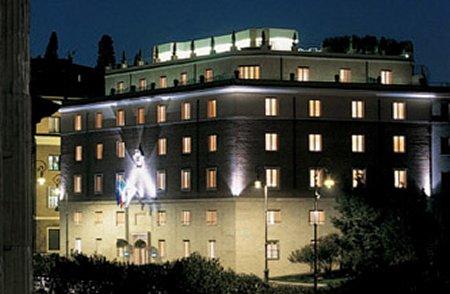
  • Fortyseven_Hotel_Rome_Italy_RomeMost companies give the concept of customer service world-class rhetoric and mediocre implementation, at best.  The attitude isn’t one of customer service, but rather of “customer serve us." 

    Just the other day, my wife Terri was in a place where for no apparent reason she was forced to take a new number and begin her wait anew, without any explanation or apology.  When she finally got to the counter she was greeted with an artificial urn labeled, “Ashes of Trouble Customers.”  Nice.  (Of course, in the interest of full disclosure, it was actually a government office and not a bona fide business, but we’ll leave that huge topic for a future post.)

    Every now and then, however, someone surprises us.  When it happens, it’s as refreshing as the sunshine after a cold rain.

    Observe Exhibit A: our family cocoon packed into a small minivan traveling sleepily through rush hour traffic in Rome.  Scooters zip by on all sides, cars dart in and out, horns blare, and pedestrians play chicken with cars by avoiding eye contact.  After three hours of hazard-avoidance, our quota is used up and we collide noisily with a passing scooter (see previous post for details).  Since the incident occurred on a busy street directly in front of our destination hotel, I suggested Terri take our kids inside to safety.  Within moments, I became vaguely aware of hotel employees in black uniforms extracting the baggage from our damaged vehicle.  Next I looked up to see one of them bringing me a bottle of water with two fancy drinking glasses.  Soon, the general manager of the hotel was standing next to me, comforting me, advising me, and reassuring me that he would provide assistance to help my with any language barrier issues.  

    After several hours of cleanup and paperwork, we were ushered to the hotel’s courtyard where our children were comfortably seated and being pampered by the hotel staff.  We were offered drinks and informed that we had already been checked into our rooms.  As a final exclamation point, I was informed that the hotel would additionally be changing my flat tire for me.  “Prego, prego, we insist!” I was told. 

    The hotel in question? The Hotel Forty Seven.  The general manager? Paolo Dalle Vacche.  The employee who brought me the water and took care of my children?  Piero Galli.  The man who changed my tire? Valentino.  I mention them all here because they deserve worldwide recognition for putting into implementation what most people only talk about – world-class customer service.  Thank you gentlemen!  Grazie mille!

    So, do you think I’ll stay at the Forty Seven upon my next visit to Rome? Wild horses couldn’t keep me away. 

    When it comes to you and what you do for a living, here are a couple things to think about when attempting to provide true customer service:

    1. Your heart matters – all the best intentions and formal training don’t amount to a thing if you don’t have a heart for thrilling your customer
    2.  Your actions speak louder than words – everyone talks, few walk. Let your actions exceed your promises.
    3. Put yourself in the customer’s position – this should be obvious, but what made my experience at the Forty Seven so exceptional was the way in which the hotel staff anticipated my needs and met them.
    4. One individual is not enough – it takes a whole culture to get it right.  Not that one individual taking the lead and the initiative isn’t how a culture is built – it is – but ultimately, most of the team has to be emotionally on board and committed to authentic exceptionalism.
    5. It makes a difference – the hotel Forty Seven didn’t merely cement their relationship with me as a customer, they made an impact on my life.  Who knows what calamities they steered me clear of by their attentiveness.

    This list is by no means exhaustive, but you get the idea.  Can you imagine what the world would be like if companies absorbed just these five lessons deeply into their operating psyche?

    All of this makes me wonder why more companies don’t get it – why they don’t truly implement the high-sounding platitudes and pronouncements that litter their flashy brochures and walls.

    I have two questions for you, dear readers: 

    1. When is the last time you had an exceptional customer service experience like mine in this example?
    2. What can you do in your business, job, or career to be like the staff at the hotel Forty Seven in Rome? 

    (Please share your responses in the comment section below.  I want to hear them!)

    Thanks for participating!

    Sincerely,

    Chris Brady

    www.amonthofitaly.com 


  • Traffic whizzed by on both sides as a protective ring of motorcyclists and scooter riders stood guard. The rush-hour sun was hot like a mid-day melt. A policewoman did her best to address me in English to see if I was physically okay. The fallen scooterist held his lower leg in pain as the ambulance arrived. In the background, I heard the loud sound of rushing air, then noticed it was coming from the rapidly flattening front tire of my rental van.

    Something I attempted to depict in my new book, A Month of Italy: Rediscovering the Art of Vacation, is that there are two main things necessary (I believe) for maximizing your downtime:

    First, a definite break should be made from your normal life. This means to truly get away. If your life looks like a race, your vacation should not. 

    Second, emergence in a foreign and unfamiliar environment will produce all sorts of unforeseen benefits. When everything is unfamiliar, your senses are over-stimulated and you begin noticing much more in a completely fresh way. You no longer subconsciously ignore 99% of what confronts you because you suddenly don't know what to ignore and what to let in. (By the way, it is not necessary to take an expensive foreign vacation to accomplish this.  There are other methods, such as attempting things you’ve never done before, staying in accommodations different from those to which you’re accustomed, spending time with people of a different culture, etc. which can provide the same result.)

    If you truly do both of the above, I promise you experiences and memories to last a lifetime. Let everyone else travel over and over again through the worn out ruts of routine; the real adventure begins when you step away from the known and submerge yourself in the unknown.

    Sometimes, however, the formula misfires.

    "I'm pretty sure you won't get arrested or anything," the hotel general manager said, trying to be reassuring. 

    "Arrested?" I managed to gulp in reply.

    "No, no, no. It's not your fault. Obviously. You have no need to worry."

    Still, I was shook by what had happened. There's a good reason the phrase "it happened so fast" has become a cliché for traffic accidents, largely having to do with the fact that it's entirely true. In this case, I had only caught a glimpse of a black streak whizzing past my left window before the scooter's foot peg caught my front tire. I had been looking left at the hotel at which we were arriving, just beginning the process of determining how to access the parking in the upcoming piazza, when the black streak materialized into a crashing, spinning scooter accompanied by a pronounced "clunk" and Terri's startled gasp. Then in slow motion I saw the scooter rider tumble and roll as his bike "high-sided" him. I jammed on the breaks, shut off the van, and rushed out to the fallen rider. Amazingly, tens of other scooter riders had already dismounted and were attending to him as well. “Thank God,” I thought, realizing in an instant that it could have been much, much worse.

    And then the long ordeal of the after-crash bureaucratic slow dance began. Those funny sounding European sirens blared, a smashed up ambulance took forever to carry the scooter rider away, police in all types of uniforms talked to observers, each other, and finally, me. After nearly two hours, the scooter rider's banged up leg was being attended to at a nearby hospital, his girlfriend came to drive his surprisingly intact scooter home, the police had me sign a statement, and we drove on the flat tire to get the van off the road and to the curb directly in front of our hotel. 

    We had begun the day on the dangerous, tight, twisty Amalfi coast, cruised at high speed on the Autostrada, and had wangled our way through crowded, rush-hour Rome without incident, only to have this happen at the very last minute of the journey. 

    Gathering ourselves in the hotel’s courtyard, my family and I said a prayer for the young man on the scooter. Meanwhile, the staff of the Hotel 47 catered to our every need (I will highlight more about their amazing service to us in the next post). I sat still for a moment, feeling totally exhausted and drained. I had certainly accomplished everything I teach about submersion in another culture! But it was time to go home. 


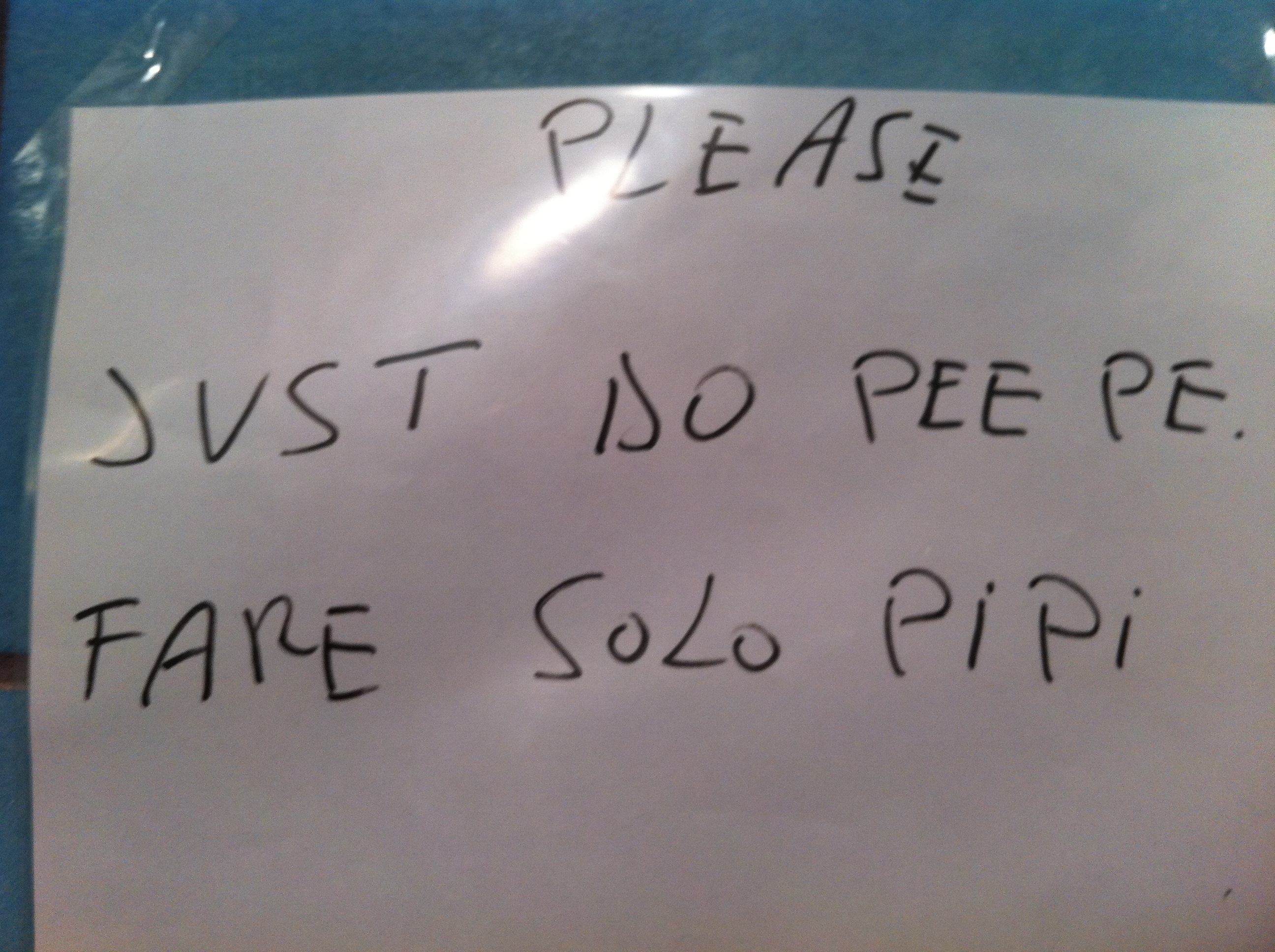
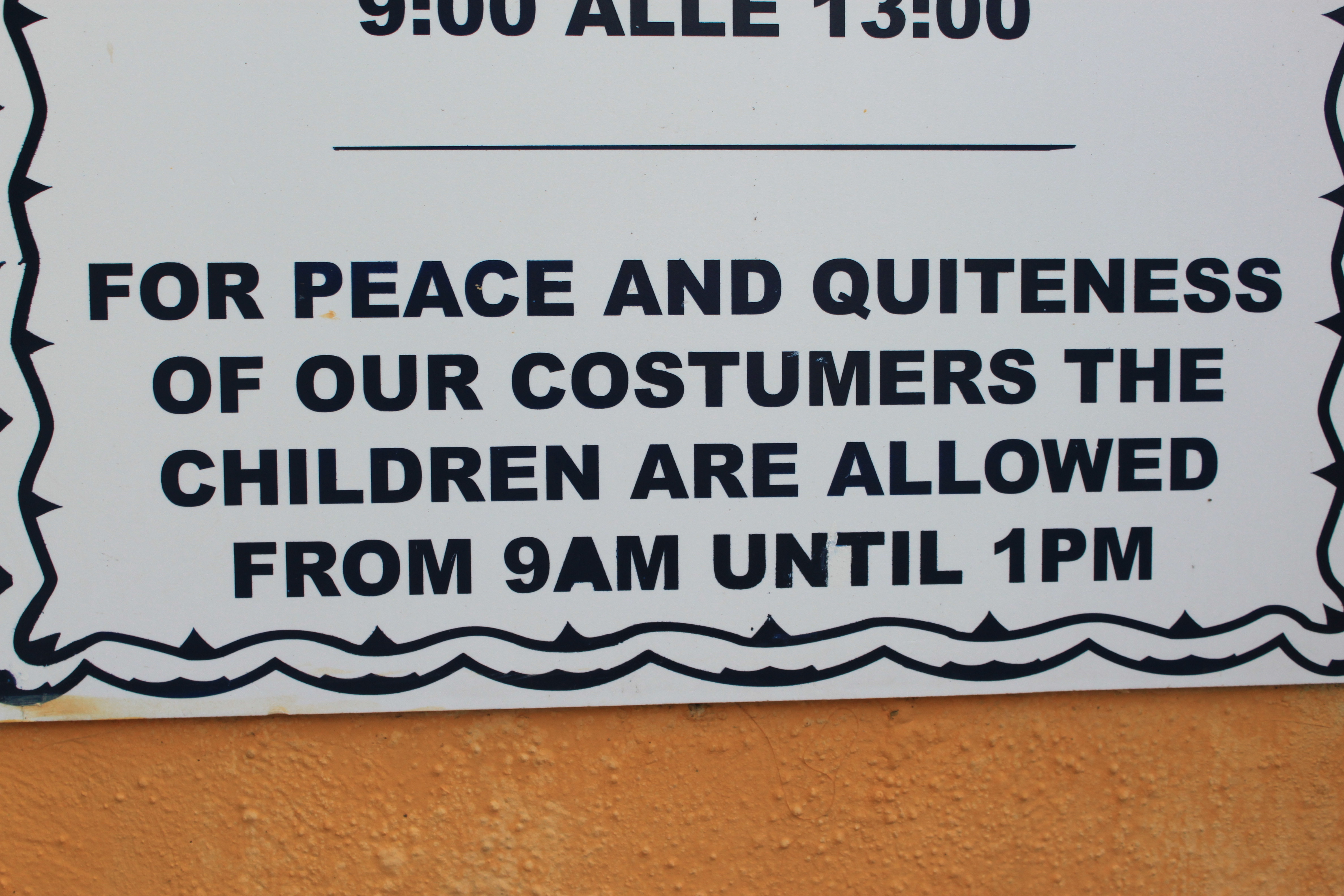
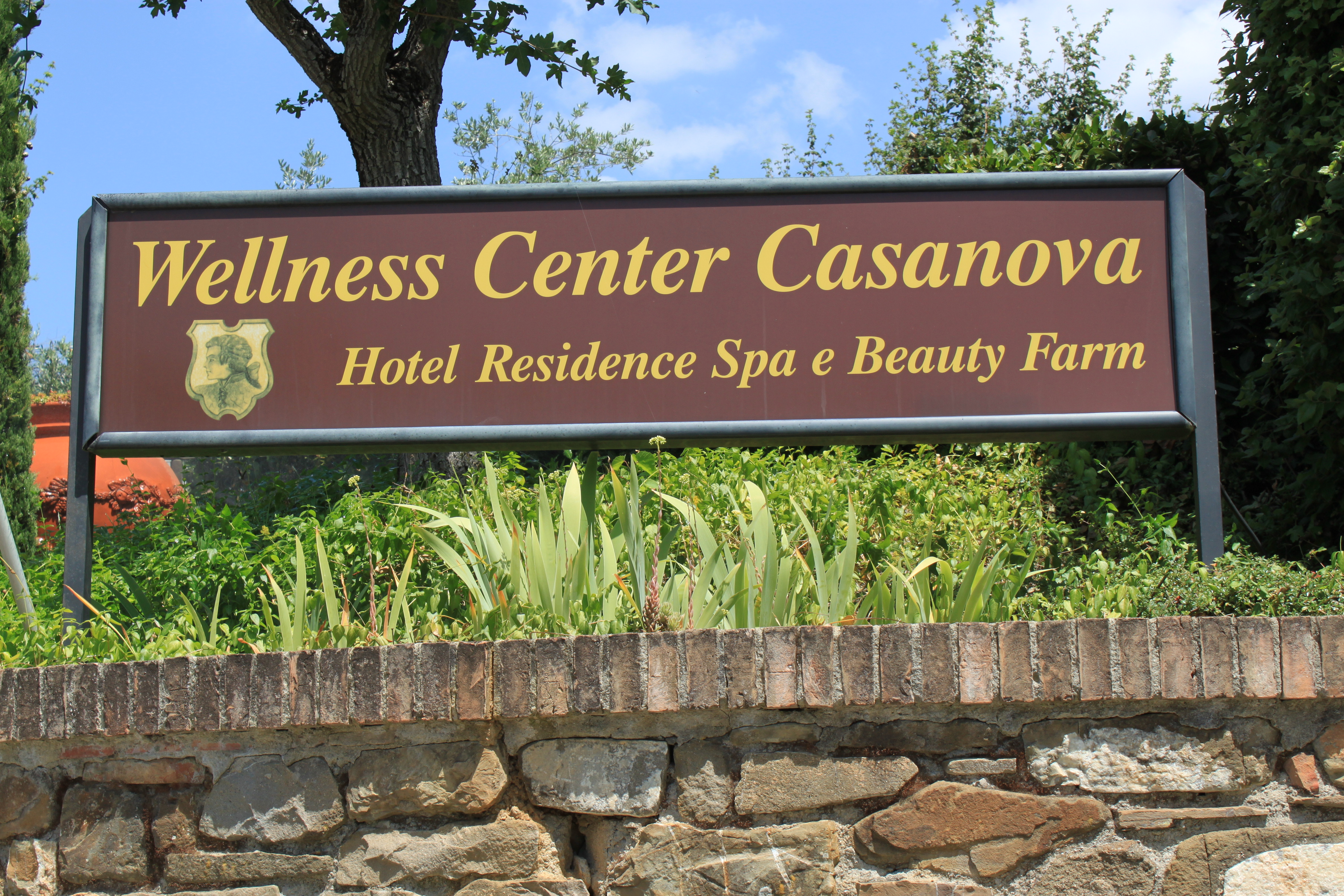
  • IMG_4259As I depict in my book, A Month of Italy: Rediscovering the Art of Vacation, one of the most interesting aspects of travel is the chance to notice things that are usually obscured by the bustle of daily living. This is even more true when traveling internationally, when so much is unfamiliar, and, well, foreign. I particularly enjoy the signs and other public displays that make it across the language barrier a little worse for wear. Sometimes, something IS lost in the translation. IMG_4406 IMG_6541 IMG_2366 IMG_7007 IMG_0363 IMG_6524 IMG_4260 IMG_2167 IMG_1868 IMG_1047 IMG_0563 IMG_0564 IMG_4270 IMG_1875 IMG_6564

    IMG_6879 IMG_3823 DSC00507