Welcome to
Chris Brady’s
Blog

“The only way to be happy, is to give happy.”

  • DSC00501Although almost everyone will readily agree that taking effective breaks and time off is necessary, fewer and fewer Americans seem to be doing so.  In fact, the United States ranks toward the bottom when compared to other developed countries when it comes to the average number of paid vacation days taken per year.  The following chart comes from infoplease.com:

    Italy                                       42 days

    France                                   37 days

    Germany                                35 days

    Brazil                                     34 days

    United Kingdom                      28 days

    Canada                                  26 days

    Korea                                    25 days

    Japan                                    25 days

    United States                         13 days

    This disparity is eye opening.  But this is not the only statistic.  According to Don Monkerud of AlterNet, “Compared to people in other developed countries, Americans don’t ask for more vacation time, don’t take all the vacation time their employers give them, and continue to work while they are on vacation.”  Monkerud’s statement is supported by the data.

    It seems that one third of Americans don’t take their allotted vacation time, 37% never take more than a week at a time, only 14% take more than two weeks at a time, one third of all women and one quarter of all men receive no paid vacations at all.  Compare this to the fact that 40% of Americans are now working 50 hours a week, and even when a vacation of sorts is wrangled from the schedule, 88% of Americans carry electronic devices while away to communicate with work!  According to the Center for Economic Policy and Research, 25% of Americans and 31% of low wage earners get no vacation at all anymore.  Careerbuilder.com sated that, “While 84% of workers planned to take at least some time off this year, 32% were taking 5 days or less, and 1 out of 10 were limiting themselves to a long weekend.”  In a survey posted on Expedia.com it was estimated that workers would give back to their employers more than 574 million unused vacation days (in the year 2006).  That represents nearly two days for every person in the country!

    It All Adds Up to a Tearing Down

    What effect does all this work and the corresponding lack of proper breaks have on lifestyle and health?  According to the US Centers for Disease Control, “83% of all deaths for adults between 21 and 65 are related to lifestyle.”  Joe Robinson, a work-life balance expert and author, stated that “Vacations are theoretical concepts that exist today only on paper.  We’re supposed to be a nation of fair play; we’re a nation of no play.”  AlterNet reports that one in three US workers report job stress, and those making over $50,000 per year report the highest levels of stress.  And how about retirement? Perhaps we can just count on resting up then.  Nope.  For the first time in US history, there are four generations in the workplace at the same time, which means people are waiting longer and longer to retire, if ever.

    “But I Know All About Vacations”

    “I already take vacations,” you may be saying, and that’s fantastic, although, as we’ve just seen, you are among the rare individuals who do.  But mere vacations are not exactly what we are concerned about when discussing the concept of Strategic Sabbaticals.  Because, even though people are taking less and less vacation, there is another trend that is part of that: they are taking worse and worse vacations.

    What does this mean?  It means that there is a right and a not-so-right way to take time off.  In other words, there is a difference between rest and restoration.  A true vacation should not only be fun, or a chance to get away, but should also rebuild you and spit you back out stronger and better than new.  Too many times vacations resemble the frenzied work life – it’s all hurry and scurry to cram in as much “fun” as possible before the time runs out.  Many participants in such vacations find themselves needing a vacation just to rest up from their vacation!

    In my upcoming new book, A Month of Italy: Rediscovering the Art of Vacation, I attempt to demonstrate the enormous power of intentional breaks in one's life. These breaks, as I've written elsewhere, are not for the purpose of idleness, laziness, or self-indulgence, but rather for accomplishing what best selling author Stephen Covey calls, "Sharpening the Saw." Far too many of us grow dull in areas where we should be shining!

    Sincerely,

    Chris Brady


  • Ok, Ok, I know, it's been a while since we've had a caption contest and you're just dying to know who won the last one, right? Well, the truth is, those of us who administer this blog of lofty literary renown have been busy laughing at the many great captions turned in for the last contest! It really is a shame that only one winner can be chosen, but alas, life is tough. Therefore, after much wrangling, we have decided upon the following entry as the winner!

    When a Butt crayon just won't do! Posted by: Jason Trimble 

    Congratulations to Jason! Simply comment on this blog to submit your mailing address (which will remain confidential) and we'll send you your free, autographed copy of Orrin Woodward and my best selling book Life.

    Now (drum roll please) we are proud to present the next caption contest! The winner this time will receive a free autographed copy of my upcoming book, A Month of Italy: Rediscovering the Art of Vacation. Enjoy!

    IMG_1880

  • The following is an excerpt from Chapter 18 of my upcoming book, A Month of Italy: Rediscovering the Art of Vacation

    ___________________________________________________________

    When life is a lot like a race, vacation shouldn’t be.

    The danger in speaking of vacations is that it feeds the tendency in all of us to want too much of a good thing. What I am advocating is not idleness, but rather a respite from busyness. In fact, to me, idleness and busyness are opposite sides of the same coin: disorder.

    Some people tend toward one extreme, languishing placidly and wasting the days of their lives. They buy into the lie that pleasure is the ultimate aim, pursuing personal peace, affluence, and gratification as their top priorities. They seek travel and experiences as an end, in and of themselves. There is a dangerous bait-and-switch dynamic at work behind the pursuit of pleasure as an end, however, and it comes from the fact that pleasure doesn’t satisfy. Instead, it leads to the pursuit of more and more pleasure, bigger and bigger stimulation, all the while satisfying less and less. I have read travel books that are plenty dreamy, well written, excellent descriptors of places and attractions, but they are shallow and Bohemian, leaving the reader feeling empty at the end.

    Other people—in fact, most from the crowds I run in—suffer from the opposite malady: filling their calendars so full they blast right through years of life without tasting a morsel of food or noticing a sunset. They are busy, busy, busy; scurrying here and there, convinced that if there is a job worth doing it’s worth overdoing. The crowded schedule and unending demands upon one’s time are often displayed as status symbols. Busyness becomes an outward show of importance. The philosophy goes like this: “I am busy; therefore I am successful.” 

    Both extremes are signs of disorder; it’s a fact we know deep down inside. "Get back toward the center," some inner voice seems to say, "you’re wobbling like an unbalanced wheel." By providing a chance to think, feel, ponder, pray, worship, learn, and realign with priorities, a proper vacation should ideally restore balance by transporting one back toward that center. 

    ___________________________________________________________

    Sincerely,

    Chris Brady


  • IMG_0151The more I've researched the category of vacations, sabbaticals, intentional work breaks, work-fasts, electronic fasts, time off, time out, or whatever else you want to throw into the category, the more I've come into contact with some philosophies that probably never would have made my radar screen. This has been very illuminating, but also a bit disheartening.

    Why I Wrote the Book

    I set out to write A Month of Italy: Rediscovering the Art of Vacation because I felt so entirely blessed to be on my first real sabbatical that I wanted desperately to share what I had learned with others. I had gotten back in touch with a program of maintaining peak performance and razor sharp clarity of focus. In my own life, I had truly rediscovered the art of vacation. In fact, I came back from that original summer sabbatical so refreshed, so recharged, that within just one year I relocated my family to a different state (a decision with which I'd wrestled for almost a decade), wrote one best selling book (Rascal: Making a Difference by Becoming an Original Character), co-authored another with my good friend Orrin Woodward (LIFE), and launched a multimillion dollar company with seven of my best friends. Not bad for a mere four weeks off.

    My Formula from College

    As I explain in the Italy book, I had once possessed a formula that, for me, worked perfectly. It was while I was studying engineering at an intensive undergraduate institute that I had first stumbled across this arrangement. It came from being outgunned and outclassed in almost every way as I struggled with the workload of seven classes per semester and more math and science than I even care to remember. The students around me seemed so much more unconcerned and laid back about it than I did, and, quite frankly, I panicked. They went out to get drunk and I hit the books. I worked so hard I earned the nickname "Machine." My homework was always done on time, I posted very good grades, and I had not an ounce of fun. At least, from Sunday night at about 8:00 until Friday after lunch. In between those times I was a quintessential workaholic. However, (and this is the part where the formula comes in), I would leave campus like a clown shot out of a circus cannon on Friday afternoon and forget all about the place for the weekend. I'd hang out with my girlfriend, visit my parents' cottage in the "up north" of Michigan, and do just about anything except school work. This usually involved all my favorite activities, such as jet skiing, motorcycling in the dunes, playing football with my buddies, water skiing, reading, playing at the beach, and camping. By the time I returned to campus I was clear-headed, wide-eyed, and ready to go. My ambition had been refueled and my tanks refilled. 

    How Had I Lost It?

    I have tried to go back and figure out exactly how or why I lost touch with something that had once been so powerful in my life. The only conclusion I can draw is that I didn't see it as such a stand-alone, creative program at the time. Let's face it, most of us grow up in a school system that sort of takes care of this for us. We are accustomed to summer breaks, holidays, weekends off, and time between level advancements to get mentally ready for the next step. Suddenly, though, we find ourselves out in the "real world" where no hours are off limits when it comes to working a job and vacations are scarce (especially for the new hire). A sort of sick ambition sets in as the aggressiveness of youth pairs itself with the resiliency of youth, blending to obscure the fact that we are not machines, and that we need regular "down times" to maximize the "up times." The older we get the less we can get away with recklessly abusing our schedule as though endless effort will somehow produce better results. It can't. In short, I had achieved a lot in my adult life, but I had gotten away from a formula of intentional rest and restoration which could have helped me accomplish so much more. Stephen Covey calls it sharpening the saw, and of all his 7 Habits of Highly Effective People, it has to be the most neglected. There are scores of books on goal setting, beginning with the end in mind, persevering, and game planning, but almost nobody talks about strategic breaks. It seems that rats in a race are not allowed a pit stop.

    Is Vacation the End Goal?

    This brings me to some philosophies of happiness which have gathered a following. Certain of these trains of thought suggest that time off is not merely an elixir to heal the wounds of stress and enable one to pursue his or her true calling in life, but rather that time off is the overall point. It's the old pursuit of happiness trap whereby pleasure is sold as fulfillment. "Just do what makes you happy and fill the space in between with enough work to pay for it." "The more you play the happier you'll be." To me, it's like the old bumper sticker that says, "He who dies with the most toys, wins!" except it's been modified for our twenty-first century sensibilities to nothing more than, "He who dies with the most adventures, wins!" The new version is just as much of a lie as the older. 

    Don't Get Me Wrong (Thanks, Chrissy Hines for an ever-quotable line, stuck in my head to the tune of your old song.)

    On the other hand, however, I am not advocating the workaholism that several generations of Americans have thoroughly proven as the path to ruined health, ruined relationships, and yes, unhappiness. All I'm saying is that we can't swing the pendulum too far the other way. If we're not careful, being idle can easily become an idol in our lives. We slide down the slippery slope of wanting too much of a good thing.

    Meaninglessness

    Remember: It is not all that important that we succeed, but it IS supremely important that we matter! Wasting our gifts in the pursuit of pleasure is ultimately not fulfilling, and tragically, it keeps us from impacting the lives of others and the world at large. I recently stumbled across this line written by Napoleon Hill toward the end of the Great Depression: "There is something infinitely worse than being forced to work. It is being forced not to work." When we are deprived of meaningful work, either by outside economics (as in Hill's time), or by internalizing incorrect philosophies of "happiness through self indulgence" (as in our time), we become sick with a sense of emptiness no amount of entertainment can disguise. Deep down, we know we were built for something greater than ourselves. 

    Fulfillment

    We must work in a useful service to truly be fulfilled. True happiness comes from being in line with our God-given calling in life, living consistently with that calling every day, and serving others with every fiber of our being. As I've said elsewhere, the only way to BE happy is to GIVE happy.

    Sabbatical vs. Self Indulgence

    So there is a significant difference between a strategic sabbatical and self indulgence. It is this distinction that I strove to demonstrate in the book. Some things are better "caught than taught," and therefore the book attempts to demonstrate what I mean without the specific pronouncements I've made in this article (for that, I imagine, the reader is elated). However, through some of the tools and other materials soon to be available on this website, I will give you specific step-by-step instructions how to craft an effective strategic sabbatical plan for yourself, consisting of micro, mini, and macro breaks scheduled into your life with the express purpose of maximizing your contribution, and thereby (as a by-product) your happiness. This is not double talk, it's doubling down on your effectiveness. Oh yeah, and it will be a total blast! Whoever said purpose wasn't fun couldn't have said that on purpose!

    So, you probably need a break. But you need it at the right time, in the right way, and for the right reasons.

    Stay tuned for more!

    Sincerely,

    Chris Brady


  • IMG_5762I came across a statistic the other day that shocked me: only about 10% of U.S. citizens have a passport. While I know that Americans are often criticized for ignorance about the rest of the world, I didn't realize just how little we get out and about!

    I know of very few things that can provide the genuine education and adventure that comes with international travel: the fascinating views, the unfamiliar smells, the undecipherable languages, the unidentifiable foods, the interesting people. It is almost a cliche to say that travel broadens one's horizons, but sometimes cliches are as true as they are literal. Myopic, insular, narrow views cannot but be blasted by the wide vistas of the rest of the world "out there."

    I will not try and convince you, however, to dust off the suitcases and buy a ticket to somewhere. Instead, I would like to present to you my random list of things to know so that your international travel is the best it can be. It is my hope that in doing so I will tear down whatever walls of fear or inertia have been holding you back from experiencing more of the world.

    1. Don't travel like everyone else, suit your own style. What this means is that there are many different ways to travel. There are pre-packaged trips, organized tours, mainstream routes, structured adventures, luxury or rustic, city or country, etc. The first rule of travel is to thine own self be true. Don't take someone else's trip; take your own. Know yourself, what you like, what you must have in terms of accommodations, and make it fit YOU. A trip is like an extension of your personality; make sure it's authentic.

    2. Prepare without becoming rigid or locking yourself in. It's the little serendipities that make travel so rewarding. Be sure to allow enough flexibility in your time-schedule and your attitude for the unexpected to happen. Remember: you can't plan wonder, you can only discover it. Your trip should be one of discovery if it is to be anything at all.

    3. Pre-learn: read up on the areas to which you will be going. Study maps for geographic reference and understanding. Put a little history into your noggin so you will have context when you get there. Also, it NEVER hurts to learn as many little bits of the language as you can; locals will always be appreciative of your efforts to speak to them in their tongue. This goes for customs, too. Learn how they bow, shake hands, and any other important little norms that can make or break your ability to connect.

    IMG_56564. Go off the beaten path: at least once on your trip wander off. Go somewhere you haven't planned. Take a walk, or rent some type of native transportation so you can get away from the worn grooves tourists have made through the same exact routes. In essence, you want to make your way through the lives of the locals.

    5. Make meaningful contact with local people. Try to initiate conversations and make friends. With the Internet it is easier than ever to stay in touch. This prolongs your travel and continues the learning experience. It is also enriching and provides ongoing insight.

    6. Travel light. Let me say this one again: TRAVEL LIGHT!!!!! You really don't need to take as much along as you might think. There is no sin in wearing a set of clothes more than once, or taking the smallest sized toiletries you can buy. Trust me, the more you have to lug that baggage into taxis, through train turnstiles, around airports, and up stairs, the more you'll come to hate your material attachment (this becomes a great metaphor for life, by the way).

    7. Take a lot of pictures. When you get back, especially with today's technology, there are endless ways to continue enjoying your experiences. Digital photos are nearly free, and can be displayed and enjoyed and shared endlessly. Don't slack in this department, you really can't overdo it.

    8. Keep a daily journal. This is a great way to wring the most out of your experiences, stimulate deeper thought and introspection, promote learning, and provide a record of dates, times, names, and events which may be useful later.

    9. Seek first to understand. You don't know what you don't know, so act accordingly. Be inquisitive, curious, and open to learning new viewpoints. Travel as a student and not a critic, be a participant and not a judge.

    10. Stay flexible. Detours, re-routings, inconveniences, and little frictions of all types will confront you as you crawl your way around unfamiliar lands. Remain easygoing and understanding. Don't demand your rights or place your own personal comfort at the top of your priority list. No matter what happens, it may be helpful to realize that even if what you are experiencing is uncomfortable, unfair, or a little bit scary, you are gaining a great story. As the saying goes, "No guts, no story."

    11. Always have money. One of the best insulators against travel troubles is money. It allows you to travel lighter, knowing you can buy what you need when you need it. It can fix problems or procure accommodations when plans fail, and it can even grease palms when and where it might be needed. A little tip here and there can work wonders in many parts of the world. I would also recommend having at least some of a country's denomination on hand before you get there (otherwise you might end up in France without even enough euro to pay for the public restroom for your toddlers – true story! I won't bore you with the details). Also, have credit cards of many different types. However, credit cards aren't nearly as popular or widely accepted in most parts of the world as they are in the U.S.. In many, many places, cash is your best bet. Paying in correct change is also highly recommended, otherwise you will end up with huge pocketfuls of heavy coins (according to a cashier I met in Japan, it is a strictly American trait to pay in rounded off sums of cash instead of in correct change).

    DSC0066612. Keep your passport on you at all times.

    13. Take time to notice things, to ponder, to think.

    14. Find a way to contribute. Figure out a way to become a blessing to the people or places you go. Is there a charity underway in that area? Is there a relief organization that could use donations? Is there a youth that could use an international pen-pal? In other words, take pictures but leave a part of yourself.

    15. Buy gifts. Don't forget to expand the impact of your trip by including others back home. This may be as inexpensive as an email, or may take the form of trinkets and keepsakes. However, make sure any gifts purchased are small and travel-durable. It's the thought that counts.

    16. Go "Dark:" What this means is to take an intentional fast from electronics (at least for a portion or portions of your trip) of all kinds; television, video games, smart phones (the average American checks his/her phone 150 times a day!), Internet, iPads, etc. Have the guts to truly unplug. If I were a betting man, I'd wager this will be one of the biggest benefits of your trip.

    I hope this ramshackle list proves helpful. However, it will be much more fun for you to construct your own list based on your own experiences. Let me know if I've missed anything!

    And don't forget, it's 3 euro for the public restroom in Nice, France.

    Sincerely,

    Chris Brady


  • Image - Version 3One of the themes in my upcoming book, A Month of Italy, is that Americans have lost the "art of vacation." According to a recent Harris poll, only 14% of Americans take more than one week of vacation at a time, while the Center for Economic and Policy Research reported that 25% of Americans and 31% of low wage earners take no vacation at all anymore. In a 2006 survey conducted by Expedia.com it was estimated that workers would give back to their employers more than 574 million unused vacation days that year! So less people are taking vacations, while those who do are taking fewer vacations, shorter vacations, and even less vacations then they've earned!

    The question begging to be asked is, why?!

    In my experience working with thousands of people in business and leadership functions for almost twenty years, and supported by research from sources as diverse as "happiness experts" on one side to government agencies and pollsters on the other, there are several distinct reasons for this bizarre trend. For argument sake, and in an attempt to hopefully get you to challenge and analyze your own prevailing beliefs about vacations, sabbaticals, and leisure time in general, I hereby present my own list of reasons. If you ever get time, that is, if you're not too busy, I mean, if you can catch a break, maybe you can read through these. Or, at the worst, perhaps you can wait and go through them on your next vacation.

    For what it's worth . . .

    The Top 10 Reasons People Have Lost the "Art of Vacation."

    10. Concern for Work Accumulation: The fear of the work that will pile up in their absence.

    9. Dread of Competition: The fear that other employees will pass them up if they are gone.

    8. Fear of Termination: The worry that they will lose their job or be replaced if they are gone.

    7. Pride of Workmanship: The belief that nobody can do their work as well as they can.

    6. Avoidance of Hassle: The perception that vacation isn't all it's cracked up to be (it's too much trouble to travel, it's a "fix" that doesn't last anyway, etc.).

    5. Fear of Intimacy: A distaste for relating to a mate and/or children outside of their usual structured and frenzied lives.

    4. Addicted to Consumerism - in essence, people choosing things and status over time and memories

    3. Leisure Guilt: Vacations aren't seen as proper 

    2. The "Blackberry Effect" – with all the technology of today, people feel as if they can't really "get away" anyway.

    1. Financial Inadequacy: Money is too tight.

    To varying degrees, each of these reasons may have some validity. But very clearly it is necessary for human beings to do as Stephen Covey teaches in his book, The 7 Habits of Highly Successful People, and that is to "Sharpen the Saw." Legitimate or not, reasons such as those in this list should not hold us back from properly unplugging and recharging (which, electrically speaking, is impossible. But in the figurative world you know what I'm trying to say!) We are not machines. Without proper rest and restoration, we lose our edge. Taken to extremes, we can lose our grip, our health, our relationships, and our ability to perform at anywhere near our peak output.

    Now don't get me wrong. I am not trying to become the poster child for self indulgence, dilatoriousness, or laziness. I believe our lives are precious and our gifts are imparted to us for a reason, and neither should be wasted in mere idleness. What I AM saying, however, is that the old jingle, "All work and no play makes Jack a dull boy," is still true, and I like to think of the word "dull" there as the antithesis of Stephen Covey's "sharp."

    So determine which of the above reasons may be holding you back from properly implementing restorative breaks into your schedule. Make a plan to sharpen your sword on a regular basis. Buy my book when it comes out and learn anew the "Art of Vacation." And stay tuned into this blog where I'll be bringing further information and insights into this neglected topic.

    Stay sharp!

    Sincerely,

    Chris Brady 


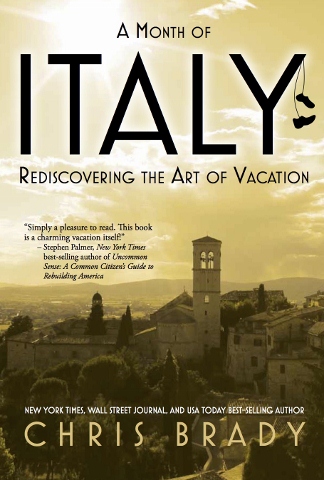
  • Italy cover 2Have you ever felt overworked, overstressed, maxed out, and out of focus?

    Have you ever needed a break from it all, and by that, I mean something more than a frenzied weekend or busy plastic vacation?

    Have you ever had enough of your cell phone, emails, social networks, texts, and the like?

    Have you ever felt like you were out of balance and needed some serious restoration?

    Have you ever considered the fact that you could take a career break – a sabbatical – to allow you to clear your head and restore your focus?

    Have you ever dreamed of traveling through the back roads of Italy and seeing the famous Tuscan countryside?

    Have you ever wanted to sample Italy’s cuisine, sunsets, culture, art, architecture, and history?

    Are you entertained by humorous narrative and adventure stories?

    For anyone who can answer “yes” to even one of these questions, I am happy to announce that my latest book, A Month of Italy: Rediscovering the Art of Vacation, is set to debut this July. For just a little taste, here is the dust jacket inscription:

    What can possibly be said about Italy that hasn’t been already? Primarily, that you can enjoy it too! Refreshingly relate-able in a genre previously populated by wealthy expats and Hollywood stars, this book chronicles an ordinary family taking an extraordinary trip, and most importantly, paves the way for you to take one of your own! With hilarious wit and fast-paced narrative, Brady thrills with honest commentary on what a “trip of a lifetime” actually feels like, and most endearingly, he succeeds in convincing you that not only should you take a similar one, but that you will!  Within a few pages you’ll be visualizing panoramic Tuscan vistas and breaking open the piggy bank, laughing as you turn the pages and dreaming of your own escape.  This story is one of going slow in order to go fast; it’s about rediscovering and brining back into favor a lost art, namely, the art of vacation, and it is, or rather should be, a story about you.

    Here are some of the early reviews:

    “I was intrigued from the first sentence clear through the book! It teaches so many life and leadership lessons—about family, relationships, learning, improving, and becoming better. I’ll read it again and again, and I’ll read it on the plane on every vacation I ever go on.” – Oliver DeMille, NY Times best selling author of A Thomas Jefferson Education, Freedom Shift, and 1913

    “A beautiful story and pivotal idea for a book!” – Richard Bliss Brookeauthor of Mach II, The Art of Vision and Self Motivation and The Four Year Career

    “With humor, Brady guides you through heart-warming history, incredible beauty, the most gracious people, and of course, the world’s most delicious food and wine! After reading his entertaining work, you will be charting your own course to Italy.”  –Sharon Lechter, Co-author of Outwitting the Devil, Three Feet From Gold and Rich Dad Poor Dad

     “Extremely engaging and delightful – a well told story!” – Chris Gross, CEO Gabriel Media Group, Inc., cofounder of Networking Times.


    “This is a book every traveler should read and bring along in order to experience the best of Italy.” Dr. Gaetano (Guy) Sottile, President and Founder, Italy for Christ, Inc.

    “Witty, funny, and at points downright hilarious, but mixed with profound truths shared in a way that makes one pause and ponder.” Orrin Woodward: Winner of the 2011 IAB Top Leadership Award

    “A spell-binding lesson in learning how to live again, with real purpose. You can’t stop turning the pages . . . .” Art Jonak, founder MastermindEvent.com

    “I have never read a book that teaches so much while being this fun at the same time.” Tim Marks, best-selling author of “Voyage of a Viking”

    “This is the best work Chris Brady has written to date. If this is a vacation handbook, it has redefined the vacation experience.” Venkat Varada, Silicon Valley Executive

    “Vacationing truly is a lost art, and Brady poignantly and beautifully illustrates why it is so vital for driven leaders. A timeless treatise on ‘sharpening the saw,’ A Month of Italy is a book I will sip and savor, ponder and reflect on time and time again. Not only are Chris’s insights powerful and refreshing, but his vivid and witty writing is simply a pleasure to read. Reading this book is a charming vacation itself, and it will inspire you to vacation deliberately, effectively, and joyfully.” Stephen Palmer, New York Times best-selling author of “Uncommon Sense: A Common Citizen’s Guide to Rebuilding America”

    “In our hectic lives we are rarely 100% present in any situation. Chris Brady shows that with proper play time, our work time is so much more effective. He has freed my spirit!” Jason Ashley, country singer/songwriter (Texas Songwriter of the Year 2008)

    “Italy is unique. Moreover, it is a country where the traveler can en- joy the most various experiences. Chris Brady’s book has the ability, astonishing even for an Italian, to convey to the reader that variety, that richness of feelings, sights, perfumes, tastes . . . and people.” Senator Lucio Malan, Senior Secretary of the Presidency of the Italian Senate

    In early July, look for it in bookstores and online stores everywhere, and of course, here. I sincerely hope you enjoy it!

    Chris Brady


  • I have received several requests to post the "Play on Words" puns and such that I gave in one of my talks at this past weekend's Spring Leadership Convention. These are not original, to be sure, but funny!

    I changed my iPad's name to Titanic. It's syncing now.

    I know a guy who's addicted to brake fluid. He says he can stop any time.

    I stayed up all night to see where the sun went. Then it dawned on me.

    This girl said she recognized me from the vegetarian club, but I'd never met herbivore.

    I'm reading a book about anti-gravity. I just can't put it down.

    I did a theatrical performance about puns. It was a play on words.

    They told me I had type-A blood, but it was a Type-O.

    PMS jokes aren't funny. Period.

    When you get a bladder infection urine trouble.

    Broken pencils are pointless.

    I tried to catch some fog, but I mist.

    Benign: What you do after you be eight.

    Bacteria: Back door to cafeteria.

    Barium: What doctors do when patients die.

    Catscan: Searching for kitty.

    Cauterize: Made eye contact with her.

    Dilate: To live long.

    Enema: Not a friend (understatment!)

    Fester: Quicker than someone else.

    Hangnail: What you put your coat on.

    Labor Pain: Getting hurt at work.

    Morbid: A higher offer than I bid.

    Nitrates: Cheaper than day rates.

    Recovery Room: Place to do upholstery.

    Terminal Illness: Getting sick at the airport.

    Tumor: More than one.

    Varicose: Near by.

    Hope you enjoyed these! Feel free to comment with more!

    Sincerely,

    Chris Brady


  • There seems to be a little confusion lately regarding the proper color for off-road motorcycle boots. I believe that this mix-up is typical of amateurs new to a sport, who confuse details such as ON ROAD and OFF ROAD motorcycling. This is unfortunate, but what can be done? Sometimes people with little-to-no experience in something pontificate as though they have knowledge in an area. I have even seen them stoop as far as a generic search on Google, as if Internet searches are a credible method of research. It is at times such as these that I suggest we exercise love and grace,but we often must set the facts in order.

    I would like to thank Twitter follower Scott Becker (@sbeck5455) for sending this very factual piece of evidence to support what all the FASTEST motocross riders already know: white boots are the choice of MOTOCROSS champions.

    20120107-phoenix-ryan-villopoto-6(Click on image for a larger photo in case the evidence is not clear)


    Now, if there are those out there who confuse MOTOCROSS with ROAD BIKING, well, let's at least be nice to them until they get their training wheels off their motorcycles. 

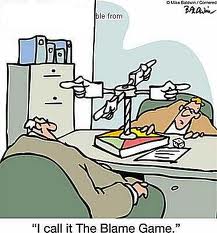
  • ImagesOver the course of my life I've been fortunate enough to find myself with a vantage point on the behavior of all types of people under all sorts of circumstances. An enormous benefit of this has been the sheer entertainment value provided therein. One example of this is the contact sport which has provided hours of fun for young and old alike. What is this sport, you ask? It's called the Blame Game. Immensely popular, timeless in its appeal, the Blame Game has been passed down as a classic from generation to generation. I am sure you've had at least some exposure to the fun and frolick this game delivers, but just to help you maximize your enjoyment of an American classic, I thought I'd supply a few of the rules I've observed in operation as folks have played this game for hour upon hour. I know these rules are helpful, because they've kept people engaged in playing the Blame Game long after most would have tired of such sport. So here you are, the Rules of the Blame Game (and, by the way, if these don't help you reach maximum enjoyment of the game, it's not my fault. Blame it on the person who gave me the idea for this article, she's the one that is the cause of all of this! (You know who you are!))

    1. The person playing the Blame Game is never allowed to take responsibility for anything that ever happens, ever.

    2.  Someone else, or several someone elses, must be chosen to "receive" the blame for what has gone wrong (please note: it makes no difference whether or not the recipient(s) of the blame was actually responsible, or even involved in the situation at all. It is even okay if they have absolutely no knowledge of what happened.)

    3. A motive or reason for the behavior of the recipient of the blame must be concocted, and again, it need not have any bearing on actual facts.

    4. A decent amount of vitriol may be mixed in, and heaped mightily on the head of the recipient of the blame.

    5. Blame can be assigned to the recipient through several means of communication, such as gossip, Internet chat rooms, blog commentary, coffee pot conferences, telephone calls, text messages, and the like. As a matter of fact, today's communication technology provides no end to the ways in which blame can be assigned to someone else. Accomplished gamers use any and all these channels continuously.

    6. Others should be enlisted to agree with the blamer and to join in the assigning of blame to the recipient. The more voices in the choir of blame, the more the blamers can actually feel that they are justified in their blaming, and the more they can comfort eachother that their lack of personal performance is not their fault.

    7. All manner of emotions can be dressed up in the Blame Game, such as envy, jealousy, hatred, covetousness, bitterness, self-pity, and the advanced condition known as "holier-than-though."

    8. Once the fun of blaming starts to wear off, it is often helpful to get around other blamers to confirm the acidity of one's thoughts and to keep from slipping into any amount of introspection or taking responsibility for one's actions.

    9. The Blame Game is extremely popular in election years, and can be used to avoid any real discussion of issues or principles. The best way to take advantage of this particular aspect is to pick a side and immediately begin blaming the other side for everything wrong in the country. Once you see how easy this is, you'll understand why it's so popular.

    10. Accomplished players learn to play the Blame Game in multiple areas of their lives.  Here are a few examples: Bad Marriage = blame spouse. Bad Job = blame boss. Bad health = blame restaurants. Bad Attitude = blame weather. Bad psyche = blame parents. Bad children = blame society. Bad relationships = blame friends. Bad business = blame economy. Bad church = blame pastor/priest.

    Remember: When it comes to blame, it's just a game, to soil someone's name, so you can remain the same.

    (Dear reader: do not get offended. I was not talking about YOU)