Welcome to
Chris Brady’s
Blog

“The only way to be happy, is to give happy.”

  • IMG_6336We never met our neighbors on one side. By the time we bought our home the husband had already moved out. We saw the children once in a while, roughly the same age as our own, but that was about it. Otherwise, the house usually looked vacant.

    Then one day I heard some racket and looked over to see a work crew dismantling the extensive wooden playset in the back yard. Piece by piece, it was being unceremonially hurled into the back of a rusty pickup truck. Soon, all that remained was a sad patch of woodchips where a happy playground had once been.

    It was all a metaphor for the pain of broken relationships. My seminary professor, Dr. Doug Bookman, once made a profound statement about the deepest pain in human experience being relational pain. Contemplating this, I agreed with him. Nothing hurts more than a broken bond with another person. Hurt feelings are the strongest feelings of hurt we can experience. In particular, when a family breaks apart it is serious business. Pain flings itself in every direction and misses no one with its touch of lasting destruction. 

    Watching those workmen that day, I thought back over my life and the empty patches of woodchips in certain backyards of my memory. I have been fortunate, as there are not too many of them, but the ones I do have are strong testimony to the truth of Bookman's comment.

    Keep the playset in your backyard in good working order. Maintain it daily with love and affection. Be intentionally loving and serving in the lives of the people God has brought into your life. Guard your relationships with constant vigilance. It's much easier to maintain good relationships and mend frazzled ones than to let them be carried away in a rusty truck. Once that happens, all that is left is a lonely patch of woodchips quietly suggesting what could have been.


  • Congratulations to the winner of Caption Contest 2011.12!  It was a tough, tough contest with many great submissions, but finally:

    Just done it!

    Posted by: Joe Telle sr January 10, 2012 at 04:55 PM

    was chosen.  Congratulations! As usual, please submit your mailing address (which will remain confidential) and you'll receive a free, autographed copy of Orrin Woodward and my book, Launching a Leadership Revolution.

    Now, here's the new contest, starring none other than the infamous "Delilah."  Good luck!

    IMG_6239

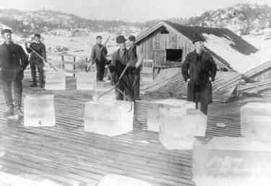
  • ImagesIn the early 1800s a boy named Frederic Tudor was on a trip to Havana, Cuba and had a thought. As he stood in the sweltering sun he wondered if people there would be interested in a cold drink. This little insight stuck with Tudor and he would grow up to pioneer the shipping of New England ice on wooden ships to places as far away as Calcutta, India.

    This was not as difficult as it may at first seem. Ice, when packed together in large quantity and kept out of the sun, actually melts very slowly. When covered with sawdust it can last even longer. In large enough tonnage, according to author William Bernstein, Tudor discovered that as much as two thirds of his original cargo could arrive in India still frozen. Innovations were even made to this process, such as the shipping of uniform blocks of ice. These were easier to stack and arrange as ballast in a ship's hull.

    Along several of these shipping routes, perishable fruits were packed on the ice and transported where they could be eaten "out of season:" apples taken south and bananas taken north, for instance. However, this idea was not really utilized much, and for some reason Tudor would continue to consider the shipping of ice his main business throughout his life. The much larger business of refrigerated shipping, technically "invented" by Tudor, would be developed upon by others. This huge breakthrough was literally right under Tudor's nose the whole time. He hadn't exactly missed it, he simply didn't capitalize on it. Instead, he began speculating on coffee futures and other diversions.

    This story makes one think about the Japanese VCR manufacturers fighting over tape formats while the real money was being made on movies, or IBM missing the trend to PC's even though they were the world's leader in computers at the time. Or even simpler; Mark Twain squandering his fortune multiple times upon get-rich-quick inventions and investments when he could literally create wealth with his pen.

    What explains the occurrence of huge ideas being missed because those involved were occupied with the smaller ones that lead up to it?

    Why do so many who begin to succeed get distracted and allow their focus to be dissipated on lesser pursuits?

    Why is good such a distraction from great

    And more important still: what big breakthrough is lurking just outside your current scope of operations?

    What have you implemented or pioneered that is good but not great? Or is a step toward something bigger?

    What could you be missing?

    These are the kinds of questions that should send chills up any true leader's spine, because, although this may sound cold – anything less is merely hauling ice!


  • 176x76_ND_Logo_2c-copy

    I am excited to introduce the following article contributed exclusively to readers of this blog by Jason Monaghan from the University of Notre Dame Executive Online Education program. For a look at the ad in question, click here. 

    Every year when I watch the Super Bowl, it amazes me how creative organizations can be in delivering their message.  One of the best ads this year (in my humble opinion) is the VW Ad featuring a dog who yearns to experience the new VW Bug.  The level of creativity is startling – especially given the success of their ad from last year – and it led me to think about how an effective leadership team must be just as creative on a daily basis. 


    Here are a few takeaways I thought of from one of 2012’s top Super Bowl commercial contenders:

     Every “old dog” has the chance to learn new tricks.  Truly effective leaders are constantly courting change.  What changes they can't find, they invent, and they stick to their vision no matter what.  As soon as you resist change because it would involve giving up “what you know,” you are stifling the chance for development. 

     Times change – be ready.  Be prepared to adjust to opportunities as they emerge. Whether that means staying in shape physically or emotionally, or even pursuing extra education – like a leadership certification or an advanced degree – being in prime shape is critical.  Who do you want to be, the overweight dog that can't get through the door once opportunity comes knocking, or the one who is lean and mean, ready to chase that new opportunity? 

     Take a risk.  Effective leadership means constantly striving and reaching for new angles.  VW had arguably the best Super Bowl ad in 2011 – and they built upon that legacy.  The team for this year also knew the smart thing was not doing the “same old, same old.” Instead, they are aiming for new heights by creating a new memorable commercial experience while leveraging their success from last year.   

     Watch carefully and apply.  Be creative in your approach and watch what resonates with your team, clients and customers. VW recognizes the trend in reality television has a few strong threads that resonate with the American audience, and one of them is the life transformation from shows like NBC’s The Biggest Loser. They built this into the new direction for this year’s ad while tying into their former success at the end – kind of like getting two ads for one. Don't be afraid to try a new tactic if you think it will appeal to your audience or team. Your leadership and willingness to try could create an entirely new trend, rather than responding to those already in the marketplace. 

     The “force” is a creative, visionary skill, not a coercive tool.  The last scene where the little Darth Vader reacts to criticism is definitely not the way to respond to dissention.  Don't use the “force” to force people to agree. Surround yourself with those who share your passion and your vision and let their ideas and opinions be the force that drives you. Leaders can create an empire by fostering an environment that readily accepts change, new ideas and trust. 


    Even with the fun and excitement of the Super Bowl this weekend, there are serious leadership lessons to be learned.  Excellence in leadership means that change is part of the daily pursuit of organizations who are striving to stay relevant.  VW accomplishes this by taking its own twist on the “force” of business.

    This guest post was provided by Jason Monaghan with University of Notre Dame Executive Online Education. Jason works with the faculty and staff at Notre Dame Online to develop skill sets for the leaders of tomorrow in Negotiations, Leadership and Management and Business Administration.

  • IMG_2101For nearly twenty years I've worked with people in an entrepreneurial setting, encouraging and coaching them to fulfill their dreams and goals. I've seen people come and I've seen people go, and through it all there emerges a pattern of behavior. I've often been asked, "What's the difference between those who 'make it' and those who don't?"

    Giving this some thought recently resulted in what I'll call my "Top 10 Reasons People Quit Something Worthy." This isn't revelation from God, it's not infallible, and it's probably not even complete. But it is mine, and now it can be yours, too.  I hope it helps!

    10. Pride – uwilling to "look the fool" while going through the necessary failures along the way

    9. Besetting Sin – an addiction or something destructive in their lifestyle that tears their life apart

    8. Lack of Character – they have to take their "game" elsewhere because they've been "found out"

    7. Distractions – men fail by "broken focus"

    6. Comfort – the "lure of lesser things"

    5. Dream Not Big Enough – without a powerful dream there is no focus, no passion, and no long term vision

    4. Relational Challenges – can't get along with others

    3. Unwillingness to Accept Personal Responsibility – blame others for lack of results

    2. Self Doubt – can't see themselves having the big victory

    1. No Mental Toughness – don't have the discipline and/or courage to hang in there when times get tough

    Of course, we could debate the order of these items, and even add a few more to the list, but the point is to provide some thought starters you can use to hold up against your own life. Also, don't get me wrong. Part of success in life is knowing what to quit! You can't do everything, and in order to succeed mightily you must focus. So quitting "unworthy" or "lesser" things is actually a part of success. The situation to which I'm referring in the list above is when people quit something worthy, something central, something that has been their heart's desire, something into which they've poured hours and energy and hopes.

    Now, a couple questions:

    Are you chasing something great in your life?

    Are you seeking to live a life of purpose and meaning?

    I hope the answer to both is a hearty "yes," and if so, then perhaps this list can help you identify weaknesses you can shore up against failure. Figure out where you're susceptible and do something about it. It's these ten you'll have to beat if you're going to "make it."


  • Eye am knot perfect, aisle admit it wright off the bat. Your likely two have sum issues as well. Butt sometimes the weigh people right or type in this new social networking world can bee funny.

    Hear are the ones that seam two cause the most problems:

    Your and You're

    Their and there and they're

    Are and our (this won amazes me)

    Should of instead of should have

    To and too and two

    Its and it's

    and all manor of apostraphes

    Sayings our fun knee to, such as:

    "Doggy dog world" instead of "Dog Eat Dog World"

    "With all intensive purposes" instead of "With all intents and purposes"

    "A tough road to hoe" instead of "A tough row to hoe"

    Wood ewe bee interested in contributing sum of you're own? Awl ewe half two dew is post a comment. Wee our sure glad your reading this blog, because the moor the marry her. 

  • FortuneI love watching people who are at the top of their game.  Whether it be the type of performance readily seen (such as sports, preaching, musical performing, acting, or public speaking), or those which can best be known by observing the finished product (such as architecture, great writing, and painting), people who rise to such levels of greatness have a tendency to "make it look easy."

    Looks, however, can be deceiving. No one can really perform "that well" without thousands of hours of unseen practice. No one is "gifted" as much as we sometimes wish to think in our efforts to comfort ourselves why we aren't that good. Certainly people have areas of gifting. Certainly there are different levels of endownments given to each one of us in different areas. But there is still a difference even among those equipped with similar inate ability – and that difference is preparation.

    It never ceases to amaze me the lengths to which people will go in order to avoid preparation. Given relatively equal abilities, the more prepared person will win nearly every time. I don't know about you, but I think I can almost always tell when someone is "winging it."  This always makes me wonder. Why wouldn't someone choose to give an endeavor all they've got? Why wouldn't they prepare? Is their heart not in it? Are they just lazy? It may be they simply haven't been convinced that preparation is a competitive advantage.

    Jerry Rice, the most decorated wide receiver in pro football history was famous for his hours of prepartion and grueling workouts, even into his forties!

    "Sweetness" Walter Payton said he gained his advantage in his offseason training and by running up and down a sand dune near his house.

    Stephen King wrote that he forces himself to follow a rigid writing routine every day and won't leave his desk until he's written at least 2500 words.

    Throughout his remarkable business career, Sam Walton was famous for walking through competitor's stores in search of even little ideas that could be copied and improved upon, and was known for digesting reams of data prior to his legendary Saturday morning operations meetings.

    John Wooden pre-scripted every single minute of every practice in every season of his coaching career.

    Napoleaon would sleep a mere three hours a night, utilizing the rest of the "quiet hours" to pour over maps and battlefield reports so that he would be the most informed commander on the battlefield.

    One of my favorite quotes is by Henry Wadsworth Longfellow:

    "The heights by great men reached and kept were not attained by sudden flight, but they, while their companions slept, were toiling upward through the night"

    In what area of life are you striving for excellence?

    Would a court of law be able to convict you of that fact by observing your preparation?

    Take time today to consider what more you can do to prepare, so you can blossom into the professional you were meant to be.

    Remember, the best make it look easy, but it's not. Excellence is always hard, and it is forged on the anvil of preparation.

    Now get to work.

  • Images"How are you?"

    "What's up?"

    "Morning."

    These and perhaps hundreds of other greetings are muttered throughout our culture with no thought and even less sincerity.  We have almost a knee-jerk reaction to seeing someone and respond by robotically throwing out a perfunctory salution. But this is better than some, who instead walk into a room and nearly ignore everyone there out of shyness or self-absorption.

    As a father to four children I have tried to teach them against their natural tendencies to enter a room and make eye contact, greet people, and show a heartfelt interest in others. Nothing is more common than a mute child who won't acknowledge adults and won't speak audibly when spoken to.  Some of this is understandable in children, of course, they being new to the art of human relations and easily intimidated by tall people who have hair growing on their face (especially when they're women). Nonetheless, we parents must make an effort to train them to notice and interact with others. It is at least as important as getting them to eat their spinach.

    The sad part, however, is that so many children don't really grow up, but merely grow bigger. They reach "maturity" without even rudimentary people skills or manners. This is not only unfortunate but annoying, and it even finds its way into driving habits – but then, I digress.

    To come at it from a positive side, I was recently making my way into a public place when I realized how glad I was to see a certain individual. We greeted and began chatting amicably and time passed without notice. Afterwards I reflected for a bit on just why this person holds such a pleasant spot in my mind, and it occurred to me at once that it was at least in part because of his greetings. Having taken note of this, I watched more carefully at our next interaction, and witnessed this same person breaking the silence barrier by approaching newcomers to our circle and offering his hand as an introduction first. His face lit with a smile, his eye contact was warm and direct, and his voice was all welcome.

    Greetings, I thought. A moment in time. A brief second, perhaps. A lifetime of goodwill fostered.

    Could it be that simple?

    Well, certainly if it's backed by a pure heart and good intentions. After all, sincerity is impossible to defend against. But given good intentions as a constant, the person who makes a sincere, hearty greeting, either to a stranger but especially to a friend or acquintance, will carry the day every time. How can we resist someone who lights up at our appearance? How can we harbor ill feelings toward someone who is outwardly glad at our arrival? How can we resist wanting to become better friends with this fascinating, and obviously intelligent creature?

    I would suggest that in our cell phone world this principle is equally important for telephone greetings. I don't mean the word "hello," but the reaction to the knowledge of the caller's identity. "Oh, Mike! Glad to hear from you! How have you been?" You get the idea. This stuff is so simple and obvious it is hardly needs mentioning. Or does it?

    So consider the following questions:

    1. How are you at walking into a room and taking notice of the individuals there?

    2. Do you make eye contact, provide heartfelt greetings, and introduce yourself to strangers?

    3. Upon seeing an acquaintance or friend, do you light up and project gladness at seeing them?

    4. Do you introduce others into your "circle" and make efforts to connect people and make them feel accepted?

    5. Do you likewise exude warm greetings on a telephone call?

    These are simple but extremely fruitful concepts to make habitual in our lives. Other people matter. The Bible tells us to esteem others higher than ourselves. One of the easiest, cheapest, and simplest way to do this is with proper greetings. 

    So, when it comes to greetings . . . 

    How are you?


  • Money View by Chris Brady“World View” is a term recently popularized by philosophers and media pundits who debate spiritual and political matters.  It refers to the lens through which people see (and therefore interpret) the world around them.  All information and observations must pass through this lens and be colored by one’s World View.

    Similarly, there is another “View” I would like to propose for consideration, and I’m calling this the “Money View.”  In my nearly two decades of dealing with people and their finances I have slowly awakened to the fact that how people are doing financially is often a direct result of their “Money View.” Just as with World Views, there are several very different Money Views, each with its own ramifications. These include, but are probably not limited to, the following:

    1.  Money as a Mystery – in which people seem to have no clue how money is made (or retained) and therefore think that others who are successful financially are somehow “lucky”

    2. Money as a Master – in which one’s entire life is lived out in bondage to the need for more money, or at least the drudgery of scraping by. This is often accompanied by terms such as, “I have to go to work,” or “Another day, another dollar.” 

    3. Money as a Monster – this is the condition whereby financial pressures become so large they dominate a person’s thoughts and affect him emotionally. Often at this stage relationships are damaged and health is compromised.

    4. Money as a Major – in which a person applies most of his focus and fascination on how to acquire more. In this situation money is an idol.

    5. Money as a Motivator – this is the condition whereby money is used to push one to higher achievement and greater contribution. This can be for both selfish or selfless reasons. Beware.

    6. Money as a Manipulator – whereby a person uses his or her money to get what he or she wants out of other people. It is here where phrases such as “Money is Power” apply.

    7. Money as a Minimizer – the condition in which the presence of money diminishes one’s ambition. This is where complacency and mediocrity reside.

    8. Money as a Maximizer – where one is driven to utilize his or her money to make a greater contribution and maximize his or her potential. This is usually much more selfless and altruistic than #5 above.

    9. Money as a Monument – where money is used as a status symbol, to build a reputation, or as an attempt to establish an immortal family legacy.

    10. Money as a Menace – wherein the money one has is a destructive force in one’s life, either by feeding addictions or by causing fights or by dominating one’s time and energy with the care and maintenance required to sustain it.

    In considering this list, it may be helpful to ask yourself some questions, such as:

    1. Which “Money View” best represents where you are right now?

    2. Which of these “Money Views” have you encountered previoulsy in your life?

    3. Notice that several of these “Money Views” are quite negative. What are you doing to make sure you are living under a positive and productive one? Which one would you choose?

    4. What are you doing to grow in your financial understanding and education?

    In each of the above views we see that money is always used as a Means. The key question in money matters is therefore, “As a means for what?” This is why the Bible again and again treats money as a heart issue. Money in itself is not evil, but the heart is desperately wicked, who can know it? Money becomes a dangerous or productive tool, depending upon the heart that wields it.

    Make sure you choose your “Money View” deliberately and intentionally, don’t simply let it choose you. Pursue some financial education to enable you to be in charge of money instead of it being in charge of you. And guard your heart when it comes to money, in plenty or in want.

    That’s my view. 



  • Ok, here it is.  The final caption contest of 2011!

    But first – we must announce the winner of the previous contest #2011.9.  Congratulations to Leveque, with the following entry:

    This answers why there are so many left lane drivers.

    Posted by: LeVeque | September 20, 2011 at 10:04 AM

    Just comment on this post with your mailing address and you’ll receive a free, signed copy of Orrin Woodward and my best seller, Launching a Leadership Revolution (personal information to be kept confidential, of course). 

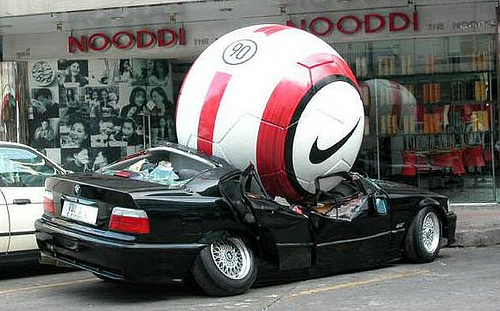
    And now, here’s the final caption contest of 2011.  Good luck!

    Funny-Car-Accident-with-Nike-Ball-Pictures; Chris Brady Caption Contest