-
 Since posting the article entitled "Mental Toughness" about Navy SEAL Operation Redwing, I have received a lot of communication about the heros involved. Also, in some of my research, I was confronted with an extremely disturbing situation that raised my dander to a level unreached in a long time!
Let me get right to the point, and then I’ll tell you what set me off!
There is a such thing as EVIL. Period. I know that some like to say that everything bad happens because of a person’s environment, lack of privileges, oppression, or poverty. And certainly, outrageous circumstances can sometimes be identified as motivations for some people who go over the edge and commit outrageous crimes. But this misses a very important point: namely, that for every case where poverty or oppression can be pointed to to explain a criminal’s behavior, similar circumstances in the lives of other law abiding citizens can be found that didn’t produce the unlawful actions. In short, causation of violence cannot be placed on the shoulders of circumstance. It’s real cause is deeper than that, and it lies at the heart of the human condition. The Bible calls it sin.
What is so dangerous to the long-term survival of our society is wrong beliefs. When people decide that "sin" is an out of date concept, that "evil" is an offensive word, and that bad things only happen becuase people are treated unfairly, we are on a slippery slope that will only allow the enemies bent on our destruction an open door.
What am I talking about?
Lemmesplain.
In researching the unbelievable heroics of Marcus Luttrell, Danny Dietz, Mike Murphy, and Matthew Axelson in Afghanistan in the summer of 2005, I came across a news story that really scared me. It let me know just how far some people in our country have drifted from a true understanding of how the world works, and drove home for me how precariously a society’s survival hangs in the balance between those who are willing to go to the mat to protect it and those who unwittingly, perhaps, would allow it to be destroyed.
Very appropriately, many people in Littleton, Colorado, the hometown of Danny Dietz, decided to erect a statue to the hero’s memory. Just a few years ago Littleton, as you probably recall, was the tragic scene of one of the world’s most violent school shootings. Apparently some of the good citizens of Littleton protested the statue of
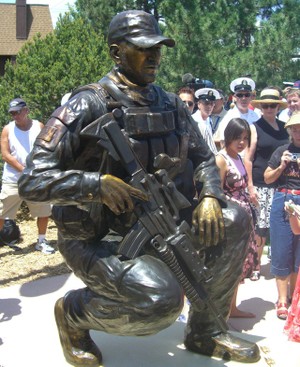 Danny Dietz (dressed in full combat attire, much the same as he would have been on the day he lost his life serving his country) because he was holding a gun! Some said they just didn’t want "violence glorified" and didn’t think it proper to have little children exposed to "guns" without adequate parental supervision (excuse me while I throw up).
 Now don’t get me wrong. I was outraged at the school shooting in Littleton. I was heartbroken over the innocent young lives cut short by those EVIL gunmen’s actions. And I understand that, maybe forever, that community will be extra sensitive to violence and the protection of its children.
With that being said, however, it is still not an excuse to soil the memory of a fallen warrior-hero. The problem is that the blame is being assigned to the WEAPON and not the source of who uses the weapon. When we blame the guns and not the sin, we attack the symptoms and not the disease. A weapon in the hand of the killer’s of Littleton High School is a weapon used for evil, and it signifies the black hearts of the gunmen. A weapon in the hand of a hero like Danny Dietz is a weapon used to protect liberty and freedom, and it signifies the incredible valor of a protector. There is quite a difference.
Rather than shelter our children, not even letting them see weapons in statue form, we should let them understand that there is EVIL in the world, that there ARE those bent on our total destruction, that people who murder innocent people, whether with planes or guns, are evil and consumed by sin, and that unless good people have the backbone to step up to EVIL and halt it at the gates, it will consume even the most well-intentioned, peace-loving person. We should let our children know that people like Danny Dietz will sacrifice their very life to protect what they believe in and people they have never even met. And yes, I’ll bet Danny Dietz would have been the first one rushing into the fray at Littleton High to save those children too, if he’d had the chance.
Perhaps some people would like to keep children from ever seeing an airplane, because, of course, they were weapons of murder on 9/11. Or maybe minivans should be kept from sight, becuase hundreds of American soldiers have been blown up by vans stuffed with explosives. You see, the argument breaks down into the ridiculous. The instrument is not the culprit, evil in a person’s heart is the culprit.
Until we properly assign blame for evil, we will never defeat it. If we hack away at the instruments instead of the heart, we will lose in any struggle against hatred and terrorism, and that’s what scares me. While our militant enemies preach hatred into their toddler children, teaching them to scream "Death to the USA" at the top of their lungs over and over, we try to shelter our kids and not even let them know about the existence of guns! We could eliminate all the guns on the earth, and sinful hearts would still find a way to commit murder. The only problem is, at that point, we would have also disarmed the Danny Dietzs of the world and taken away his ability to protect others. It doesn’t make any sense. And it never has.
Everyone loves peace. I have enjoyed an unfair amount of it in my lifetime, and I am very thankful for my blessings as a free American citizen. But "peace at any price" is a time bomb. It was "peace at any price" that allowed the Holocaust.
One of my favorite quotes of all time is from Wil Durant, and it goes like this: "Love peace, but keep your powder dry."
I hope our country never loses the stomach to stare into the face of EVIL and see it for what it really is. I hope our citizens never lose the will to fight for what’s right; refusing to fall asleep to the lullabies of the "peace at any price" crowd. And I hope our country never stops celebrating the men and woman who, throughout the ages, have sacrificed and died so that we may live free. I, for one, am extremely thankful that we at least have a few people who still understand the truth. Maybe the U.S. military will be the last place the "fire for freedom" burns brightly, the last place where people truly understand that Freedom isn’t Free!
-
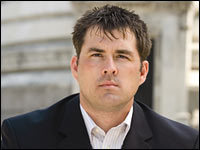 Marcus Luttrell, the U.S. Navy SEAL that was the lone survivor of Operation Redwing in Afghanistan, in which just four Navy SEALS held off and/or killed a large group of Taliban fighters, wrote about the difficulty of the SEAL program training. At one critical point in the gruelling routine, in which all but the most resolute fail out or resign, Luttrell's mentor gave him some advice:
"Marcus, the body can take damn near anything. It's the mind that needs training. Can you handle such injustice? Can you cope with that kind of unfairness, that much of a setback? And still come back with your jaw set, still determined, swearing you will never quit? That's what we're looking for!"
In the book, Lone Survivor, Luttrell explains in great detail the unbelievably harsh training all SEALS must go through in order to call themselves by that name of honor. Just reading about it is exhausting. One instructor told Luttrell, "You're going to hurt while you're here. That's our job, to induce pain; not permanent injury, of course, but we need to make you hurt. That's a big part of becoming a SEAL. We need proof you can take the punishment. And the way out of that is mental, in your mind."
Luttrell explains why some men just couldn't make it through the training:
"Judging by the one guy I knew, I didn't think any of the ones who quit were in much worse shape than they had been twelve hours before. They might have been a bit more tired, but we had done nothing new, it was all part of our tried-and-tested routines. And in my view, they had acted in total defiance of the advice handed to us by Captain Maguire. They weren't completing each task as it came, living for the day. They had allowed themselves to live in dread of the pain and anguish to come. And he'd told us never to do that, just to take it hour by hour and forget the future. Keep going until you're secured. You get a guy like that, a legendary U.S. Navy SEAL and war hero, I think you ought to pay attention to his words. He earned the right to say them, and he's giving you his experience. Like Billy Shelton [the other mentor mentioned above] told me, even the merest suggestion [should be listened to]."
Point #1: Both comments were from instructors who were also SEALS, who had been through it before, who knew what they were talking about. For advice givers, this should be the only kind we listen to; those with fruit on the tree. Luttrell did listen to those men, realizing that every little thing they said was important and for a reason.
Point #2: Success is more a matter of mental toughness than physical strength or intellectual prowess. Battles are always first won in the mind.
Point #3: The only way to make it through difficult circumstances is to take each blow as it comes, to focus upon the day at hand and not worry or be overcome by the burden of the days still ahead. One step at a time, you can get through almost anything.
These three points are very important. They apply not just to the incredibly tough life of a United States Special Forces Officer, but to any of us that want to achieve significance in our lives. There will always be difficulty, opposition, and obstacles. Getting through them is a game of mental toughness, forcing the mind to take things one at a time, and listening and adhering to the best advice available from qualified mentors.
During Operation Redwing, Luttrell and three other of America's finest, most hi
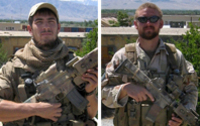 ghly trained, tough-as-nails, fighting machines were betrayed by an act of kindness they showed to three goat herders. Within about an hour of sparing their lives, the goat herders alerted an entire Taliban army to the prescense of Marcus Luttrell, Matthew Axelson, Michael Murphy, and Danny Dietz. Although the odds were overwhelming, four men basically holding their own against an army of over a hundred armed with explosives and RPGs, the mental toughness was on hand to even the tables. Far away from home, cut off from any back-up, on unfamiliar terrain, surrounded by enemies, and always concerned about the "liberal press"
 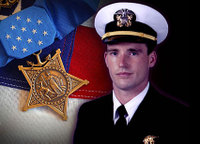 back home in America which would crucify them for their tiniest error, these four young men used every ouce of their training and combat experience. For hours and hours they kept up a continuous fire fight, three times falling off cliffs to establish new defensive positions. Wounded and dying, the American guns continued to eliminate their enemy.
 How could it be possible that with odds of 35 to 1the Taliban could not even kill one of the American soldiers for hours and hours? How did these fine young men stand up to such terrifying horror? What was the substance they summoned deep from within that pushed them to fight even when mortally wounded?
The answers are many, and worth taking a quiet moment to ponder.
The valor, patriotism, honor, courage, and mental toughness of these men is a credit to the country they represented. I salute them. I admire them. I thank them. And, I am committed to learning from their example. We should all learn from their example.
It's the least we can do.
-
-
It's when the chips are down that true leaders rise to the surface. In struggle, confusion, and challenge, real leaders take stock of the situation and lead others through the chaos. For some reason, the others are happy to follow. The substance between the leader and those who volunta
 rily follow his or her direction is called influence. Influence is the mark of a leader. Without influence, one might have a title, a position, decorations, degrees, authority, and many other things that are designed to bestow power or title or status, but not true leadership.
 When analyzed in this manner, it becomes apparent that leaders pop up in inconvenient places within organizations, and that's the point. Leadership isn't always found at the top of organizational charts or on the voting ballot, and sometimes it seems as though it is rarely found in such places. No, more often, leadership is displayed by ordinary people in ordinary positions.
In one of the books that Orrin Woodward and myself are currently writing we will cover the concept of "Leaders Under Managers." Quite often, leaders are trapped in a position "under" people of greater authority or power who possess much less leadership abiltiy. As I survey the pages of history I find countless examples of this. I have often written of Horatio Nelson, England's (and the world's) most famous sea captain. When speaking of Nelson, it is easy to call him an Admiral, which is the position of command in which he died. At that point, even though he was in charge of an entire fleet, he was still subservient to the Chief Lord of the Admiralty back in London. And we must remember that Nelson, throughout most of his career, was in a position under other captains, squadron commanders, commodores, and admirals. In fact, although he was never outrightly insubordinate, Nelson did have to struggle to overcome stodgy senior commanders and take liberties with his orders from time to time in order to post some of his most magnificent achievements.
So if you are going to be a leader, it goes with the territory that you will be held back or potentially frustrated by those in "authority above" you. The first thing to do in such a situation is to realize that it is not only normal, but common. Secondly, you must realize that your day will come, that leaders always rise to the surface, and it will likely just be a matter of time and opportunity before you are able to spread your wings. Thirdly, understand that you can still lead, right where you are, with what you have and in what you've been given to do. This is done by accepting responsibility, taking command of the situations that are within your circle of influence, and striving for excellence in all you do. As you live this way, others will be persuaded to your cause and allow themselves to be influenced by you. As you continue to perform and inspire and enlist others to do so as well, your opportunities will grow. Sometimes your opportunities will grow through normal means, other times they will grow through calamity, bu
 t opportunities for a leader always come. The key is to be in motion and be prepared.
The wrong way to handle being a "leader under a manager" is to allow yourself to get frustrated. Don't get angry at the circumstances that hold you back. Resist jealousy and pettiness and bitterness; all cancers that will kill a leader's influence if allowed to fester. Understand that the obstacles in your way actually serve a purpose in and of themselves: they test your leadership abilities and make you stronger. Instead of resentfulness toward those who don't share your vision or ability, foster a spirit of servanthood and help them all you can while you can. If they stand opposed to you as an enemy, pray for them and keep your eye on the ball. As I wrote in an earlier post, your goals should remain set in stone and your plans can be in sand. Adapt to situations and circumstances as necessary, holding the line on your integrity and refusing to sink to your enemies' level. Keep your attention fixated on your vision and cause, all the while strengthening and buidling yourself so that when your opportunities come, you are prepared. Those who waste their time in bitterness or political games with those who would hold them back lose focus on the big picture and sometimes miss their chance.
Understand: Success comes when opportunity and preparedness meet. Leaders can't always control their opportunities, but they can be prepared and ready. And this will only happen if leaders don't waste their time on the obstacles in their way but instead focus on the bigger picture of fulfilling their destiny.
Keep your eye on the ball.
Focus on the bigger picture.
Lead where you are, with what you've got, right now.
And never forget: for real leaders, your chance will come!
-
 I thought you guys would dig this one.
 -
It was a thrill to meet so many of you today at the book signing in Flint, MI. Orrin and I both enjoyed getting a chance to talk with so many and hear the stories of what is happening with the book in people’s lives. Thanks for coming out to shake a hand and share a comment. (And thank you to the world-class staff at Barnes & Nobles for such great hospitality! The cookie was awesome.) We appreciate all
 of you! God bless!
 -
 One of my favorite things is to create something new. There is a satisfaction in conceiving something in one's mind and then working to bring it to reality. For me it could be a book, an article on this blog, a business activity, home designs, or a drawing. I think this is true for most people, as evidenced in the technical, business, medical, scientific, and certainly artistic worlds.
 There is, however, an interesting downside to creating something; namely, pride of authorship. Many times the creator falls in love with the creation. When this happens, it becomes difficult to maintain a non-biased perspective and we begin to cling to our creations. As the saying goes, "Love is blind."
What separates great leaders from all the rest is their ability to wreck the present in pursuit of the future. This is the phenomenon that can make a leader feel as though he or she is "going against the grain" or "running up hill." "Everybody out there" can often seem to be against a leader on a mission. This is because people fall in love with the status quo and don't want to see change. One speaker joked that the only people that like change is babies. But there is one other group of people, in addition to babies, that love change: leaders.
As author Maury Klein wrote, "The process of discovery, whether in art, science, business, or any other field, must always swim against the powerful tide of conventional wisdom. If discovery disrupts, its execution destroys. The new concept acts as a death ray seeking to destroy all obstacles in its path, indifferent to anything that is incompatible with it. In virtually every field of endeavor or production, innovation brought with it obsolescence of some kind." Joseph Schumpeter, who coined the term "creative destruction," said, "This process of Creative Destruction is the essential fact about capitalism."
People and organizations can become encamped on the hill of their last victory, resting on their laurels while proclaiming "this is what got us here." But for leaders, it is important to learn, as a recent book was entitled, that "what got you here won't get you there." Greatness comes from having the courage and conviction and vision to attack the status quo, assault the comfortable and the "known," and to turn "best practices" upside down, pursuing a vision that transcends "conventional wisdom." It takes guts to do this, but real leaders thrive upon it.
And why is assaulting the status quo so difficult? Why does creative destruction nearly always coincide with pain and anguish? Because the status quo is comfortable for someone. The status quo is a power source for someone. The status quo is a source of pride for those involved in its original creation or in sustaining it. Never forget: changing the status quo almost always threatens someone else's position. With few exceptions, leaders will need to learn how to overcome stodgy "experts" and managers in authority positions "above them," or organizational structures and any other beneficiaries of "the way things are."
There is a choice, and sadly, many individuals and organizations take the path of "that's how we've always done it." As another of my favorite quotes so aptly puts it, "Nothing is so firmly entrenched as the opinions of the experts."
But in the case of creation, the experts are always wrong. The leader's choice is to assault the status quo, to tear down strongholds and ask the tough questions, slaying sacred cows and striving for the greater good at the expense of the ensconced and privileged few. It is uncomfortable and it requires courage, staying power, and conviction in the eye of the storm. But no matter how tough or resistant the status quo is to the change efforts of a leader, it is still better to be exhausted in the attempt of the pursuit of great things, than to rust while clinging to outmoded ideas and practices that guarantee, sooner or later, irrelevance.
So choose creative destruction in your greatest areas of endeavor, and steer clear of the "safe" path to irrelevance and slow-but-certain ruin through failure to keep up with changing times.
It's your future.
Create it.
-
I read a book recently that really got me thinking (always a good thing). It taught the lesson of giving value to others beyond the level expected. The concept is "under promise and over deliver."
What a great place the world would be if everybody, in every transaction, placed chief concern on adding the most value to the other person. In a world where so many people seem bent on calculated benefit to themselves, only doing thing
 s that they perceive will bring value back to them, it is always refreshing to run across someone who operates differently. "What can I do to help you?" "How may I serve you?" These questions, when sincere, are like a breath of fresh air.
 Who are the people in your life who have behaved in this manner? When were you truly touched by the selflessness of another? Who deserves special mention here on this blog for living this principle? I think more of us should be inspired to live this way, and those who are deserve a call-out here! Let’s hear about it; give us their stories! And let’s all of us remember to add value to others as a matter of habit, without calculating a return for ourselves!

Welcome to
Chris Brady’s
Blog
“The only way to be happy, is to give happy.”


 Welcome to Chris Brady's Blog


