Welcome to
Chris Brady’s
Blog

“The only way to be happy, is to give happy.”

  • "Too bad that all the people who know how to run the country are busy driving taxicabs and cutting hair."  – George Burns

    "It is only after time has been given for cool and deliberate reflection that the real voice of the people can be known."  – George Washington

    "When the people applauded him wildly, he [Phocion] turned to one of his friends and said, "Have I said something foolish?"  – Diogenes Laertius

    "People have one thing in common; they are all different."  – Robert Zend

    "Society in its full sense is never an entity separate from the individuals who compose it."  – Ruth Benedict

    "The aim is not more goods for people to buy, but more opportunities for them to live."  – Lewis Mumford

  • With the popular response to the earlier post on this blog of Church Bulletin bloopers, I also received a recommendation from reader kckarate.  What follows are some actual classified ads froResizem the book he recommended; Anguished English.  Thanks kckarate!  These are hilarious!  Enjoy, everyone!

    1. Lost. Small apricot poodle.  Reward.  Neutered.  Like one of the family.

    2. A superb and inexpensive restaurant.  Fine foods expertly served by waitresses  in appetizing forms.

    3.  For sale:  Antique desk suitable for lady with thick legs and large drawers.

    4.  For sale:  Quilted high chair that can be made into a table, pottie chair, rocking horse, refrigerator, spring coat, size 8 and fur collar.

    5. Four-poster bed, 101 years old.  Perfect for antique lover.

    6. Now is your chance to have your ears pierced and get an extra pair to take home, too!

    7.  Wanted:  50 girls for stripping machine operators in factory.

    8.  Wanted:  Unmarried girls to pick fresh fruit and produce at night.

    9.  We do not tear your clothing with machinery.  We do it carefully by hand.

    10.  No matter what your topcoat is made of, this miracle spray will make it really repellent.

    11.  For sale:  Eight puppies from a German Shepherd and an Alaskan Hussy.

    12.  Great Dames for sale.

    13.  Tired of cleaning yourself?  Let me do it.

    14.  20 dozen bottles of excellent Old Tawny Port, sold to pay for charges, the owner having been lost sight of, and bottled by us last year.

    15.  Dog for sale:  Eats anything and is fond of children.

    16.  Vacation special:  Have your home exterminated.

    17.  Mt. Kilimanjaro, the breathtaking backdrop for the Serena Lodge.  Swim in the lovely pool while you drink it all in.

    18.  The hotel has bowling alleys, tennis courts, comfortable beds, and other athletic facilities.

    19.  Stock up and save.  Limit one.

    20.  Save regularly in our bank.  You’ll never reget it.

    21.  Man wanted to work in dynamite factory.  Must be willing to travel.

    22.  Used cars:  Why go elsewhere to be cheated?  Come here first!

    23.  Christmas tag sale:  Handmade gifts for the hard to find person.

    24.  Wanted:  Man to take care of cow that does not smoke or drink.

    25.  Our experienced Mom will care for your child.  Fenced yard, meals, and smacks included.

    26.  Mixing bowl set designed to please a cook with round bottom for efficient beating.

  • The War of 1812 for many was more properly called the Second War for Independence.  The new United States was struggling to make it in the tough world of foreign affairs, and its troubles with England had bubbled up into a war for which the new nation was not ready.

    Much of North America was still unsettled, at the time, and the "frontier" was the Ohio valley and the dense forest regions around the Great Lakes.  Control of these inland waterways was critical to control of the frontier territory, and both the United States and England were eager to dominate there. 

    Onto this scene sailed a twenty-seven year old American named Oliver Hazad Perry.  In a small, fresh water sailing fleet, Perry engaged the bulk of England’s Great Lakes squadron in what became the Battle of Lake Erie.  Perry commanded the Lawrence, a ship named for a recently killed captain of the American navy who had foLo13_2olishly lost one of the United States’ six powerful frigates in direct disobedience to orders.  Lawrence’s reckless conduct had pitched his awesome ship against one of the ablest captains and best trained crews in the British navy.  Lawrence’s ship the Chesapeake, was destroyed in less than fifteen minutes!  Stragely, Lawrence’s dying words, "Don’t give up the ship," caught on as a sort of battle cry among the American sailors ever after.  Even though Lawrence had foolishly put himself and his crew into a position where giving up their ship was inevitable, the phrase became almost as powerful as "Remember the Alamo" would decades later.  Because of this, as Oliver Hazard Perry sailed to confront the British Great Lakes fleet that day, his ship, the Lawrence, flew a flag that proudly stated, "Don’t Give Up the Ship!"

    Although all the ships in the engagement were tiny by ocean-going standards, the Battle of Lake Erie would be the biggest, most violent naval engagement the Great Lakes would ever see. Perry sailed directly into the British ships and fought furiously.  The Lawrence was one of the two biggest, most powerful American ships on the Great Lakes.  The other one was called the Niagara.  For some reason, though, the Niagara didn’t engage in the battle.  It stood a ways off, out of harm’s way, and watched Perry get torn to shreds in the Lawrence.  Although Perry was fighting a losing battle, he had inflicted heavy casualties on five British ships at once, firing furiously and refusing to quit.

    Finally, the Lawrence was almost a complete wreck.  Four-fifths of Perry’s men had been killed or wounded.  The gun deck was littered with bodies and refuse, the dead and dying sprawled everywhere. With so much death and destruction, hardly a gun was left firing aboard the Lawrence.  Still, from the mast of the ship flew the flag that said, "Don’t Give Up the Ship!" 

    At this point in the battle, Perry did the unthinkable.  He lowered one of his 940only remaining ship’s boats into the water, and with a small contingent of men, he rowed away from the battle and toward the untouched Niagara, which was still watching the battle from a safe distance.  Perry and his men in the little boat were fired upon by the same cannon that had torn his ship to pieces.  However, many of the British ships were damaged badly enough that they neither destroyed his boat nor made much of an attempt to pursue.  Perhaps they thought the battle was over and Perry was fleeing the scene.  But as Perry reached the Niagara, he needed only moments to convince the crew to follow his orders instead of those of their timid captain.  The Niagara made sail and headed directly for the fleet of damaged British ships. 

    It is interesting to imagine what the men aboard the British ships must have thought, seeing the heroics of this young captain and his bravery while rowing a boat through heavy enemy fire.  How their attitudes must have changed as they realized he was bringing a new ship to engage them!  And engage them he did.  With the fresh fire power of the Niagara brought to bear on the damaged British fleet, the outcome was not even a question.  The bravery of 18126p8Oliver Hazard Perry had won the day and secured the Great Lakes and the western frontier to the United States.  Throughout the remainder of the War of 1812, the British would never regain what they had lost that day.

    Perry’s actions are impressive, given the bad advice he had flying from a flag staff aboard his ship.  Perry didn’t fall in love with the idea of winning the battle aboard his ship, committing to the chivalrous but silly notion that he should either win or sink on his ship.  Instead, he had victory in mind, a clear goal on the horizon for which he would change his plans and disregard the popular naval passions of his time.

    It is interesting to think about Perry’s exploits that day in leadership terms.  What he did was nearly unprecedented in naval history, but is even more powerful as a metaphor for how a leader should attack a goal.  Many times, leaders set goals to accomplish something, and then profer plans to achieve that goal.  Somehow or somewhere along the way, however, the leader falls in love with the PLANS and gets overly committed to them at the expense of the goal.  As the saying goes, and as Perry so deftly demonstrated that day, Goals should be set in Stone, and Plans should be set in Sand.  If the plans arent’ working, scrap them and come up with more plans.  But never give up the goal!  If one ship isn’t working, get another ship, but be sure and get to the victory!

    Oh, and by the way.  Don’t even ask me for the name of the original captain of the Niagara, who watched safely from a distance while his countrymen fought the battle; he doesn’t deserve to have history remember it.


  • May_07_006By the way, special thanks to reader Mike Mooney for sending this one in!  Thanks Mike! (ps: I don’t think that’s him in the picture!)

  • Open_book "These are not books, lumps of lifeless paper, but minds alive on the shelves.  From each of them goes out its own voice . . . and just as the touch of a button on our set will fill the room with music, so by taking down one of these volumes and opening it, one can call into range the voice of a man far distant in time and space, and hear him speaking to us, mind to mind, heart to heart."  – Gilbert Highet

    "My education was the liberty I had to read indiscriminantly and all the time, with my eyes hanging out."  – Dylan Thomas

    "There is more treasure in books than in all the pirates’ loot on Treasure Island . . . and best of all, you can enjoy these riches every day of your life."  – Walt Disney

    "I am a part of all that I read."  – John Kieran

    "Show me the books he loves and I shall know the man far better than through mortal friends."  – S. Weir Mitchell

    "The man who does not read good books has no advantage over the man who can’t read them."  – Mark Twain

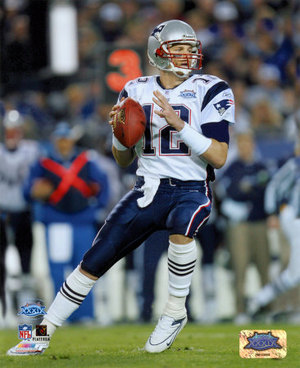
  • Tombradysuperbowlxxxixpassinginfi_2It is fascinating to use historical examples to illustrate leadership principles.  In the Lauching a Leadership Revolution book, co-author Orrin Woodward and I use several.  What I don’t think we’ve ever told anyone, however, is that we stumbled upon the idea by discussing Tom Brady, quarterback of the New England Patriots.  His story was such a clear illustration of the Third Level of Influence; Performance, that it inspired us to find other individuals whose stories could serve to equally illustrate the book’s concepts. 

    Tom Brady’s story is extremely interesting.  It caught our attention because of the deliberateness he used to climb from scrawny obscurity to international stardom.  His success story is an excellent example of what can happen when a person commits to making steadfast, incremental, consistent improvements in one’s self over a long period of time.  Since we wrote the book in 2005, Tom Brady has driven himself even deeper into the record books, recently leading the Patriots to an undefeated regular season, and being named the league’s MVP.  As I write this, he and his team are one win away from another Superbowl appearance.

    Author Robert Kiyosaki writes about what he calls the three keys to wealth:

    1. long term vision

    2. delayed gratification

    3. the power of compounding

    In the story of Tom Brady, all three of these principles can be seen at large.  His story is covered from a slightly different angle in our book, so I won’t rehash it all here.  My purpose in this article is to focus upon #3: the power of compounding.

    Most people, when they are new to the self-improvement journey, don’t realize the power of proper steps applied over a long period of time.  There is a saying, which I believe to be true, stating that "people overestimate what they can achieve in a year, and underestimate what they can achieve in ten."  The challenge for most people is staying the course when they don’t see any evidence of results for their efforts.  Frustrated, they give up and quit, leaving behind the new ground they had gained.  Later, perhaps, they get reinspired and begin again.  Only now, they are forced to re-plow ground they’d already covered before.  This cycle then repeates itself.

    Others, however, and a trite small number it appears to be, break out of this cycle.  They make a decision based upon a long term view to improve or accomplish something in their life.  Then they get to work doing what is necessary to head in that direction, delaying gratification, saying "no" to a thousand "good" distractions that come up along the way, focusing instead on the one great, overriding goal they’ve set on the long term horizon.  As the days go by, these people take the little steps of improvement, ever heading toward their goal, one tiny inch at a time. 

    At first, of course, no one notices any results.  This phase might last a long time.  Then, their efforts are noticeable enough that critics are attracted to throw their bile upon the proceedings.  Many times, this is enough to break the cycle and get the person to quit on their journey.  At this point, though, champions persists.  Eventually, results starts to show up.  Next, results become entirely obvious.  Somewhere at this point in the journey, people start saying that the achiever is "talented" or "gifted" or "lucky" and "were always going to make it big in something."  These comments may be true to a small extent, but they are due more so to the weeks and months and years of work when no one was paying attention.  No one, that is, but the achiever.

    Whenever we see people who have achieved enormous success, stature, character, mental fortitude, or spiritual maturity, we can know for certain that it was the result of a long process of incremental change.  Nothing truly good in the realm of human accomplishment comes easily or quickly.  But incredible things can result from proper steps taken over a long enough period of time. 

    Benjamin Franklin, through his "Thirteen Virtues" forced himself to improve in his relations with people, transforming himself from an argumentative, dogmatic know-it-all into an ambassador capable of wooing the King of France in the middle of Europe’s most complicated court environment.  Theodore Roosevelt, a small, weak, and sickly child, transformed himself into a hearty and adventurous leader, even taking a bullet in the chest at point blank range and being able to give a ninety minute speech before receiving medical treatment!  And skinny Tommy Brady, growing up in California dreaming of being the next Joe Montanna, transformed himself into one of the best quarterbacks in the history of the game. 

    The inspiring part about this principle is that it applies to everyone reading this page.  Anyone can grow and accomplish beyond their wildest dreams if they will take to heart what this principle teaches.  Never forget the power in the cummulative effect of incremental change over time!      

  • ChinesewomanunhappywithhusbandSome of these leave me speechless.

  • "Don’t talk about yourself.  It will be done when you leave."  – Wilson Mizner68c83boaster

    "One nice thing about egotists: They don’t talk about other people."  – Lucille S. Harper

    "Egotism is nature’s compensation for mediocrity."  – L. A. Safian

    "There’s only one thing that can keep growing without nourishment: the human ego."  – Marshall Lumsden

    "An egotist is a man who thinks that if he hadn’t been born, people would have wondered why."  – Dan Post

  • Uc06330  On many stages recently, I have spoken about the need for a leader to respect the individual.  It is not enough to talk about "people," like many politicians do so dangerously at this time in the electoral process, but rather it is of supreme importance for leaders to focus upon and respect the rights and "evidence of the Creator" apparent at the level of the individual.  What this means is that each individual is special and has equal rights under law.

    Whenever we get off track and sacrifice individual rights on the altar of "people" as a broader category, we begin treading down a path where eventually no one will have individual rights or liberty.    For proof of this, witness the murderous and bloody results of the French Revolution, which was founded on principles at first similar, but upon closer inspection, radically different than those of the American Revolution.  The difference between the two is the American focus upon the rights of the individual, versus the French focus upon "Fraternity" or "the group."

    Interestingly, the foundation for this belief system in the United States of America originated in a document that was intended to be revolutionary.  The Declaration of Independence was drafted as a document to justify to a watching world why thirteen disparate colonies were choosing to do the impossible and unthinkable and overthrow their soveriegn monarch.  Only as a bi-product was the Declaration of Independence supposed to enumerate the fundamental creed that America would base its system of law aDeclaration_of_independencend Bill of Rights upon.

    Thomas Jefferson is given credit for the authorship of the Declaration, even though he was part of a five man committee responsible for its creation, and even though the document went through revision by the entire Second Continental Congress.  Still, history shows that the opening salvo of words that establish the foundation of the American Creed of which we are speaking, were indeed Jefferson’s creation.  Interestingly, these opening fifty-five words were hardly debated or modified at all by the committe or the Congress.  They read as follows:

    "We hold these truths to be self-evident, that all men are created equal, that they are endowed by their Creator with certain unalienable rights, that among these are Life, Liberty, and the pursuit of Happiness.  That to secure these rights, Governments are instituted among Men, deriving their just powers from the consent of the governed."

    Apparently the truth of these opening words really were "self-evident" to the founders.  According to my favorite historian, Joseph Ellis, these opening words would "grow in meaning to bec ome the seminal statement of the American creed.  With these words, Jefferson had . . . casually and almost inadvertantly planted the seeds that would grow into the expanding mandate for individual rights that eventually ended slavery, made women’s suffrage inevitable, and sanctioned the civil rights of all minorities." 

    Abraham Lincoln, too, understood the significance of these words on the direction of America, writing, "All honor to Jefferson – to the man who, in the concrete pressure of a struggle for national independence by a single people, had the coolness, forecast, and capacity to introduce into a merely revolutionary document, an abstract truth, applicable to all men and all times, and so to embalm it there, that to-day, and in all coDeclarationming days, it shall be a rebuke and a stumbling block to the very harbingers of the re-appearing tyranny and oppression."

    Whenever our candidates or representatives or elected officials veer off track, whenever our leaders begin steps towards tyranny (read Communism, Socialism, etc.), whenever the rights of an individual is sacrificed for the "common good," the words in the opening paragraph of the Declaration of Independence is there as a timeless protection.  May we never forget it. 


  • Rat_111 "A critic is a legless man who teaches running."  – Channing Pollock

    "To escape criticism – do nothing, say nothing, be nothing."  – Elbert Hubbard

    "A critic is a man created to praise greater men than himself, but he is never able to find them."  -Richard Le Gallienne

    "Criticism comes easier than craftsmanship."  – Zeuxis

    "People ask you for criticism but they only want praise."  – Somerset Maugham

    "Pay no attention to what the critics say; no statue has ever been put up to a critic."  – Jean Sibelius

    "Miss Truman is a unique American phenomenon with a pleasant voice of little size and fair quality . . . There are few moments during her recital when one can relax and feel confident she will make her goal, which is the end of the song."  – Paul Hume

    "I have read your lousy review of Margaret’s concert.  I’ve come to the conclusion that you are "an eight ulcer man on four ulcer pay" . . . some day I hope to meet you.  When that happens you’ll need a new nose, a lot of beefsteak for black eyes, and perhaps a supporter below."  – Harry S. Truman

    So much for that!