
Dont’ despair, my fellow readers! I will devise a way to pick winners for all of these. Maybe we can figure out a way for all of us to vote on the funniest ones. Stay tuned. In the mean time, here’s another for your viewing pleasure! God bless and have a great day!
-
"A leader is best when people barely know he exists. Not so good when people obey and acclaim him; worse when they despise him." – Lao Tsu
-
 One of the biggest challenges leaders of all types will face is the difficulty in dealing with people. Some people are easy to deal with, while others can be tough. But it’s even more complicated than that. Sometimes the easiest people to get along with harbor quiet resentments, while the difficult ones will at least "tell it to you like it is." Additionally, each person is a fallen, sinful creature, (as is the leader!), with foibles, quirks, oddities, fears, blindspots, and weaknesses. Then there are gender differences, culture differences, age differences, religious differences, differing world-views, hormonal influences, sicknesses, and mood swings! Wow! What a list! (And I am sure through reader comments to this article that we could expand the list even further!)
Like it or not, a leader must learn to deal with all these issues in a continually effective way. Leaders without people skills will not be leaders for long, if at all. It is amazing for me to see this displayed time and again: people who think they are leading that can’t get along with others! Remember, leadership is with, for, and about others. If you can’t succeed in starting and maintaining valuable relationships over time, you will not be able to lead effectively! Period.
Further, let me mention that I believe there are two periods of "people skills" to be considered. The first category deals with initial impressions. These include the ability to "come across well" to others, the ability to build quick rapport, and the capability of connecting with strangers by finding common ground or identifying areas of respect. The second area is maintaining relationships with people over the long haul.
There are five main books we recommend people read on a recurring basis to grow and continue to improve in their ability to work with people:
1. The Magic of Thinking Big, David Schwartz
2. How to Win Friends and Influence People, Dale Carnegie
3. How I Raised Myself from Failure to Success in Selling, Frank Betzger
4. How to Have Confidence and Power in Dealing with People, Les Giblin
5. Personality Plus, Florence Littauer
These five books will cover a broad range of approaches and principles that have been proven extremely effective in elevating one’s ability to deal with other people. Of course there are other books I could recommend, but reading these five over and over will hurt no one.
Now, let’s delve a little deeper. I believe the best way to develop "people skills" is to forget about the "skills" part of this for a moment. First, it is important for one to get one’s heart right toward people. This, I believe, li
 ke everything else, can only come through faith in Christ and the resulting Biblical world-view. Without a true and proper understanding of WHO you are, and WHO’S you are, you will not have a real heart for people. Understanding that others are created by God in His image, with their own special and unique design, while simultaneously understanding one’s own fallen condition and need of Grace, relations with people will be strained and continually incoherent. This is because we will not be interested in serving others, but in having them serve us. Also, we will be more interested in winning "battles" with people and squabling with them when we feel affronted, offended, and wounded. We will feel that we are righteously indignant when wrongs are done to us and will not be forgiving of others.
With the proper Biblical view, however, a heart for others is readily at hand. The Bible teaches that we are to love our neighbor, and we are to be as forgiving of others as the Savior is of us. For those of us that are believers, we are commanded to be as salt and light in a fallen world. This means that our Godly example is meant to be a witness for the God in heaven that is the power behind our ability to love others.
See why I said that this rises above mere "skills" and gets into "heart" issues? Truly, the best way to have "people skills" is to begin with getting our hearts right toward others. If we don’t, the "skills" may open some doors, fool some people, and get us some results for a while. But eventually, our hearts for ourselves, rather than for others, will be found out, and as a result people will lose trust in us and over will flee from our influence.
Okay, now that that is accomplished (as though it were that easy), let’s move on to the "skills" part. Building upon a firm foundation of a heart that is right toward others, willing to serve and to love and to forgive, people skills can become very important. Learning to smile, to listen, to be interested in the other person, to get the other person to open up about themselves, to Affirm, Approve, and Appreciate others are incredible lessons we should all learn. Remembering names, refraining from interrupting, and making good eye contact are all "skills" that will get results with others. The five books I mentioned are full of interesting stories and applications of these concepts. Read them again and again. Practice these skills until they become habits. But don’t get so caught up in the "skills" part that you become a cheesy fake. Instead, apply well-meant people skills to a servant’s heart toward people, and watch them adhere to you and offer you a chance to influence them.
And when in doubt, lead with the heart!
-
 If ignorance is bliss, there should be more happy people in the world.
"Tain’t what a man don’t know that hurts him; it’s what he knows that just ain’t so." – Frank McKinney Hubbard
An ignorant person is one who doesn’t know what you have just found out.
"I would rather have my ignorance than another man’s knowledge, because I have got so much more of it." – Mark Twain
A man doesn’t know what he knows until he knows what he doesn’t know.
"Discussion is an exchange of knowledge; argument an exchange of ignorance." – Robert Quillen
"Genuine ignorance is profitable because it is likely to be accompanied by humility, curiosity, and open mindedness; whereas ability to repeat catch-phrases, cant terms, familiar propositions, gives the conceit of learning and coats the mind with varnish water-proof to new ideas." – John Dewey
-
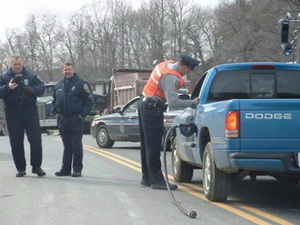 "Is there a problem, officer?"
 -
 "We make a living by what we get, but we make a life by what we give." – Albert Schweizer
My co-author and friend Orrin Woodward and I feel strongly about being good stewards of God’s gifts and giving to good causes. We strongly support a 501c3 organization called All Grace Outreach. You can read all about this organization at www.allgraceoutreach.com. I am told this site is slightly under construction, and expanded capabilities will be available there soon.
All Grace Outreach specializes in donating to causes where people are underprivileged, such as orphan and/or abused children, battered spouses, homeless inner-city people, and to the organizations that support these people through a gospel message and outreach. All Grace also supports Christian publications and the development of Christian ministers for preaching both domestically and abroad.
We would invite you to consider donating to this organization, and to put such a possibility in your prayers. Wherever you choose to give of your gifts, we would hope you would grow in your understanding of stewardship, and give from your heart. Author Jeff O’Leary has the following to say about giving:
"First, we can be wise stewards when we understand that none of our possessions are our possessions. They belong to God, and we will all be called to account for how we used what He entrusted to us. The second consideration of good stewardship is that we should spend our loaned resources in light of God’s priorities rather than ours. Our sacrifice honors Him and displays obedience to Jesus’ command to store up our treasures in heaven rather than on earth."
-
 One of the biggest things to understand, if you’re going to be a leader, is that you must take responsbility for your results in life. One of my favorite quotes goes something like this, "You are where you are because of the sum total of your actions to this point in your life." That’s tough advice, but in my experience it is totally true.
What I run into a lot are people who would like to lead, or people who think they are leading, or people who have lead in the past, who refuse to take responsibility for their situation. Maybe they missed a goal, or maybe they didn’t do as well in their finances as they had planned, or maybe a business venture didn’t go so well, or maybe they have messed up relationships, or maybe they have trouble at home, but the ONE THING they won’t even CONSIDER as a possibility is that THEY ARE THE PROBLEM.
Contrast this condition with REAL LEADERS. Real leaders take stock of a situation, take a look at themselves, and as Jim Collins says, they confront the brutal reality as it really is. Then they TAKE RESPONSIBILITY themselves to make the changes necessary to move on and fix the situation.
I don’t know why this is so rare. But what I have witnessed time and again are people who decide that their circumstances are to blame, or their mentor is to blame, or their spouse is to blame, or any number of things that safely keep THEM out of blame’s way.
Want to become a leader? Want all the benefits of success, admiration, recognition, contribution in the lives of others, and everything else that comes from striving as a leader? Want respect from those who should be following you? Do you really want this? I hope you do. And I’ll share a secret with you about how to accomplish it.
Are you ready?
Here it is.
The secret to becoming a leader and enjoying all the benefits that go along with it is:
LEAD
What?
You’ve got it.
LEAD.
You are not a leader if you are not leading. In my opinion, anyone who is daring to become a leader ought to wake up each morning and command themselves to do just that, to "LEAD."
This is silly. This is dumb. It seems so redundant. "Of course," you might say, "If I want to be a leader I’ve got to lead. Who wouldn’t have THAT figured out already?" Well, believe it or not, hundreds, if not thousands of people.
People want all the trappings of leadership without accepting any of the responsibility. People want the success without the struggle. And they want the respect without the battle.
If you ever feel as though you are failing in your leadership journey, the solution is simple. Go out and lead. Get active. Take command. Begin performing right now, right where you are, with what you have. Take responsibility for your results and DO someting about it. Get off your couch. Throw away the excuses. Go out the door. Lead.
There is no faking it in leadership. You are either leading or you are not.
We all have a choice.
We can either lead, or we can try to explain why we are not.
-
 What should we prescribe for this poor fellow? Ever felt like this?
 -
 "We should be careful to get out of an experience only the wisdom that is in it – and stop there; lest we be like the cat that sits down on a hot stove-lied. She will never sit down on a hot stove-lid again – and that is well; but also she will never sit down on a cold one anymore!" – Mark Twain
"Experience enables you to recognize a mistake when you make it again." – Franklin P. Jones
"There are many truths of which the full meaning cannot be realized until personal experience has brought it home." – John Stuart Mill
There is only one thing more painful than learning from experience; and that is not learning from experience.
The best teacher is experience – someone else’s!
"The best substitute for experience is being sixteen." – Raymond Duncan
-


